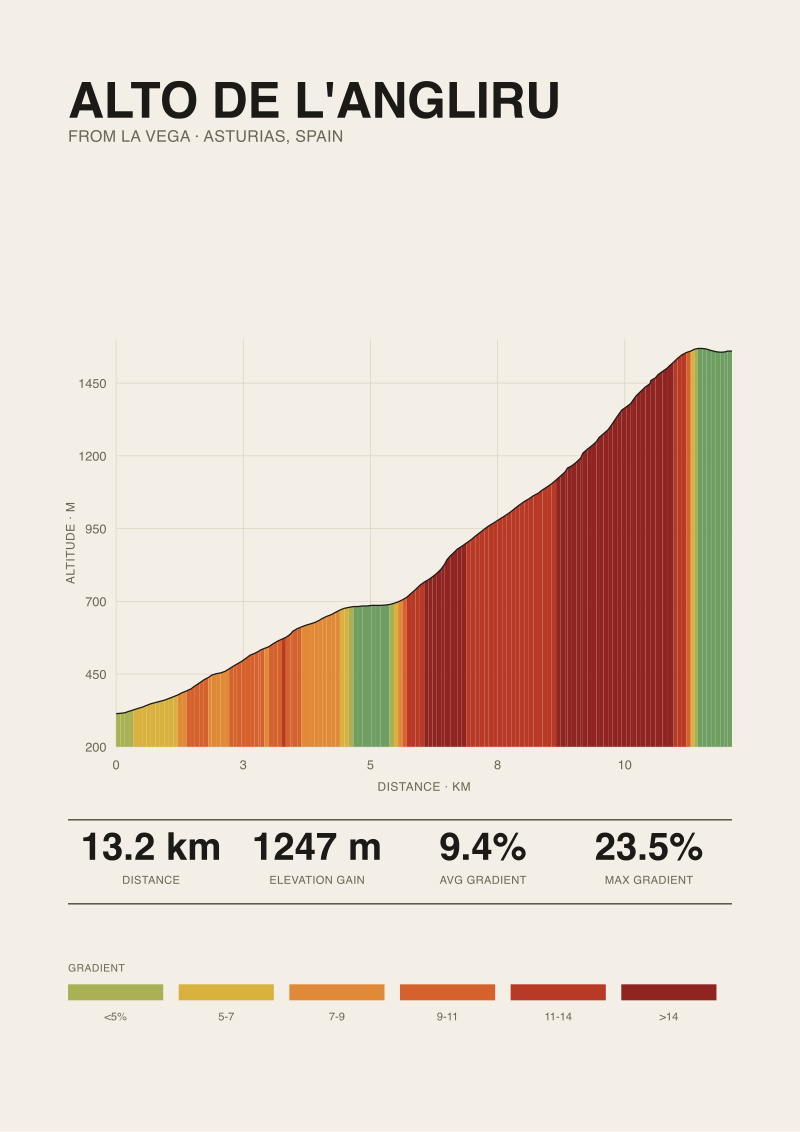
The Alto de l'Angliru covers 13.22 km and climbs 1,247 vertical metres from La Vega at 314 m to the summit at 1,560 m, with an average gradient of 9.4% and a published maximum of 23.5% at Cueña les Cabres. That geometry — long, then suddenly vertical — decides which print sizes read on a wall and which collapse into a smear. This is not a taste guide. It is a flowchart. Three questions about your room, your distance, and your framing choice route you to a format that actually works. Answer them in order.
Question 1: How Far Will You Stand From the Print?
This is the first fork because every other decision depends on it. An elevation profile is a data drawing. Its readability is a function of viewing distance and the smallest legible feature — in the Angliru's case, the ramps at Cueña les Cabres that spike toward the published 23.5% maximum. Those spikes occupy less than one kilometre of horizontal distance out of 13.22. On a small print seen from across a room, they disappear. On a large print seen from close range, they dominate.
Measure the primary viewing distance before you measure anything else. Walk from the intended wall to the point where you will most often be looking at it — the sofa, the kitchen island, the desk chair, the head of the bed. That is the number that matters. Not the room's diagonal. Not the wall's centre.
If You Will Stand Within 1.5 Metres
Close-range viewing is the only case where a small format survives. Prints in the A3 range (roughly 30 × 42 cm) or standard 30 × 40 cm work here because the eye is close enough to resolve the fine steps in the profile — the false flat at the start, the pitch change around kilometre four, the wall at Cueña les Cabres. This is the format for a home office wall behind a monitor, a hallway you brush past daily, or a stair landing where the print sits at eye height as you climb the last step.
Below A3 the profile compresses too much to read the Angliru's specific signature. A 20 × 30 cm print reduces the climb to a rough diagonal with a bump. That is not an Angliru print. That is a triangle.
If You Will Stand Between 1.5 and 3 Metres
This is the range where most living-room and bedroom viewing actually happens, and it is where A2 (roughly 42 × 59 cm) becomes the working minimum. At two and a half metres, an A3 print reads as decoration; you know it is a mountain, but the specific geometry of the Angliru — the way the profile stays civilised for six kilometres and then loses its manners — is lost.
A2 restores the vertical exaggeration needed for the Cueña les Cabres section to register at conversational distance. If you have space for A1 (roughly 59 × 84 cm), take it. The Angliru rewards horizontal room to breathe; its 13.22 km of length wants millimetres per kilometre, not micrometres.
If You Will Stand Beyond 3 Metres
Anything under A1 is invisible past three metres. The eye reads it as a rectangle with texture. Go A1 minimum, and consider A0 (roughly 84 × 118 cm) if the wall accepts it. At four to five metres — a large open-plan living space, a studio, a gallery wall in an office lobby — A0 stops being extravagant and starts being the only size that lets a viewer actually see the 1,247 metres of gain distributed across the profile's real shape.
Question 2: How Much Uninterrupted Wall Do You Actually Have?
Viewing distance decides what your eye needs. Wall width decides what your wall permits. The two constraints often disagree. When they do, wall wins — a print oversized for its surface reads as cramped no matter how legible the data is up close.
Measure the wall's usable horizontal run. Not the full wall — the run between whatever anchors the composition on either side. A radiator, a light switch cluster, the edge of a bookcase, a door frame, a picture rail: these are the boundaries. Subtract 15 to 20 cm of breathing room on each side. What remains is your working width.
If You Have Less Than 60 cm of Usable Width
You are in A3 territory, portrait or landscape depending on the wall's shape. This is a common outcome for narrow segments of wall — between two doorways, above a low sideboard, in a corridor. The Angliru's 13.22 km reads acceptably at this scale only if the viewing distance question routed you to close range in Question 1. If Question 1 said you will stand at three metres and Question 2 says you have 55 cm of wall, the two answers are incompatible. Pick a different wall or a different print.
If You Have Between 60 cm and 100 cm
A2 lands cleanly in this range with margins that let the frame breathe. This is the most common working case in domestic interiors: above a desk, over a low chest of drawers, on the wall opposite a sofa. A2 landscape shows the Angliru's climb rightward with room for the summit altitude label at 1,560 m to sit legibly without cropping. A2 portrait works only if the print's design orients that way — most elevation profiles are horizontal because the climb is horizontal.
If You Have More Than 100 cm
A1 fits comfortably from 100 cm upward; A0 needs at least 130 cm to avoid the trapped-against-the-edges look. This is the range where the Angliru's shape gets to do what it is meant to do. The long approach along the Riosa road, the pitch change, the wall — all of it stretched across enough horizontal distance that the eye can follow the climb like a rider would read it.
 Alto de l'Angliru
The print from this article · from €29.95
View the print →
Alto de l'Angliru
The print from this article · from €29.95
View the print →
Question 3: Are You Framing It, or Hanging It Flat?
The framing decision is often treated as an afterthought. It is not. A frame with a mat adds 8 to 12 cm on each side to the print's footprint. A frame without a mat adds 2 to 4 cm. A flush-mounted or unframed print adds nothing.
That difference reshapes every answer to Question 2. A print that fits your wall unframed may not fit framed. Decide the framing question before you order, not after.
If You Are Framing With a Mat
Add roughly 20 cm to both the width and height of the print. An A2 print (42 × 59 cm) with a standard mat and moulding lands around 62 × 79 cm. That is significantly larger than the raw print dimension and it changes the wall-width answer above.
Matted framing also changes the readability calculation. The mat pushes the profile into the centre of the visual field, which makes small features harder to see from distance because the eye has to work through the surrounding white space. If you are framing with a mat, size up one format. What worked as A2 unframed reads better as A1 matted.
If You Are Framing Without a Mat
A close-edge frame in aluminium or thin oak adds a few centimetres of hardware but does not force the profile inward. The readability calculation from Question 1 holds. Add 4 cm to your Question 2 width answer and stay on the format that questions one and two agreed on.
This is the most common outcome for the Angliru profile because the print's own margins already provide the breathing room a mat would add. Doubling the whitespace usually oversizes the composition on the wall.
If You Are Hanging Unframed
Poster hangers, magnetic rails, or flush-mount methods leave the print at its true dimensions. Follow the format Question 1 and Question 2 agreed on with no adjustment. This is also the only method that works for the largest formats in rooms with low ceilings — A0 framed with a mat is 100 × 138 cm and will not clear a standard 240 cm ceiling above a sofa. A0 unframed on hangers will.
If You Answered Everything: The Size Map
Cross-reference your three answers below. Each row is one route. The recommendation is a format, not a preference.
| Q1: Viewing Distance | Q2: Wall Width | Q3: Framing | Recommendation |
|---|---|---|---|
| Under 1.5 m | Under 60 cm | Matted | A3 portrait; consider a thin frame instead of matted at this size. |
| Under 1.5 m | 60–100 cm | Matted or flat | A3 landscape framed, or A2 unframed if the wall permits. |
| Under 1.5 m | Over 100 cm | Any | A2 unframed or A2 with thin frame — larger will overpower close viewing. |
| 1.5–3 m | Under 60 cm | Any | The wall is too narrow for this viewing distance; pick a different wall. |
| 1.5–3 m | 60–100 cm | Matted | A2 matted, landscape. Standard living-room case. |
| 1.5–3 m | 60–100 cm | Unframed or thin | A2 unframed, or A1 if the wall reaches 100 cm. |
| 1.5–3 m | Over 100 cm | Any | A1 landscape — the format the Angliru's length was built for. |
| Over 3 m | Over 100 cm | Any | A1 minimum; A0 if the wall reaches 130 cm and the ceiling permits. |
The three-metre-plus row with narrower walls is deliberately absent. A print smaller than A1 does not survive that viewing distance, and a wall narrower than 100 cm does not survive that format. If your room routed you into that combination, the honest answer is that this wall is not the right home for an Angliru profile at this scale. A different wall in the same room usually solves it.
Our own catalogue at the shop is organised around these three questions rather than by "small / medium / large", because the sizes that get returned are almost always the ones ordered without asking the wall first.
Why the Angliru's Shape Punishes the Wrong Format
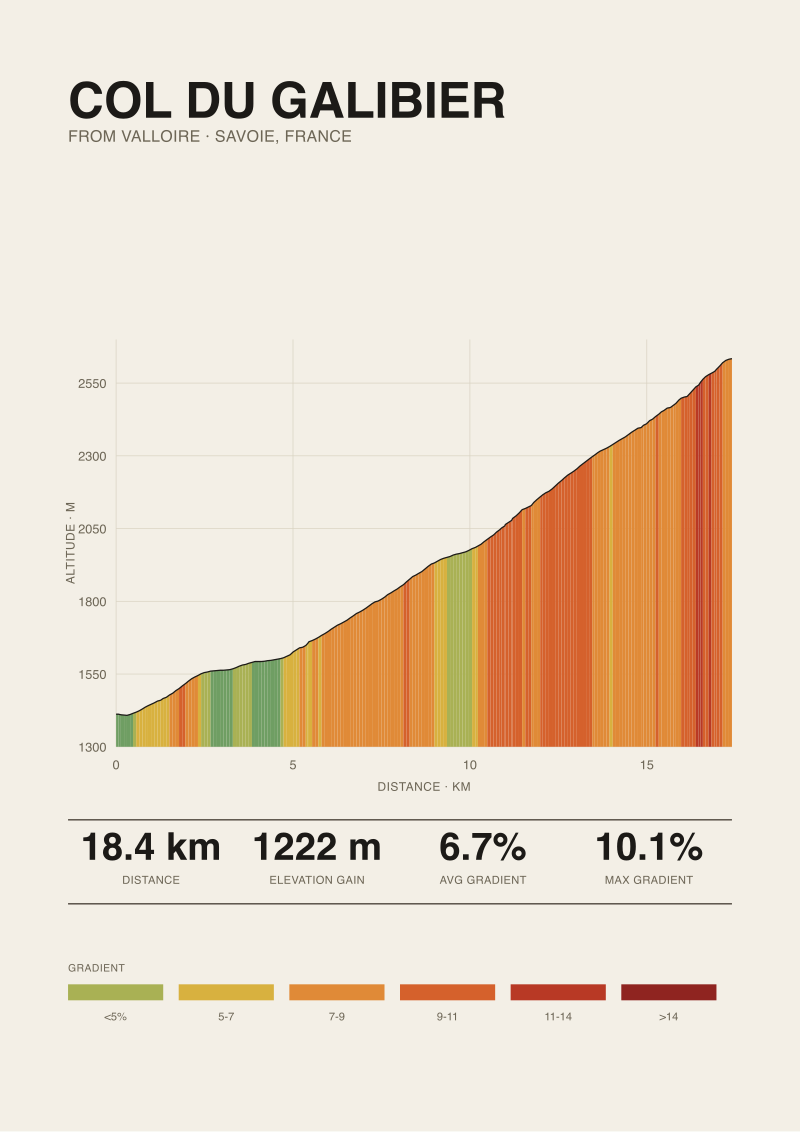
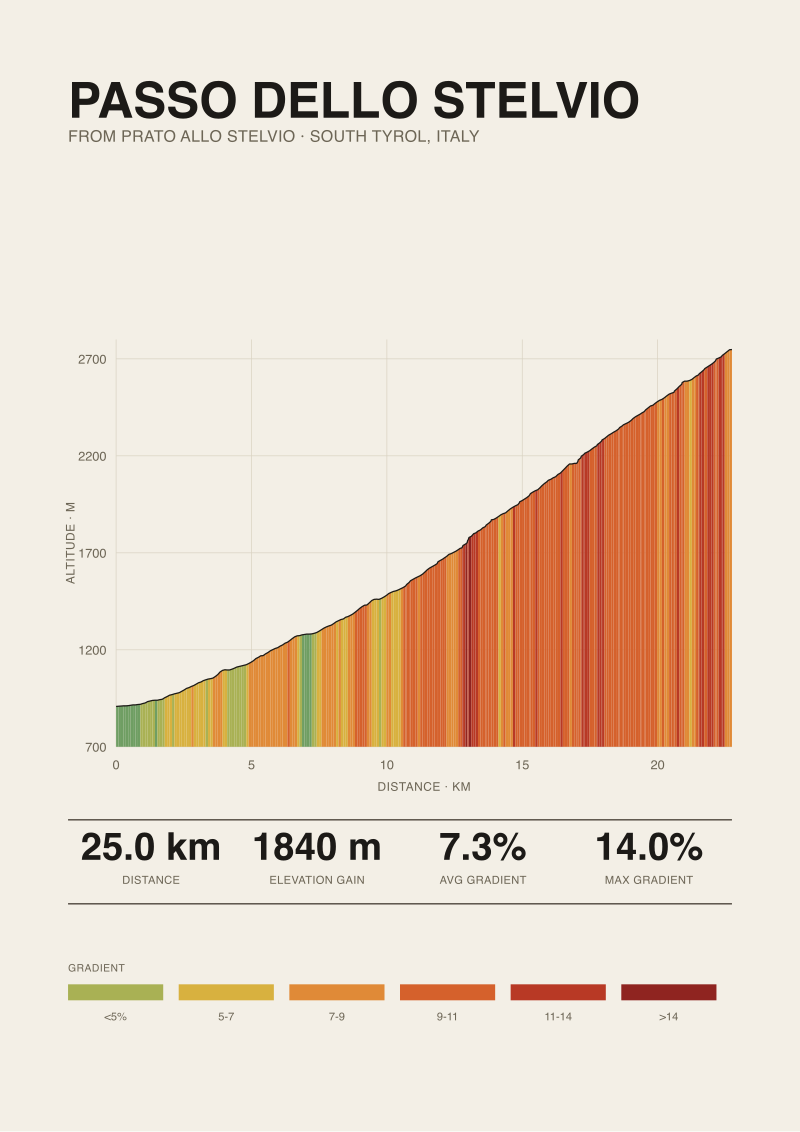
Most elevation profiles are forgiving. A climb with a steady gradient — the Galibier's north side, much of the Stelvio — reads at almost any scale because the eye needs only to follow a diagonal. The Angliru is not that climb.
The 9.4% average is a lie the profile itself exposes. The first three kilometres from La Vega sit at civil single-digit gradients. The middle section climbs steadily but survivably. Then, from roughly kilometre eight onward, the road decides to become vertical. Cueña les Cabres, the ramp that carries the published 23.5% figure, is a single-kilometre event that contains most of the climb's difficulty and almost none of its horizontal distance.
That distribution is what a print has to convey. On a small format, the wall at Cueña les Cabres becomes a pixel — a spike so brief the eye reads it as noise. The climb looks like a slightly bent diagonal. That is a Category 1 climb. That is not the Angliru.
On the correct format, the wall reads as what it is: a violent right-turn upward that the rest of the profile spent 11 km leading you into. The 1,247 m of gain resolves into its two personalities — the honest 6% of the approach and the 18–23% ramps of the last five kilometres. Two climbs stacked on top of each other, which is exactly what the road feels like to ride.
Getting the format right is not decorative. It is what turns the print from a triangle into a document.
The next question is not about size — it is about which room this print actually belongs in. That question has nothing to do with the wall's dimensions and everything to do with who lives with it. That is where the work of choosing starts.
 Col du Galibier
The print from this article · from €29.95
View the print →
Col du Galibier
The print from this article · from €29.95
View the print →
FAQ
What is the smallest print size that still reads as the Angliru?
A3 (roughly 30 × 42 cm) is the floor. Below that, the Cueña les Cabres section — the ramps carrying the published 23.5% maximum gradient — compresses into a spike too small to distinguish from the rest of the profile. The 13.22 km of the climb needs enough horizontal distance for the pitch change around kilometre eight to register visibly. Anything under A3 reduces the Angliru to a generic diagonal with a bump.
Should I choose portrait or landscape orientation for an Angliru print?
Landscape almost always, because the climb is 13.22 km long and only 1,247 m tall. That is a horizontal event. Portrait orientation forces the profile to compress along the axis where it has the most information — the length of the road — while stretching the axis where information is scarce. Portrait works only when the wall itself is narrow and tall enough that landscape would not fit, and even then the profile loses legibility.
How high should the centre of the print sit above the floor?
Standard gallery convention places the centre of a print at roughly 145 to 150 cm from the floor, which corresponds to average eye level for a standing adult. In rooms where viewing happens from a seated position — living rooms, dining rooms — drop the centre to around 135 cm so it aligns with seated eye level. The Angliru's profile has a strong horizontal axis; hanging it too high tilts the geometry unfavourably.
Does the frame colour affect how the elevation profile reads?
Yes, more than most buyers expect. Dark frames concentrate the eye inward toward the profile and suit prints with light backgrounds. Light frames blend into pale walls and let the data hold the composition. Thin metal frames disappear at conversational distance and are the safest choice for elevation prints because they add no visual competition to the profile's line work.
Can I hang an A0 Angliru print in a room with a standard 240 cm ceiling?
Framed with a mat, A0 lands at roughly 100 × 138 cm and clears most standard ceilings only if hung low over a large piece of furniture like a sofa or sideboard. Unframed with poster hangers, A0 needs less vertical clearance and hangs comfortably in rooms where framed A0 would feel cramped. The ceiling height is a real constraint at this scale — measure before ordering.
What viewing distance is the print's data actually designed for?
Elevation profiles reward viewing distances that are roughly one and a half to two times the print's longest dimension. An A2 landscape print, at 59 cm wide, reads best from about 90 to 120 cm. An A1 landscape print, at 84 cm wide, works from 130 to 170 cm. Standing much closer turns the profile into visible pixels; standing much farther collapses the fine gradient changes into an undifferentiated line.
Why does the print separate measured elevation from published road-book figures?
Because they disagree, and honesty is more useful than a clean number. Our profile draws from OpenTopoData SRTM 30-metre satellite data, which captures the road's overall geometry but smooths individual ramps. The published 23.5% maximum at Cueña les Cabres comes from Vuelta road-book measurements and climbfinder.com. Both are real; they answer different questions. The print shows the measured line and notes the road-book maximum as a separate figure.
Does matting extend the useful life of the print?
Acid-free matting keeps the print's surface off the glass, which prevents the paper from bonding to the glazing over decades and protects against condensation cycles in humid rooms. If you plan to keep the print for longer than five years in a room with variable humidity — a kitchen, a bathroom-adjacent hallway — matted framing is the conservation choice. For a home office or living room in a stable climate, unframed or flush-mounted works indefinitely.
From the collection
New climbs and 10% off your first print.
One email now with your code. No noise after.