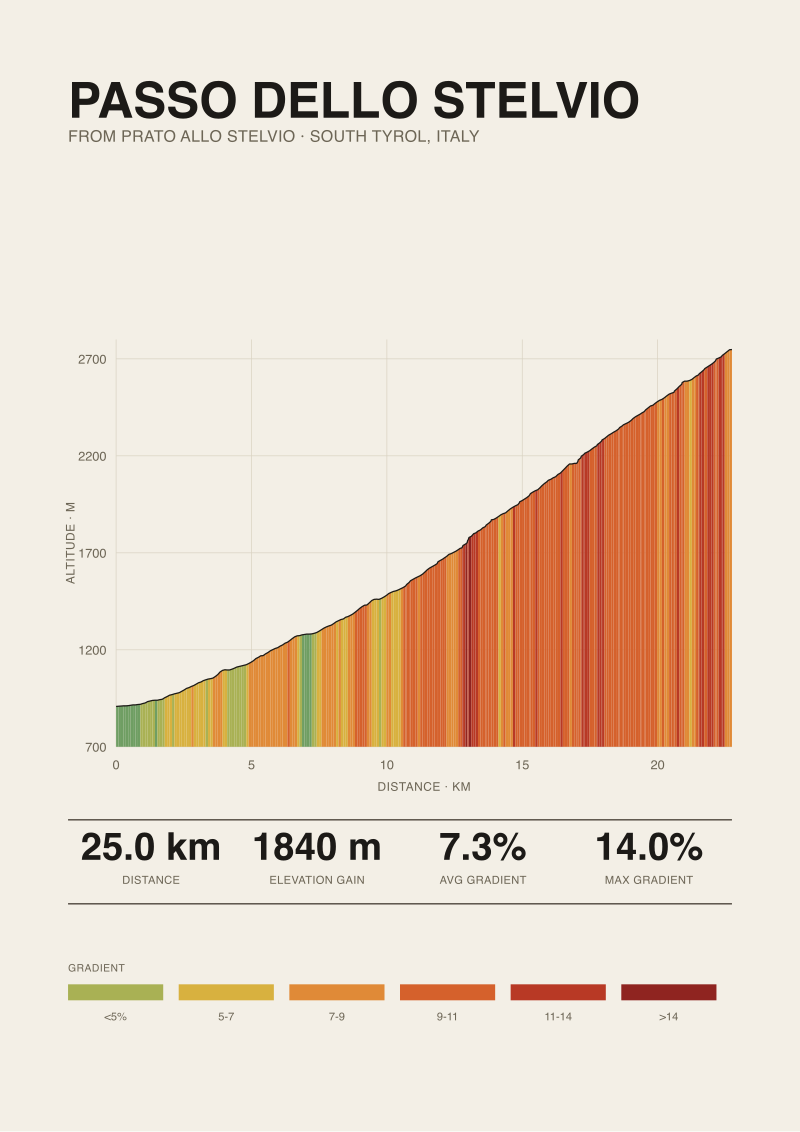
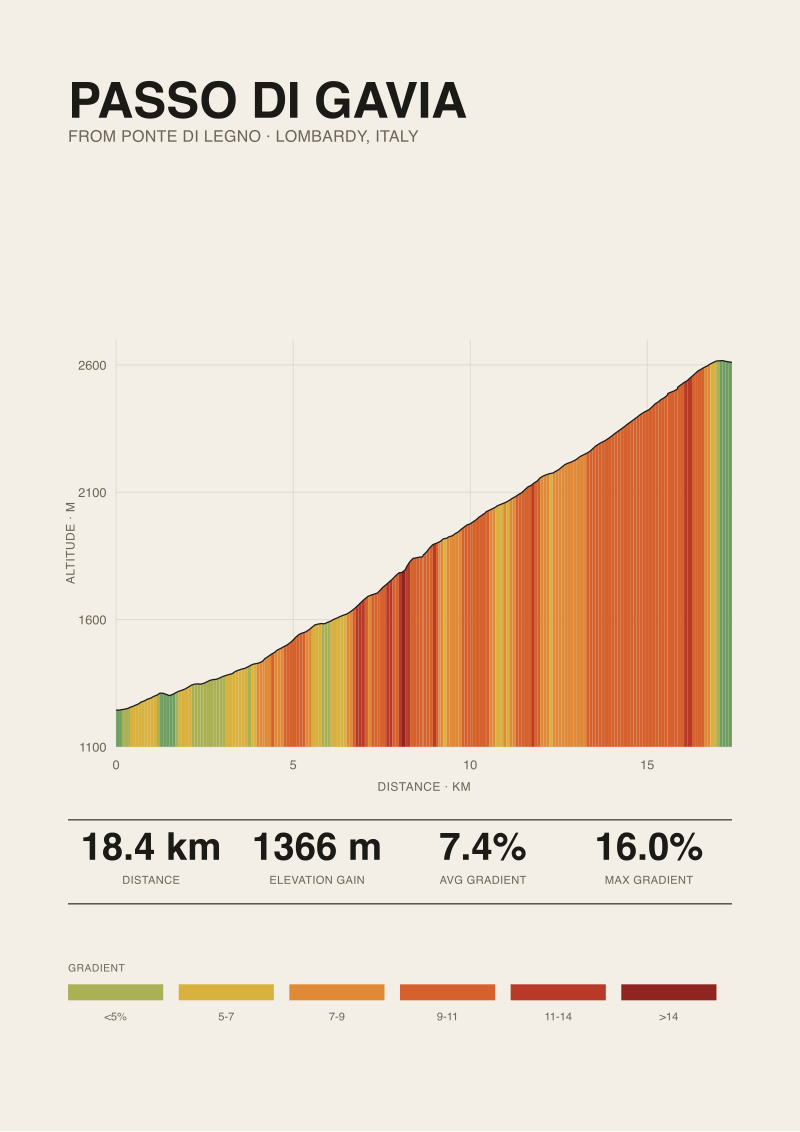
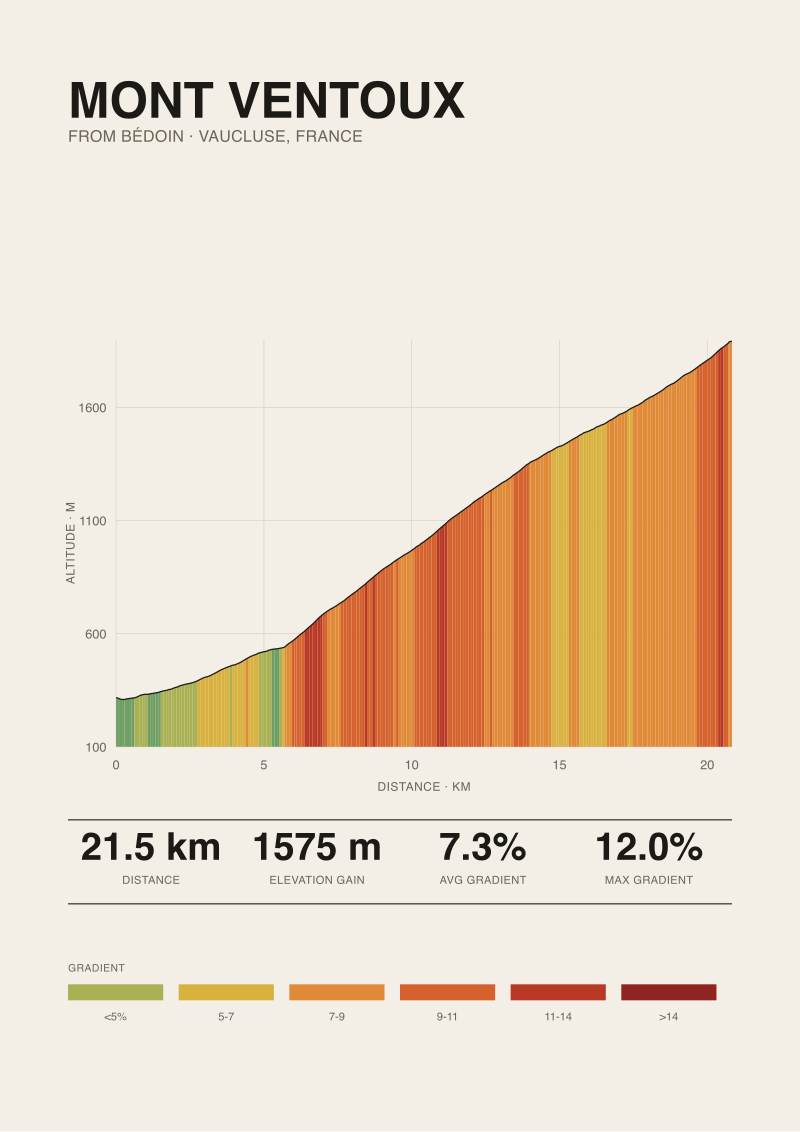
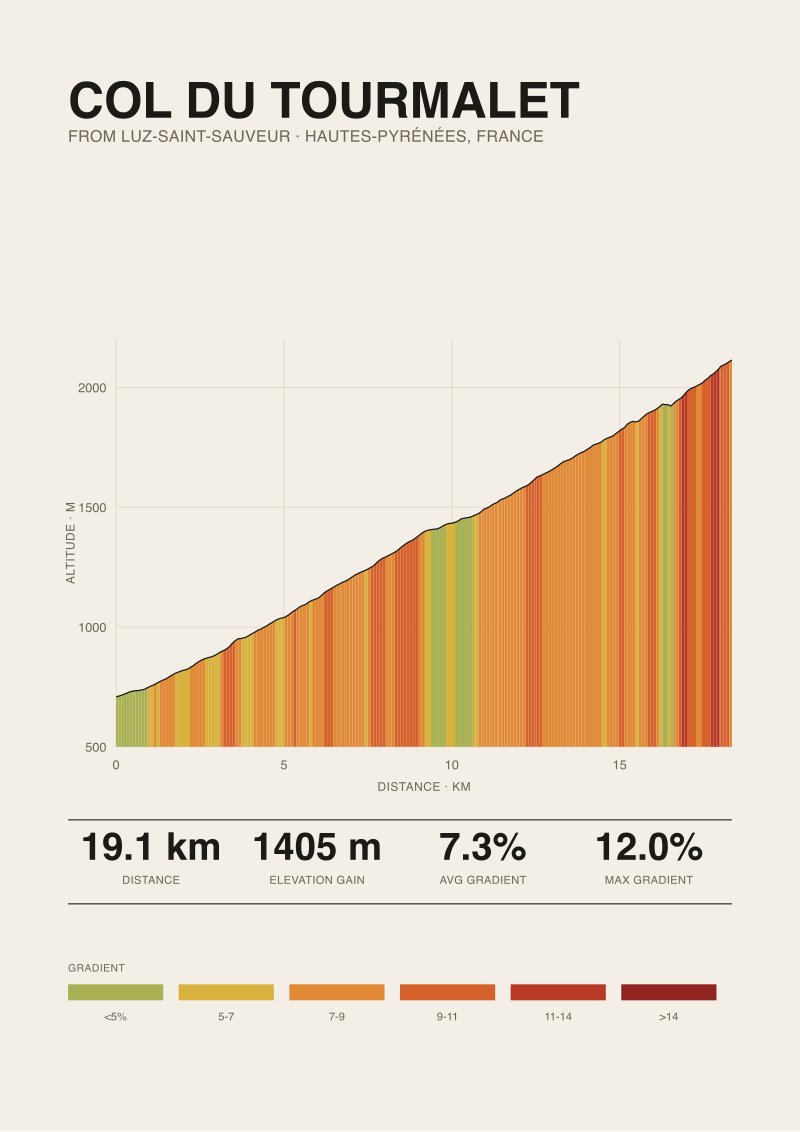
Col de la Loze is not obviously the hardest climb in professional cycling. Hear us out. Before the argument can be settled, the incumbents deserve to be measured. From SRTM 30m elevation data: Stelvio from Prato allo Stelvio runs 25.04 km at 7.3 percent average for 1,840 m of gain; Ventoux from Bédoin covers 21.51 km at 7.3 percent for 1,575 m; Tourmalet from Luz-Saint-Sauveur is 19.12 km at 7.3 percent for 1,405 m; Gavia from Ponte di Legno hits 18.42 km at 7.4 percent for 1,366 m. Four climbs, near-identical averages, four very different reputations. The word "hardest" has to answer to that spread before it can move on to a newer mountain.
How did the argument get here in the first place?
1953: Stelvio Enters the Argument at 25 km and 2,748 m
The modern conversation about "hardest climb" is largely a post-war invention, and its first serious entry is Stelvio. The 1953 Giro d'Italia was the first Grand Tour to send its peloton over the pass, and Fausto Coppi's attack on the penultimate stage reset the reference frame. Before that day, the argument was regional: hardest in the Alps, hardest in the Dolomites, hardest in the Pyrenees. After it, the argument became continental.
The numbers explain why the mountain absorbed the conversation. Stelvio from Prato allo Stelvio climbs 25.04 km at an average of 7.3 percent, gaining 1,840 m to a summit of 2,748 m. No other pass then in Grand Tour rotation combined that length and that altitude. Twenty-five kilometres is a threshold that resists memorisation on a first ascent. Riders who could recite the Galibier's numbers came back from Stelvio unable to say what happened at kilometre nineteen.
The published maximum gradient is 14 percent (climbfinder.com), which is not extreme by post-war standards. What is extreme is that the average never drops below the pain threshold for the full length of the effort. There is no recovery kilometre on Stelvio. That combination — 25 km with nowhere to hide, ending at 2,748 m where oxygen is already thin — is what installed the mountain as the reference against which all later "hardest" claims would be graded. Everything after 1953 is arguing against this baseline, whether the writers know it or not.
1967: Ventoux Fixes the Word "Hardest" to a Single Mountain
Fourteen years after Stelvio's coronation, the vocabulary shifted again, and this time not because of a race won but because of a rider lost. Tom Simpson's death on the upper slopes of Mont Ventoux during the 1967 Tour de France collapsed the technical question and the mythic one into a single mountain. From that day forward, "hardest" acquired a second meaning: not just the number that hurts, but the mountain that has proven it can kill.
The measured profile is more moderate than the reputation suggests. Ventoux from Bédoin is 21.51 km at 7.3 percent for 1,575 m of gain — 3.5 km shorter than Stelvio, 265 m less climbing, identical average. The published maximum is 12 percent. On paper this is a demanding climb, not an exceptional one. What the paper does not carry is the forest section between roughly 6 km and 15 km, where the road pitches into a corridor of trees at consistent gradient with no switchbacks to break the rhythm, and the exposed lunar summit above the tree line where wind and radiant heat are the actual antagonists.
This is where the "hardest" argument first learned to include weather as data. Before Ventoux, the debate stayed inside the gradient column. After 1967, any serious defence of a "hardest" claim had to account for what the environment does to the numbers on the day. Stelvio's altitude affects performance; Ventoux's exposure affects survival. The distinction matters. Any newer candidate for the title inherits both burdens: it must equal the profile of Stelvio and the exposure of Ventoux, or explain why one of those requirements no longer counts.
 Passo dello Stelvio
The print from this article · from €29.95
View the print →
Passo dello Stelvio
The print from this article · from €29.95
View the print →
1988: Gavia Redefines Hard as Weather Plus Gradient
The 1988 Giro d'Italia stage over the Passo di Gavia is where the "hardest climb" argument acquired its final variable. Andy Hampsten took the maglia rosa on a day of snow and freezing rain that reduced the field to a procession of hypothermic finishers, and the mountain that produced those images went from a regional pass to a permanent fixture in every "toughest climbs" list written since.
The measured profile is the shortest of the four incumbents. Gavia from Ponte di Legno is 18.42 km at 7.4 percent for 1,366 m of gain, starting from an already high 1,244 m and topping out at 2,610 m. Its published maximum from that side is 16 percent (climbfinder.com, Ponte di Legno). That 16 percent is what changes the character. Stelvio, Ventoux and Tourmalet all peak at 12 to 14 percent published; Gavia goes two points higher, and the pitches sit inside a road that in 1988 was still partly unpaved.
What 1988 taught the argument is that "hardest" is not a single scalar. It is a vector with at least four components: length, average gradient, maximum gradient sustained over meaningful distance, and the environmental band the summit sits in. Gavia loses to Stelvio on length. It loses to Ventoux on wind exposure. It wins on gradient ceiling and on altitude density — every metre of gain happens above 1,244 m, where the oxygen deficit is already in force. Any climb that wants the title has to beat the incumbents on at least one of these axes without collapsing on the others. That is the standard the next candidate walked into.
2020: Col de la Loze Arrives as a New Candidate
The 2020 Tour de France introduced Col de la Loze to the general cycling audience for the first time, as the summit finish on Stage 17. Miguel Ángel López won the stage; the yellow jersey changed hands on the upper slopes; the television commentary began using the word "hardest" within the first hour. That was the moment the incumbents' hold on the title formally came under challenge.
The challenge is not baseless. Loze's summit at above 2,300 m places it in the altitude band that only Stelvio and Gavia occupy among the four benchmarks. The final section of the road, built specifically as a paved bike path over the top, contains ramps whose gradient values are quoted at levels that would put them past Gavia's 16 percent published maximum. The claim, therefore, is that Loze combines Stelvio-adjacent altitude with Gavia-exceeding gradient in a single climb. If both halves of that claim survive measurement, the incumbents have a real problem.
We do not publish gradient figures for Loze here because our SRTM 30m dataset for this article is set to the four benchmarks; the honest position for a measurement desk is that until we render Loze on the same basis, comparisons using its road-book numbers against our measured numbers for Stelvio are not like-for-like. What we can say from the 2020 stage alone: the mountain arrived with a plausible technical case and a decisive competitive one. It did not arrive with two decades of aggregated race evidence. The incumbents accumulated theirs across half a century. That is the gap the second test case had to start closing.
 Passo di Gavia
The print from this article · from €29.95
View the print →
Passo di Gavia
The print from this article · from €29.95
View the print →
2023: The Second Test Case Sharpens the Claim
Loze returned to the Tour de France in 2023 as the summit finish on Stage 17 for the second time, and this appearance did more for the "hardest" argument than the first. Tadej Pogačar cracked on the upper slopes, gave up over a minute in a handful of kilometres, and effectively conceded the general classification. When a rider of that calibre visibly comes undone on a specific mountain, the mountain acquires a competitive receipt that no road-book description can substitute for.
This is the axis on which the incumbents built their reputations. Stelvio's 1953 stage produced a Coppi ride that reorganised the Giro. Ventoux's 1967 stage produced a death and a permanent memorial. Gavia's 1988 stage produced Hampsten in the snow and a re-drawing of what a Grand Tour could ask of its field. Each mountain earned its ranking one televised catastrophe at a time. Loze now has two: 2020's yellow-jersey handover and 2023's Pogačar collapse. Two data points is not fifty years. But the direction is set.
What 2023 also did is expose the weakness in the incumbents' file. Tourmalet is the softest of the four on our data — 19.12 km at 7.3 percent for 1,405 m of gain, published maximum 12 percent, summit at 2,114 m below the altitude band of the others. Tourmalet's ranking has always been more historical than technical: the first great climb of the Tour de France, ascended for the first time in 1910, revisited more often than any other Pyrenean pass. Loze does not need to displace Stelvio to change the conversation. It only needs to displace Tourmalet. On measured profile alone that is a much lower bar than the marketing implies, and the 2023 stage tightened the argument enough that ignoring it is no longer defensible.
What It All Means
The "hardest climb" title is not vacant, and it has never been settled. Reading the four incumbents on their own measured numbers, the honest ranking on profile is Stelvio at the top by length and total gain (25.04 km, 1,840 m), Gavia second on gradient density and altitude entry (16 percent published max, 1,244 m start), Ventoux third on exposure at moderate profile (21.51 km, 7.3 percent, no switchbacks in the forest), Tourmalet fourth on all measurable axes except history. Every "hardest" claim written since 1953 has been arguing inside this ordering, whether it says so or not.
Loze's case is that the ordering above no longer captures the state of the art. It has the altitude band of Stelvio and Gavia. It has, per its published road-book figures, gradient ramps that would place it beyond Gavia's ceiling. It has produced two decisive Tour de France moments in three years. What it does not yet have is measurement on the same basis as the four incumbents on this page, and what it does not yet have is fifty years of race-evidence sediment. Both of those are addressable, one by a measurement pass and the other by time.
Where the argument stands, on the evidence available: Loze has earned a place in the conversation and has narrowed the gap with Tourmalet to the point where the older mountain's ranking survives on history rather than data. It has not yet earned displacement of Stelvio or Gavia on measured profile, and it will not until it is rendered on the same elevation basis and given the same race-history window they had to build their files. The correct editorial position is neither the marketing claim nor the reflex dismissal. It is that "hardest" is now a five-mountain conversation instead of a four-mountain one, and that the ordering inside that five is genuinely open.
If the reader wants to see these four incumbents drawn from the measured elevation data used in this piece — printed at scale, on the same axes, so the comparisons hold visually the way they hold numerically — the four profiles are in the studio's shop.
FAQ
Which of the four incumbents is objectively the longest?
Stelvio from Prato allo Stelvio, measured from SRTM 30m elevation data at 25.04 km. That is 3.5 km longer than Ventoux from Bédoin, 5.9 km longer than Tourmalet from Luz-Saint-Sauveur, and 6.6 km longer than Gavia from Ponte di Legno. Length alone does not decide "hardest", but it is the axis Stelvio has not yielded on since it entered the Grand Tour rotation in 1953. No other regularly raced Alpine pass matches it on measured length from the base of the timed effort.
Why do all four averages land at 7.3 or 7.4 percent if the reputations differ so much?
Because average gradient is a poor descriptor of difficulty. A 7.3 percent average can hide a 6-percent-then-9-percent structure, a steady 7.3 all the way, or a false-flat that concentrates the real climbing into three brutal kilometres. All four incumbents land at 7.3 to 7.4 percent, and yet Gavia rides like a different animal because its 16 percent published maximum falls inside a shorter climb, while Stelvio's 14 percent maximum is diluted across 25 kilometres. Average is the first number and the least informative.
Where does Col de la Loze fit on measured elevation data?
This article does not publish Col de la Loze figures on the same SRTM 30m basis used for the four incumbents, because doing so requires a dedicated measurement pass we have not run for this piece. What is publicly established: Loze summits above 2,300 m and its final section contains gradient ramps quoted in road-book figures at levels beyond Gavia's 16 percent published maximum. Any direct comparison against Stelvio or Gavia should wait until Loze is rendered on the same measurement basis.
What makes Ventoux different from a comparable Alpine climb?
The forest section and the summit exposure. Ventoux from Bédoin is 21.51 km at 7.3 percent for 1,575 m of gain, with a published maximum of 12 percent — numbers that in the Alps would be considered demanding but not exceptional. What separates it is roughly nine kilometres inside a forest corridor at consistent gradient with no switchback recovery, followed by an exposed limestone summit where wind and radiant heat operate on the rider directly. The 1967 Tour de France, on which Tom Simpson died on these slopes, is the reason "hardest" acquired a second meaning beyond the profile.
Why does Gavia rank so high despite being the shortest of the four?
Two reasons, both structural. Gavia starts at 1,244 m, which means every one of its 1,366 m of gain happens in air where the oxygen deficit is already reducing available power. Its published maximum gradient from Ponte di Legno is 16 percent (climbfinder.com), the highest of the four. The combination of altitude entry and gradient ceiling compresses difficulty into a shorter climb rather than spreading it. The 1988 Giro d'Italia stage, won by Andy Hampsten in a snowstorm, added the weather variable to a mountain that was already technically demanding on paper.
Is Tourmalet the weakest of the four benchmarks on measured data?
On profile, yes. Tourmalet from Luz-Saint-Sauveur is 19.12 km at 7.3 percent for 1,405 m of gain, with a published maximum of 12 percent and a summit at 2,114 m — below the altitude band Stelvio, Gavia and Loze occupy. Its ranking in the "hardest" conversation rests on its history: it was the first great climb ever included in the Tour de France, in 1910, and it has been revisited more often than any other Pyrenean pass. The historical weight is real, but on measured profile alone it is the softest of the four.
What is the difference between measured profile data and road-book figures?
Measured profile data here comes from OpenTopoData's SRTM 30m elevation dataset — a satellite-derived elevation grid sampled at 30-metre resolution along the climb's road line. Road-book figures are the numbers printed in cycling reference sites and traditional publications, often gathered from local sources or historical measurements. The two agree on averages more often than they disagree on maximums, because a single ramp of 50 metres can push the published maximum up in a way that satellite sampling smooths out. We name the source when it matters.
Does "hardest" have a single defensible answer?
No, and any article that gives one is trading precision for engagement. "Hardest" is a vector with at least four components: length, average gradient, sustained maximum gradient, and the environmental band the summit sits in. Stelvio wins on length and total gain. Gavia wins on gradient density and altitude entry. Ventoux wins on exposure. Tourmalet wins on history. Loze wins on the combination of altitude and quoted ramp gradient, pending measurement on the same basis. Rank them differently on any of those four axes and the answer changes.
From the collection
New climbs and 10% off your first print.
One email now with your code. No noise after.