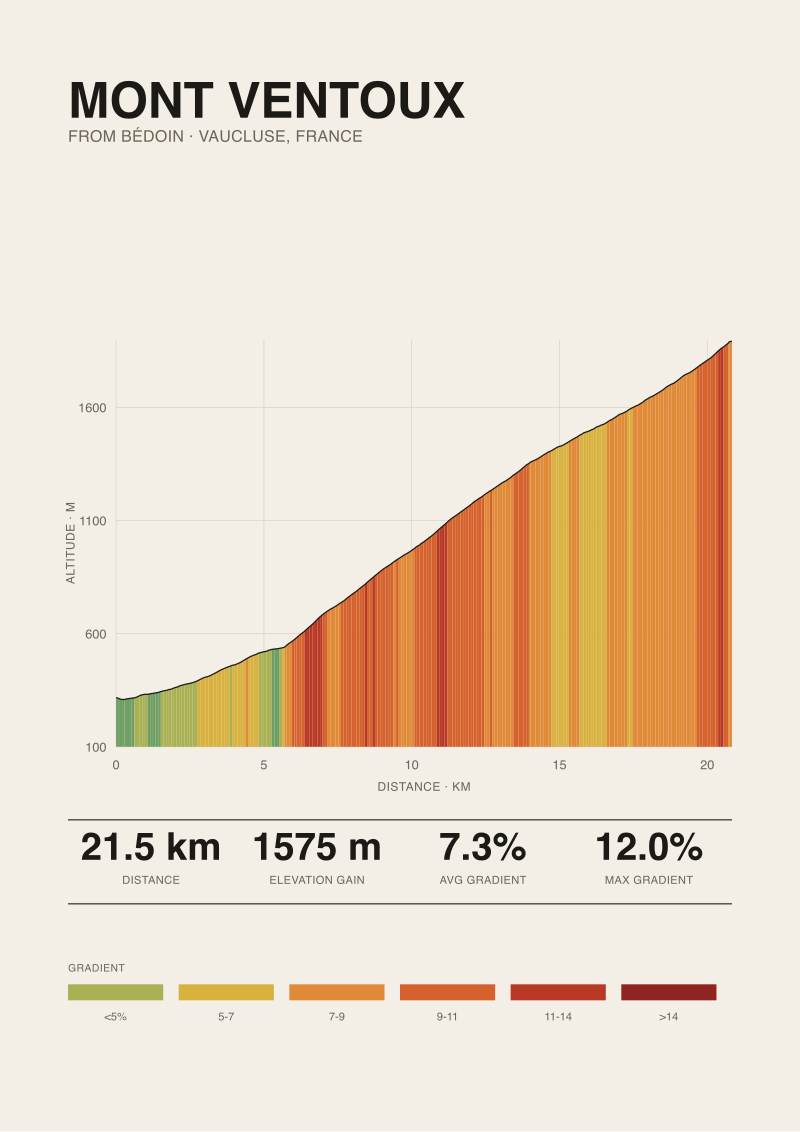
We measure road climbs for a living. The Stelvio from Prato allo Stelvio is 25.04 kilometres and 1,840 metres of vertical at an average of 7.3 percent; Ventoux from Bédoin is 21.51 kilometres and 1,575 metres at the same average. Once those numbers sit on your desk in profile form, you read the annual crop of gift guides for climbing cyclists differently. The same twelve products reshuffle across a dozen articles, the same stock photos, the same copy pretending to know the reader. They do not. The mistake is not the products they pick. The mistake is that none of them has ever looked at what a climb actually is.
What They All Get Wrong
The shared error runs underneath every gift guide written for climbing cyclists, and it has three layers that stack on top of each other.
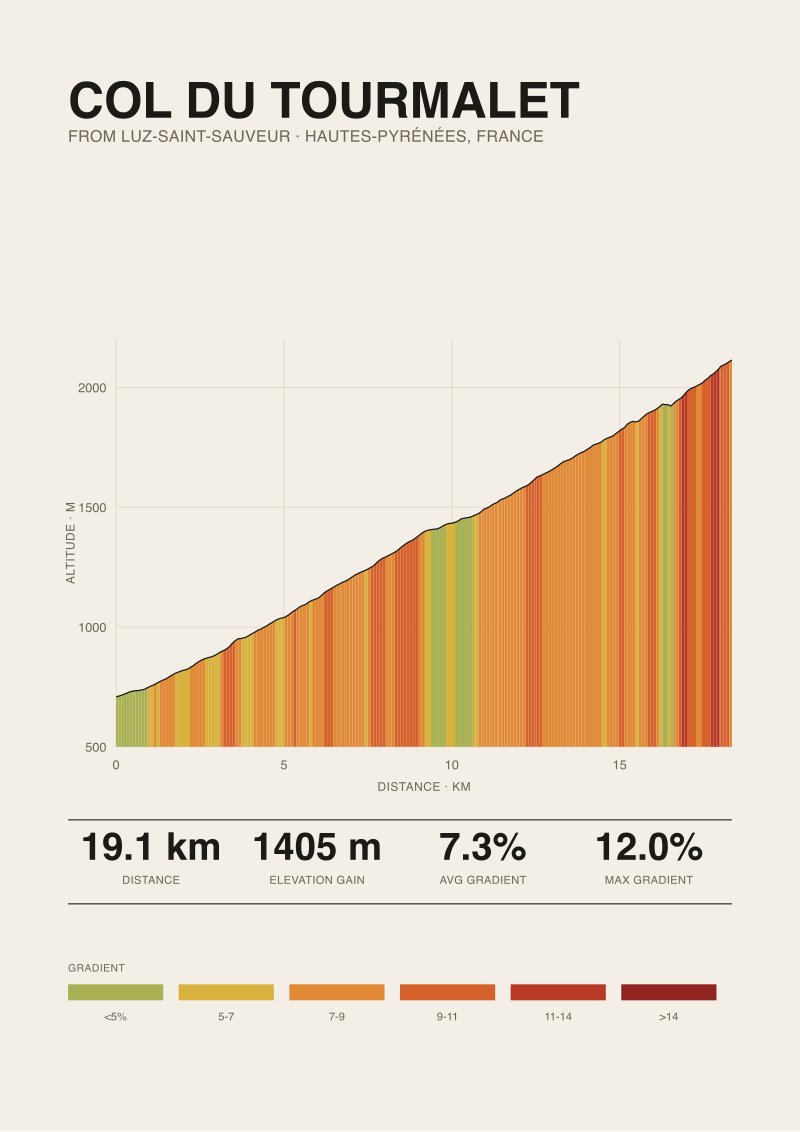
The first layer is category confusion. The guides treat "climbing cyclist" as a synonym for "road cyclist who owns a bike." The recipient is described as someone who "loves the outdoors," "enjoys long weekend rides," "trains for events." That describes half of the road-cycling population. A climbing cyclist is a narrower species. They are the rider who plans a summer around three passes rather than ten, who reads a route by its vertical metres before its distance, who can tell you within five metres what the summit of the Tourmalet from Luz-Saint-Sauveur sits at (2,114) because they have looked at that number more times than they have looked at their own resting heart rate. Treat them as a generalist and every product recommendation lands slightly off. Bib shorts marketed on aerodynamics rather than seated-climb comfort. Wheels sold on rolling resistance rather than lockring reliability at 2,600 metres. Nutrition packs designed for four-hour endurance rides rather than the two-and-a-half-hour grind of a single 18.42-kilometre ascent from Ponte di Legno.
The second layer is the "for him who loves the mountains" framing. It reduces the recipient to a mood board. Mist. Silhouette. Switchbacks in monochrome. The copy speaks of "conquering peaks" and "epic climbs." Neither word appears in the vocabulary of anyone who has actually ridden the Gavia in bad weather. The rider who has done that climb — 18.42 kilometres, 1,366 metres of gain, a published maximum of 16 percent above Ponte di Legno — talks about it the way a sailor talks about a specific storm on a specific day. Concrete, dated, geographically anchored. The gift guides erase every one of those anchors and replace them with a generic emotional register the recipient does not use with their own friends.
The third layer is quantitative laziness. When the guides do reach for a specific climb, they name it wrong. A well-known feature will be described as "one of the steepest in Europe" without a number. A profile will be called "brutal" without a gradient. Averages will be quoted as if they mean something, when the Ventoux average of 7.3 percent conceals a middle third at 9 to 10 percent under the trees where the actual ride is decided. The reader knows all of this. They notice. The gift guide loses them by the second paragraph, and after that no product recommendation lands, because they no longer trust the source.
What Is Almost Always Missing
The category that never appears in these guides is the one the reader would actually value: gifts that speak to a specific climb, on a specific mountain, in a specific measured shape.
The climbing cyclist's memory is geographical. They remember the false summit on the Stelvio after Trafoi, the way the road ramps back up towards the museum, the last few switchbacks visible from three kilometres below. They remember the treeline on Ventoux where the road turns white and the wind arrives, roughly at kilometre 15 of the 21.51 from Bédoin. They remember the flat kilometre near La Mongie where the Tourmalet lets you breathe before the summit ramp to 2,114 metres. These are not moods. They are places on a profile they can draw from memory.
A gift that acknowledges this is a gift that names the place. It says: I know which mountain. I know the side you rode. I know the number of metres you gained that day, and I know that the number matters to you more than the total distance. That is a narrow surface, and it is precisely the surface the guides refuse to touch because it requires the writer to know the difference between the Gavia from Ponte di Legno (18.42 km, 1,366 m) and the Gavia from Bormio, or between Ventoux from Bédoin and Ventoux from Malaucène. Naming the side is the whole gift. Getting the side wrong is worse than not giving anything.
The other missing category is honesty about limits. Every gift guide pretends every product is right for every reader. The climbing cyclist does not believe this. They already know that heart-rate straps chafe on long ascents, that certain wheelsets clatter through the switchbacks on Sa Calobra, that a cheap saddle bag will detach itself somewhere between hairpin nine and hairpin twelve on Alpe d'Huez. They want the giver to have done the same filtering they do. A gift chosen with a stated limit — "this is for the road-book planning, not for the ride itself"; "this is for the wall above the desk, not for the bike" — reads as respect. A gift wrapped in universal marketing copy reads as noise.
The third missing category is a piece that acknowledges the offseason exists. Six to eight months of the year, the climbing cyclist is not on the mountain. They are looking at maps, planning next June, reading race history from 1988, arguing about whether the Angliru is legitimately harder than the Zoncolan. Every guide treats them as if they are riding today. Almost nothing they receive addresses the long, patient months when they are only thinking about climbing. That is the majority of the calendar. It is the majority of the emotional relationship. And the gift industry ignores it entirely.
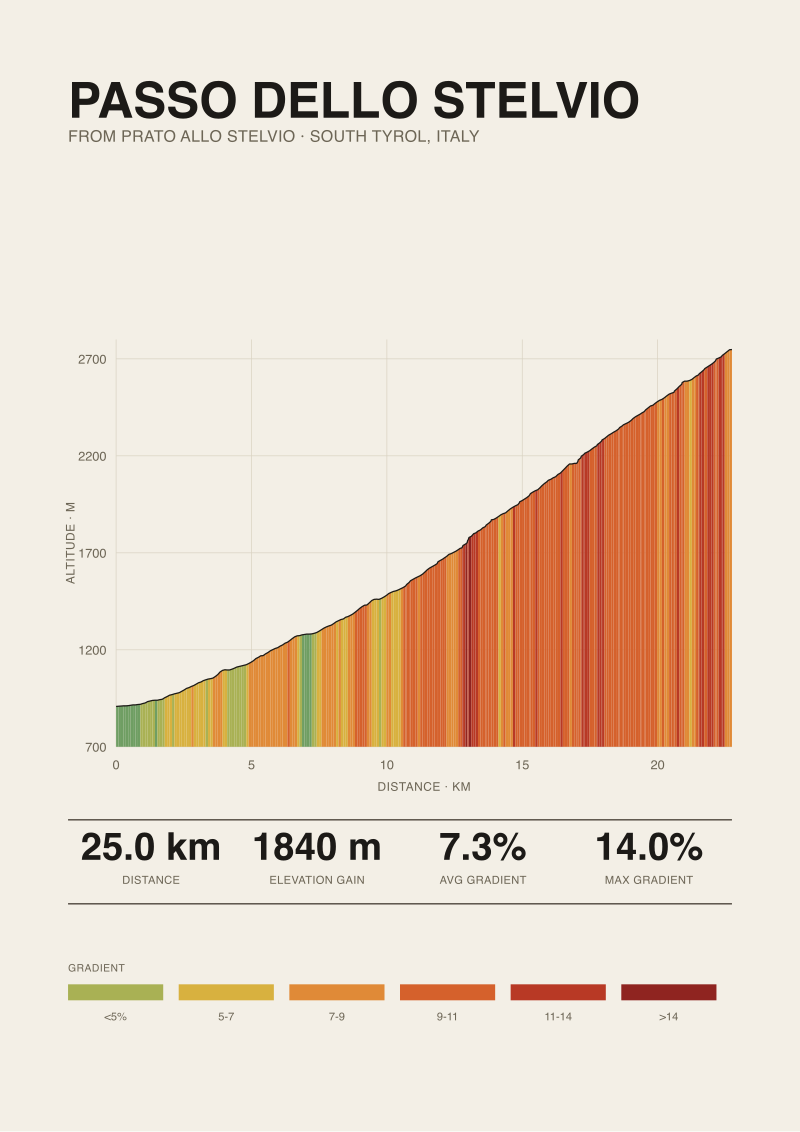 Passo dello Stelvio
The print from this article · from €29.95
View the print →
Passo dello Stelvio
The print from this article · from €29.95
View the print →
What I Would Say Instead
A gift for a climbing cyclist is a gift about a place, a number, and a profile they recognise. That is the whole principle, and it changes what you buy.
Start with the place. Not "the mountains" — a specific pass, on a specific side, in a country they can find on a map without help. The Stelvio from Prato allo Stelvio, 25.04 kilometres from the valley at 908 metres to the summit at 2,748. The Tourmalet from Luz-Saint-Sauveur, 19.12 kilometres from 709 to 2,114. The Gavia from Ponte di Legno, 18.42 kilometres from 1,244 to 2,610. If the recipient has ridden it, the specificity is the recognition. If they have not ridden it but want to, the specificity is the invitation. Either way, "a print of the Alps" fails and "the Stelvio, north side, 1,840 metres of vertical" succeeds. The rider was going to look up that number anyway. You have saved them the search and told them you already knew.
Then the number. Climbing cyclists live inside a small vocabulary of measurements. Length in kilometres. Vertical in metres. Average gradient. Maximum gradient, honestly cited. Summit altitude. A gift that includes any of these on its face — as data, not as decoration — is a gift that speaks the language. A gift that reaches for gradient percentages it did not verify is worse than one that stays silent. If the giver has to invent the maximum on the Gavia to make the gift feel important, the reader will notice, because the reader has probably looked it up before and knows the published figure is 16 percent above Ponte di Legno and that satellite elevation data reads slightly lower. Precision is the compliment. Fake precision is an insult.
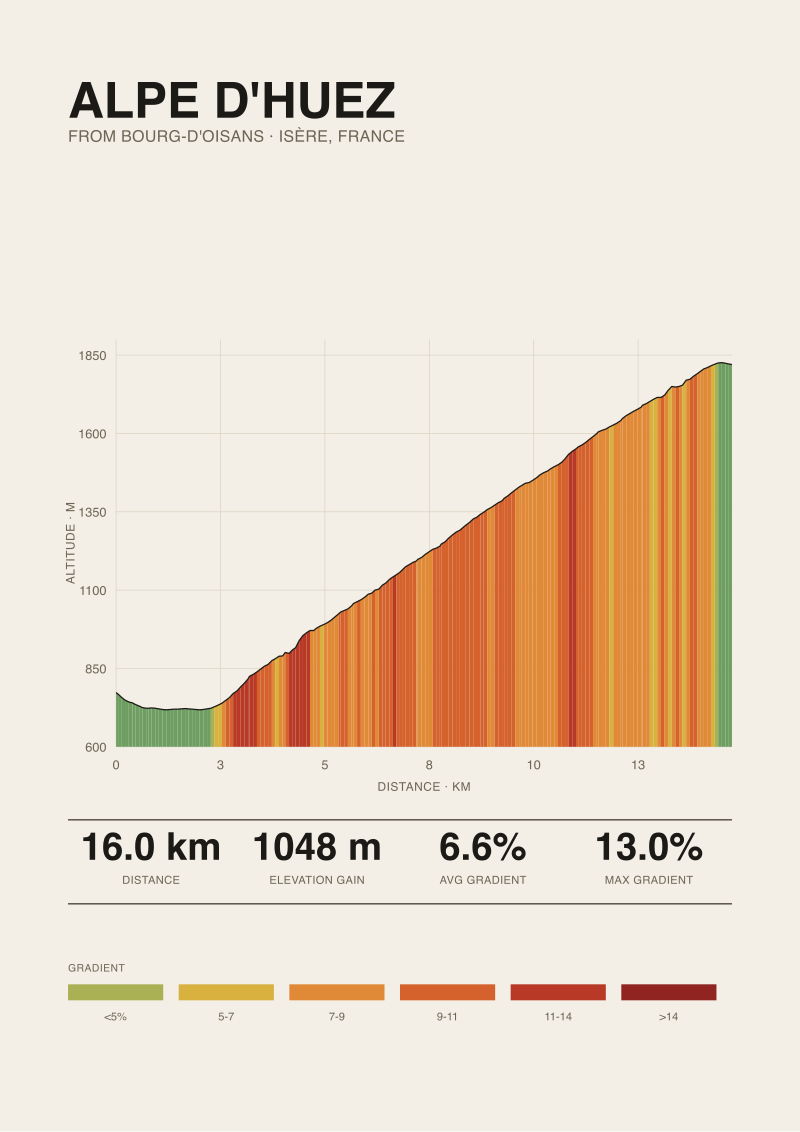
Then the profile. The elevation shape of a climb — where it ramps, where it plateaus, where the false summit teases before the final wall — is the thing the rider carries in memory. A print, a chart, a rendering that captures that shape honestly, from measured data, is one of the few gifts that survives the transition off the bike. It sits on the wall in the offseason, when the road to Bédoin is closed and the summit of the Gavia is under snow. It is a piece of the climb that comes home. This is where our studio's own work belongs in an article like this, and only here: our prints of these specific climbs are made from the elevation profiles the climbs actually have, drawn from satellite data at 30-metre resolution, with the published road-book maximums cited separately from the measured averages. That is the one commercial line we will draw in this piece. If it is not the right gift for your recipient, it will still tell you what shape the right gift should take.
Everything else follows from the principle. A guidebook that names the climbs by their profile, not their reputation. A weather-service subscription for the specific range they ride. A map printed at a scale where the switchbacks are visible individually. A framed race photograph from a stage the recipient can date without prompting. A small book on the geology of the Dolomites. None of these is a "cyclist" gift in the guide-industry sense. All of them are climbing-cyclist gifts in the only sense that matters to the reader.
This piece does not cover training gifts, gear reviews, or bike-fit recommendations. It does not rank retailers. It does not compare price points, because a gift chosen on this principle is not competing on price. And it does not tell you what to buy for the general road cyclist in your life, because that person is not the reader described here. Three exclusions, honestly stated, so the rest of the argument can stand.
FAQ
What actually distinguishes a climbing cyclist from a general road cyclist?
They organise their season around vertical metres, not distance. A general road rider plans a summer of long weekends and Sunday café rides; a climbing cyclist plans a trip around three specific passes and reads route notes by their elevation gain first. They know summit altitudes from memory — the Stelvio's 2,748 metres, the Tourmalet's 2,114 — and can discuss the difference between two sides of the same mountain. Gifts that ignore that distinction land as generic.
Is a climb print appropriate for someone who has not ridden that specific climb?
Yes, when it is a climb they clearly want to ride. The Stelvio from Prato allo Stelvio, the Ventoux from Bédoin, the Tourmalet from Luz-Saint-Sauveur — these appear on almost every serious climbing cyclist's medium-term list. A print of a climb on their planning shortlist reads as an invitation, not a memory. The failure mode is picking a climb they have no intention of riding, or picking the wrong side of the right mountain.
Why does the side of the mountain matter so much?
Because it changes almost every number. The Gavia from Ponte di Legno is 18.42 kilometres and 1,366 metres of gain; the Gavia from Bormio is a different length, different vertical, different gradient profile, different road entirely. The same is true for Ventoux, Stelvio, and Tourmalet. To a climbing cyclist, saying "the Gavia" without saying which side is like saying "Manhattan" without saying which street. The specificity is the whole point.
What should I avoid buying?
Anything sold on the phrase "epic climbs," any product with generic switchback stock photography and no named mountain, any accessory that quotes gradients without a source, and any gift built around "conquering" language. Climbing cyclists do not use those words about themselves. Universal cycling merchandise — jerseys, mugs, socks with a generic bike graphic — reads as effort without knowledge. The recipient will accept it politely and it will sit in a drawer.
Are there gifts that work for the offseason specifically?
Yes, and they are underrated. Six to eight months a year the recipient is not on the mountain. Gifts for the planning table — a large-scale map of the Écrins or the Dolomites, a book on the 1988 Giro's Gavia stage, a print of a climb they intend to ride next June, a good weather-data subscription for the range — outperform gifts designed for the ride itself, because they meet the rider where they actually spend most of their year.
How do I get the numbers right if I do not ride these climbs myself?
Do not guess. Averages, summit altitudes and vertical gains for the major European passes are documented in reputable sources, and satellite-derived elevation data is publicly available. Published maximum gradients are usually cited from established road books — use the cited figure and name the source. Inventing a "steepest section" or rounding a summit altitude to sound impressive is the single most reliable way to signal that the gift was chosen without care.
Is there any single gift that works for almost every serious climbing cyclist?
Nothing works for everyone, but the closest is a printed piece — a chart, a map, a profile — of one specific climb the recipient has a documented relationship with. It survives the offseason, it sits on the wall, and it does not compete with gear they may already own in a specific brand or size. The condition is that the climb must be the right one, drawn from the right side, with the numbers cited honestly.
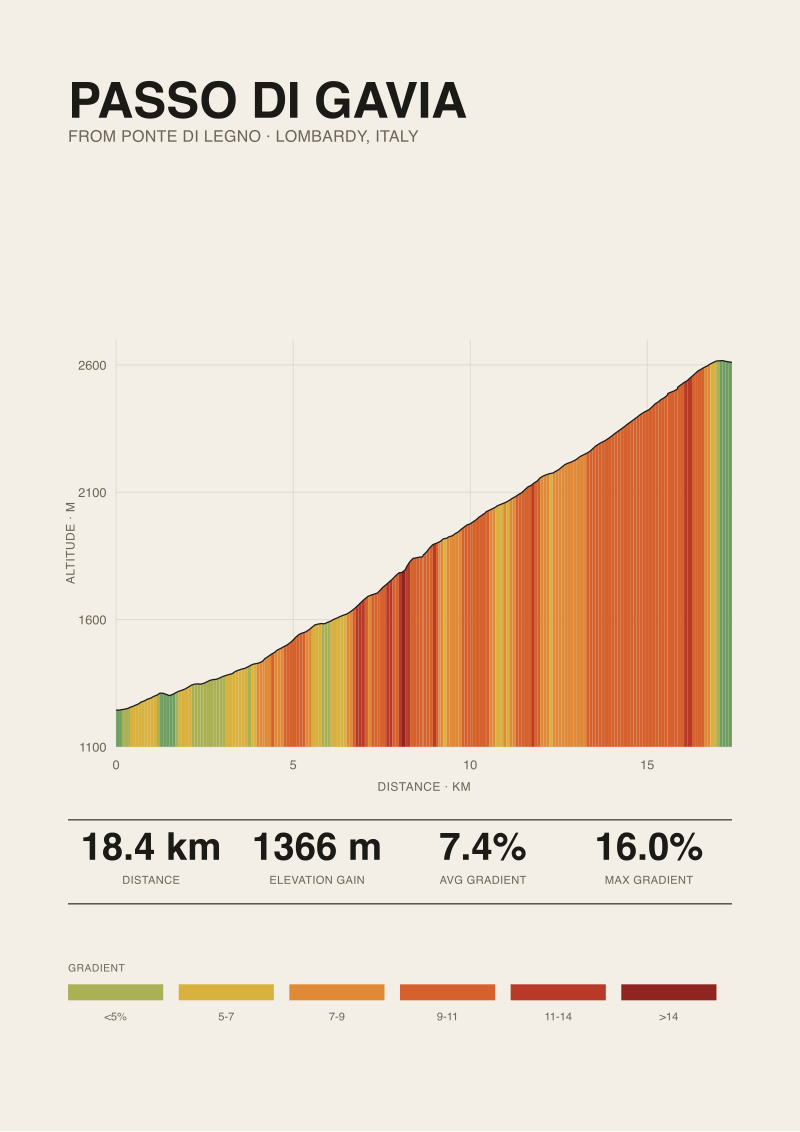 Passo di Gavia
The print from this article · from €29.95
View the print →
Passo di Gavia
The print from this article · from €29.95
View the print →
From the collection
New climbs and 10% off your first print.
One email now with your code. No noise after.