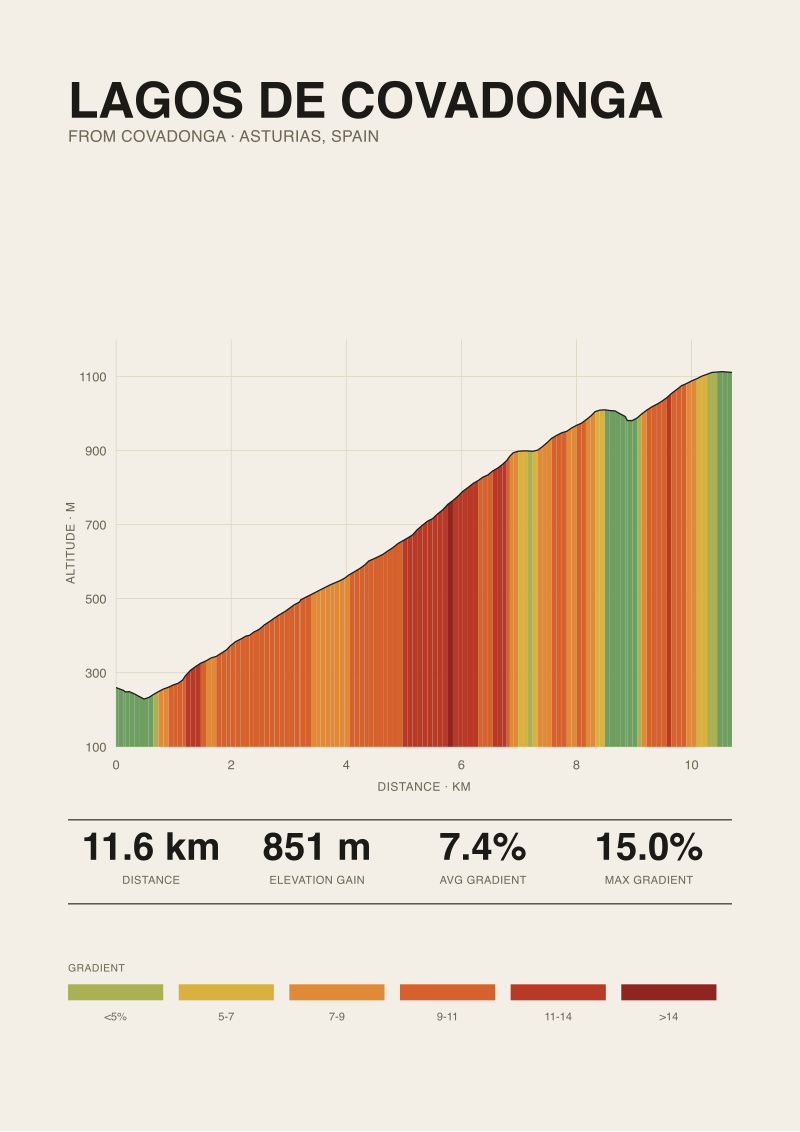
11.57 kilometres. 851 metres of vertical gain. A 7.4 percent average gradient that would earn Category 1 on almost any French climb rating scale, but not Hors Catégorie. These are the numbers we pulled from SRTM 30-metre elevation data for the ascent from Covadonga to the two lakes at 1,111 metres above sea level. On paper, the climb that shaped the modern Vuelta a España is not the hardest mountain the race owns. It is not even close.
And yet, since 1983 — when it first appeared on the Vuelta route — Lagos de Covadonga has been treated as the race's emblem. Not the Angliru, which arrived only in 1999 and is shorter but averages closer to double digits. Not the crueller Pyrenean walls the race has borrowed on trips over the border. Lagos. The finish where organisers place the queen stage more often than any other. The finish where, historically, a Vuelta is legitimised.
The conventional reading of why this happened is clean. Covadonga is a natural amphitheatre — the sanctuary of the Reconquista at the bottom, the glacial lakes at the top, the Picos de Europa closing the sky on either side. It sits close enough to the Cantabrian coast to catch Atlantic weather. It sits deep enough into Asturias to feel like Spain's proper mountains rather than a rehearsal. And it is decisive, the argument goes, because the road above the sanctuary climbs hard and does not let up. That is the version of Lagos de Covadonga that gets told. It is not wrong. But it is not quite what the elevation data shows either.
Why the Emblem Is Deserved
Before dismantling anything, we should be honest about the parts of the story that hold. The 1983 stage, won by Marino Lejarreta on the climb's Vuelta debut, was the moment a mid-August (later September) Grand Tour stopped importing prestige from elsewhere and started manufacturing its own. Before Covadonga, the Vuelta's mountain identity was ambiguous — a race that visited Sierra Nevada, the Pyrenees, the odd Asturian pass, without an emblem attached to any of them. After Covadonga, it had a location the way the Tour has L'Alpe d'Huez and the Giro has the Stelvio: a place the general public knew by sight.
The weather is real. Atlantic systems arrive in Asturias in September the way they refuse to arrive in the southern French Alps in July. The final three kilometres cross exposed pasture where a headwind stops behaving like weather and starts behaving like gradient. In race after race, the finish has been decided as much by whoever committed to a raincape at the start line as by anything the climb itself demands.
The position in the Vuelta calendar matters. Covadonga arrives late — typically in the second week — into legs that have already absorbed a first-week block. Riders come to it fatigued in a way they do not come to first-week climbs at the Tour. And the amphitheatre effect is not just aesthetic: with television helicopters and the lake basin behind them, riders arrive at a finish that reads on camera as a proper summit rather than a road-end. That composite — history, weather, timing, framing — is enough to earn any climb its reputation. The reputation is deserved. The reputation is just not, on the numbers, about the numbers.
The elevation profile tells a story the reputation obscures — the difficulty is not distributed across those 11.57 kilometres. It is concentrated in a stretch you can walk across in twenty minutes.
Where the Emblem Framing Breaks Down
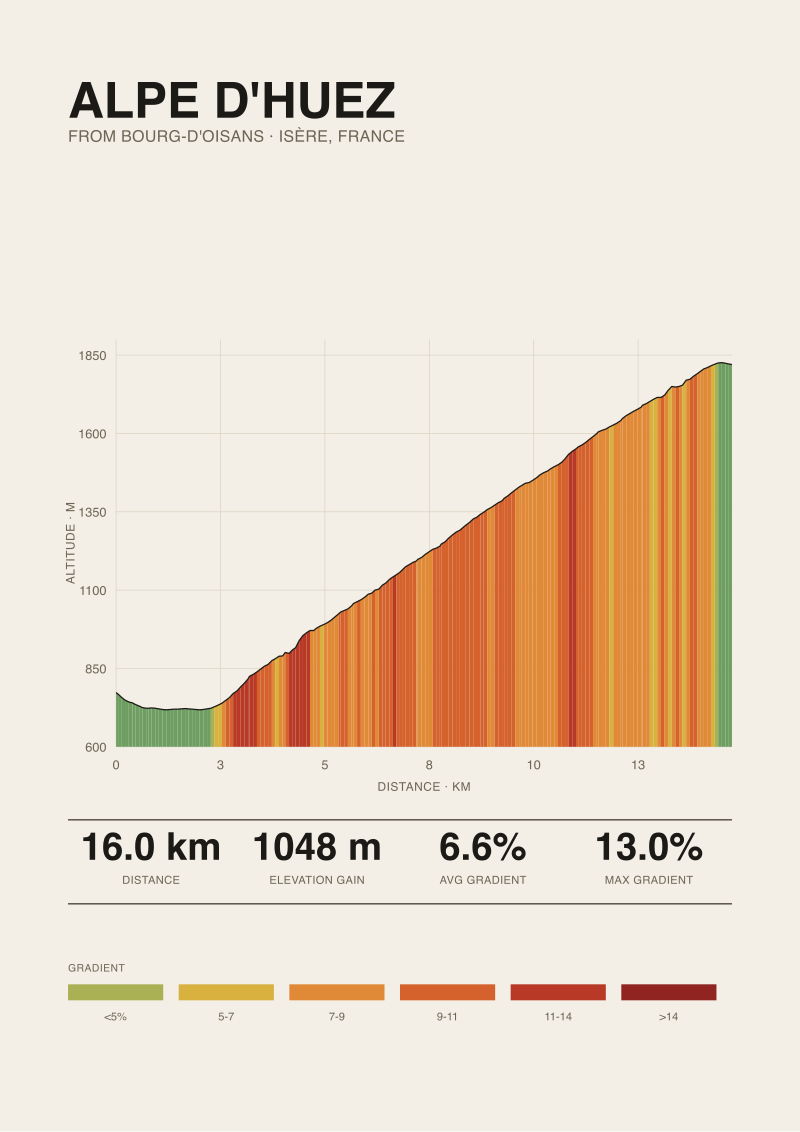
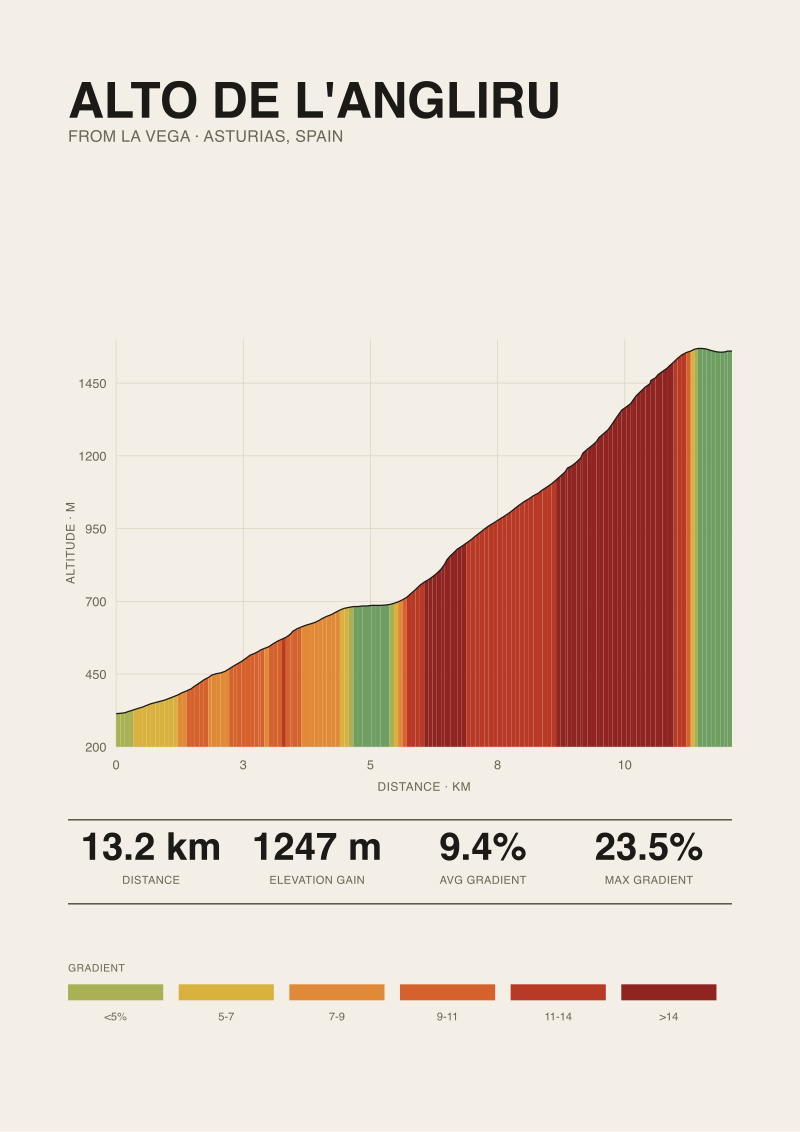
Start with the comparisons. Alpe d'Huez, the climb Lagos is most often benchmarked against by non-Spanish audiences, is roughly 13.8 kilometres at 8.1 percent. Longer, steeper on average, more vertical gain. The Angliru — the Vuelta's own more recent brutality — is shorter than Lagos by roughly a kilometre and a half but averages close to 10 percent. On any pure difficulty index that weights length by average gradient, Lagos de Covadonga finishes below both. It also finishes below Zoncolan, below the Mortirolo, below any number of climbs that never became a Grand Tour's emblem.
So the question the numbers force is not "why is Lagos de Covadonga hard?" — it is not, comparatively — but "why is Lagos de Covadonga decisive?" And here the SRTM profile diverges from the road-book average in a way that matters more than either figure taken alone.
The climb from Covadonga does not rise at 7.4 percent for 11.57 kilometres. It rises at a moderate gradient through the first six or seven kilometres of forested valley, a stretch where a well-drilled team can shepherd a leader without either drama or metabolic cost. Then, in the final third, the profile changes shape. The road exits the trees, exposes the rider to whatever the Atlantic is delivering that afternoon, and hits the pitch known as La Huesera — "the boneyard" — where the published maximum reaches 15 percent, per the Vuelta's own road-book and climbfinder's route data.
That 15 percent figure is not our measurement; SRTM 30-metre elevation data smooths out short pitches like Huesera and would understate it. This is one of those cases where the road-book beats the satellite. But the direction of the disagreement matters: the published gradient is steeper than the modelled one, which means Huesera is objectively harder than an average-gradient reader would guess.
The consequence is that the 7.4 percent average is genuinely misleading — a decoy. A rider who reads Lagos as a steady grind pays for that reading in a specific place, at a specific moment, on a wall that arrives too late in the stage to recover from and too concentrated to survive by pacing. The climb is decisive not because it is hard for 11.57 kilometres. It is decisive because it is hard for one and a half.
 Lagos de Covadonga
The print from this article · from €29.95
View the print →
Lagos de Covadonga
The print from this article · from €29.95
View the print →
The Rule We Use Instead: Read the Decisive Segment, Not the Average
When we draw a climb as a print, we make a choice about what to render. The temptation is to render the whole ascent as one gradient — a clean triangle from the base to the summit, average slope, done. It is what most infographics do. It is also useless as an editorial description of what the climb is.
The rule we work from now is different. Every consequential Grand Tour climb has a decisive segment — a stretch of roughly one to two kilometres where actual selection happens. Sometimes that segment is at the top, sometimes in the middle, occasionally near the bottom of a summit finish that starts steep and eases. Averages hide it. Peak gradients advertise it but strip the context of where in the climb the peak sits and what came before it.
For Lagos de Covadonga, the decisive segment is La Huesera and the exposed ramps immediately above it — call it the last three kilometres, with the crux the roughly 1.5 kilometres around the 15 percent wall. For Alpe d'Huez, the decisive segment is usually the opening third — the first six hairpins from Bourg-d'Oisans to hairpin 15 — where the climb starts at 10 percent and shells anyone who committed to the wrong wheel. For Angliru, the decisive segment is basically the entire back half; there is no hiding.
The framework asks a single editorial question: where does the race actually get made? Once you have that answer for a given climb, the average gradient becomes a supporting figure rather than the headline. You stop describing Lagos de Covadonga as an "11.57 kilometre climb at 7.4 percent" — that description is technically correct and editorially wrong. You start describing it as a climb where the road above the sanctuary hides the difficulty for six kilometres and then delivers it, concentrated, on a single stretch of exposed pasture at 15 percent.
That is the sentence Marino Lejarreta could have written in 1983. It is the sentence every rider who has climbed it in a Vuelta has, in some version, written since.
When the Old Rule Still Wins
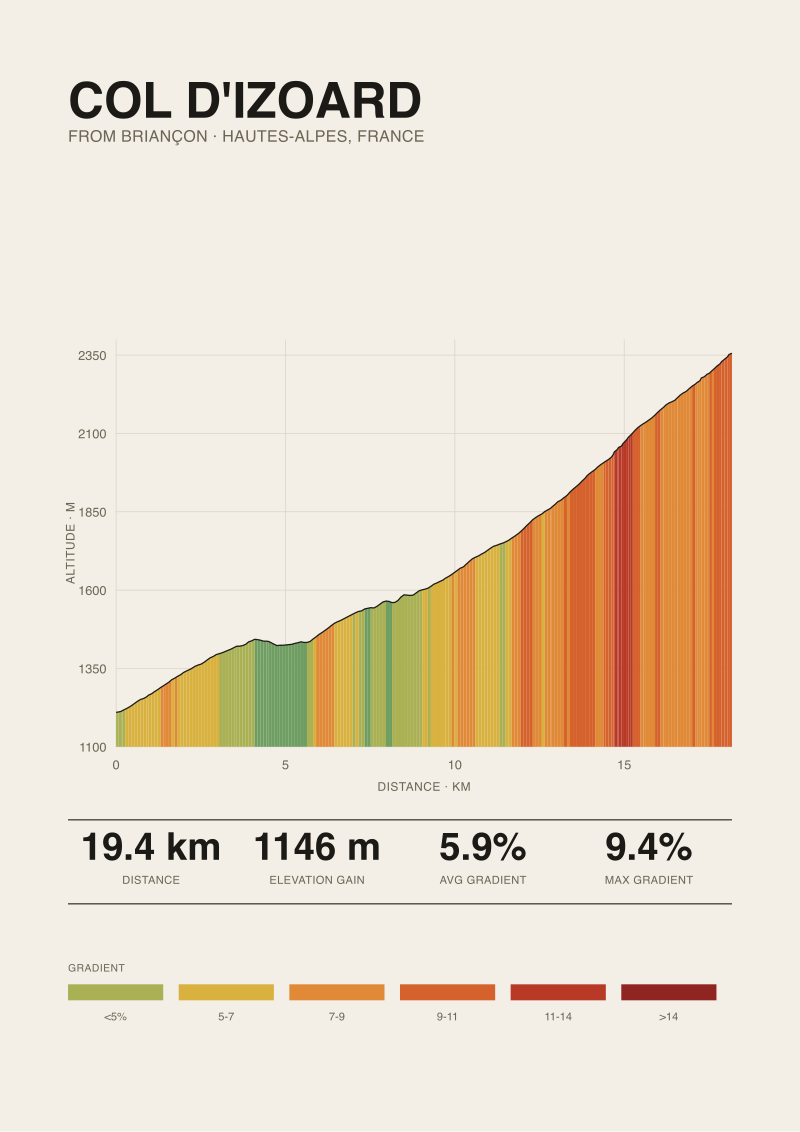
We are not going to pretend the decisive-segment framing is universal. Ventoux from Bédoin is a climb whose average gradient (roughly 7.5 percent over 21 kilometres) is a genuinely faithful description of the experience — the forest section grinds at nearly the same slope as the moonscape above Chalet Reynard, and the difficulty accumulates rather than concentrates. Most of the classic Alpine climbs behave the same way: Galibier, Izoard, the long Pyrenean cols. For those, the average tells you the truth.
And in Grand Tour general classification arithmetic, a twenty-kilometre climb at seven percent will always cost more riders more time than a three-kilometre wall at fifteen percent, regardless of what any decisive-segment analysis says. Averages tell you the fatigue tax. Peaks tell you the fireworks. This piece has been about Lagos de Covadonga specifically and about the family of climbs that behave like it — profile-average-hiding-a-crux — not about a general theory of every summit finish. There is a version of this argument that would push further into GC time-loss modelling and stage-design theory. That is a different piece.
 Alpe d'Huez
The print from this article · from €29.95
View the print →
Alpe d'Huez
The print from this article · from €29.95
View the print →
FAQ
When did Lagos de Covadonga first appear in the Vuelta a España?
The climb debuted on the Vuelta route in 1983, with Marino Lejarreta winning the stage. That debut is the moment the race began building its mountain identity around a signature finish rather than borrowing prestige from other geographies, and it is the reason later organisers kept returning to Covadonga rather than rotating through the Cantabrian range more evenly. Every subsequent visit has been read against the 1983 template.
Is Lagos de Covadonga an HC (Hors Catégorie) climb?
The Vuelta typically categorises it at the top end of its own rating scale, but on the pure profile numbers — 11.57 kilometres at 7.4 percent average — it sits closer to a strong Category 1 than to the HC benchmark set by climbs like Alpe d'Huez or the Angliru. Categorisation on Grand Tours is partly a race-organiser decision that reflects position in the stage and prestige, not only raw profile data. Lagos benefits from both.
How does Lagos de Covadonga compare to Alpe d'Huez on the numbers?
Alpe d'Huez is longer (roughly 13.8 kilometres versus 11.57) and steeper on average (around 8.1 percent versus 7.4). It also delivers more vertical gain. On a pure difficulty index weighting length by average gradient, Alpe d'Huez outscores Lagos comfortably. The two climbs became Grand Tour emblems through similar processes — repetition, television, a specific geography — but not through similar profiles.
What is La Huesera and why does it matter?
La Huesera — "the boneyard" — is the steep pitch in the upper third of the climb where the published maximum gradient reaches 15 percent, according to the Vuelta's road-book and climbfinder's route data. It matters because it concentrates the difficulty of the ascent into a stretch of roughly 1.5 kilometres, which is where selection actually happens on race day. Riders pacing off the 7.4 percent average tend to arrive at Huesera under-fuelled or over-geared.
Why is the published maximum gradient different from what satellite data would show?
The 15 percent figure comes from published road-book measurements taken on the road itself. Our profile data comes from OpenTopoData SRTM 30-metre elevation, which smooths short pitches and would understate the true peak. This is one of the cases where the road-book beats the satellite. When we discuss decisive segments, we take the road-book peak seriously and treat the SRTM average as a reliable overall figure rather than a reliable peak figure.
Is Lagos de Covadonga still relevant to modern Vuelta general classification battles?
Yes, though the arrival of the Angliru in 1999 and other harder finishes has given the race more brutal options. Lagos remains a fixture because its decisive segment is late enough in the climb and exposed enough to weather that it produces selection reliably, and because the amphitheatre framing plays on television in a way harder but visually plainer climbs do not. The emblem status is partly editorial, not only competitive.
What makes Asturian weather so significant for this climb?
The final three kilometres cross exposed pasture with no tree cover, at an elevation where September Atlantic systems routinely deliver rain, low cloud and headwinds. Because Vuelta stages here typically finish in late-summer conditions rather than the settled July weather of the Tour, the wind and rain component is a structural feature of the finish rather than an occasional variable. Stage outcomes have shifted on rain gear decisions made at the base of the climb.
From the collection
New climbs and 10% off your first print.
One email now with your code. No noise after.