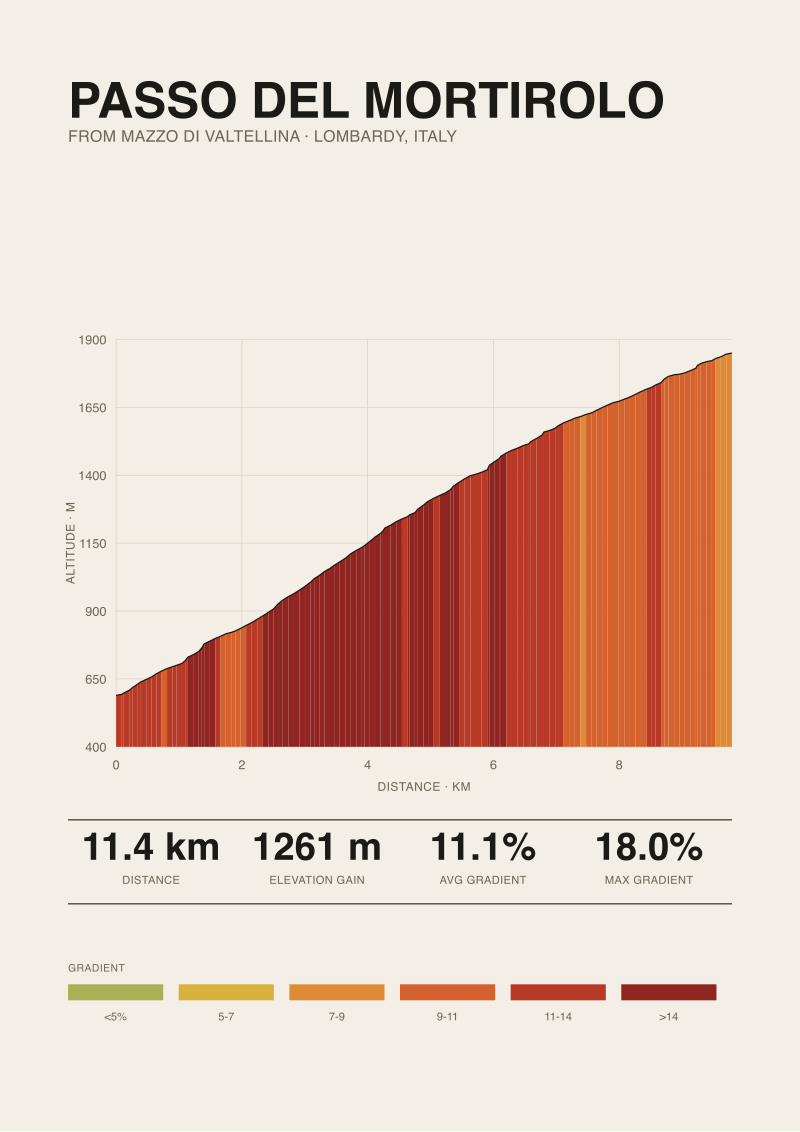
The Passo del Mortirolo from Mazzo di Valtellina is 11.37 km long, gains 1,261 metres, and averages 11.1 percent. Those three numbers, in that order, are how the climb is introduced in almost every road book, ride guide, and forum post about it. Published maximum gradient, per climbfinder.com's Mazzo profile, sits at 18 percent. The conventional reading of those figures is that the Mortirolo is a hard climb because it is steep on average and briefly savage at its worst. That reading is not wrong. It is just not enough to plan a ride around, and the gap between what those four numbers say and what the mountain actually does to a rider is the subject of this piece.
Why This Is Actually True
The 11.1 percent average is not a marketing figure. It is arithmetic. Divide 1,261 metres of vertical gain by 11,370 metres of horizontal distance and the result is 0.1109. Round it and you have the number every guide prints. That number is real, and it does something useful: it places the Mortirolo inside a very small club of paved European climbs whose average gradient sits in double digits. Very few roads clear ten percent averaged over more than ten kilometres. This is one of them.
The published 18 percent maximum does its own job. It tells the reader that somewhere on the ascent there is a pitch steep enough that gearing, not fitness alone, becomes the decisive variable. Eighteen percent is roughly the gradient at which a 75 kg rider on a 9 kg bike needs about 500 watts to hold 10 km/h. That figure is not sustainable for most amateurs, and it is not meant to be. It is a warning, and it is the correct warning to publish.
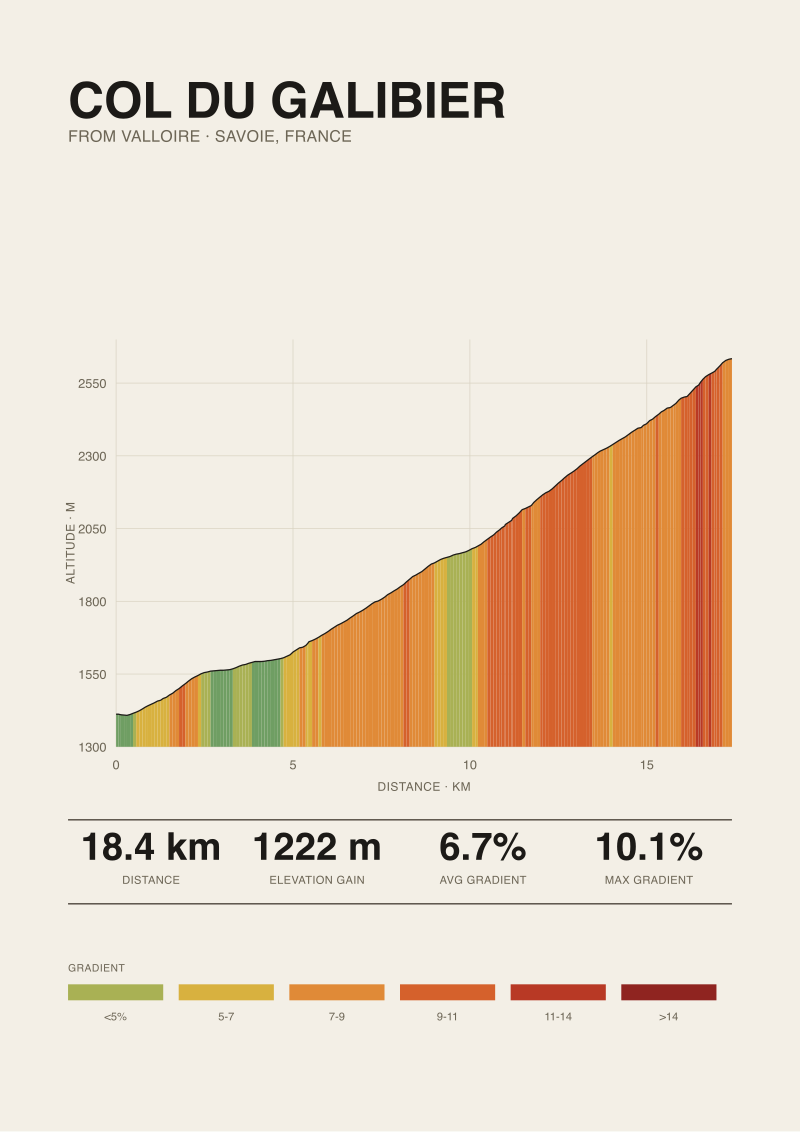
The two figures also do something the sport rarely acknowledges: they let riders who have never met discuss climbs on shared terms. A conversation that proceeds on "steeper than the Aubisque, shorter than the Galibier" is a conversation everyone can follow. That utility is genuine. Dismissing summary statistics because they are summaries misses the point of why summaries exist. A road book cannot ship a five-hundred-point profile for every climb in the Alps, and a rider glancing at a page does not want one.
So the standard framing — 11.37 km, 11.1 percent, 18 percent peak — is not wrong. It is compact, comparable, and directionally correct about how hard the Mortirolo is. Anyone who reads those numbers walks away with the correct impression that this climb belongs in the top tier of European paved ascents. That is what a summary is supposed to do, and the Mortirolo's summary does it.
But averages describe distributions, and the Mortirolo's distribution is where the ride is actually decided.
Where It Breaks Down
The Mortirolo gains 1,261 metres over 11.37 km. If those metres were distributed evenly, the gradient would be 11.1 percent from the first pedal stroke in Mazzo to the summit arch at 1,850 m. The road would feel hard, but it would feel the same kind of hard for the entire ascent. That is not what the Mazzo side does, and it is not what any climb with an 18 percent published maximum does. An 18 percent maximum implies non-uniform distribution by definition. If the road never exceeded 11.1 percent, there would be no maximum worth publishing.
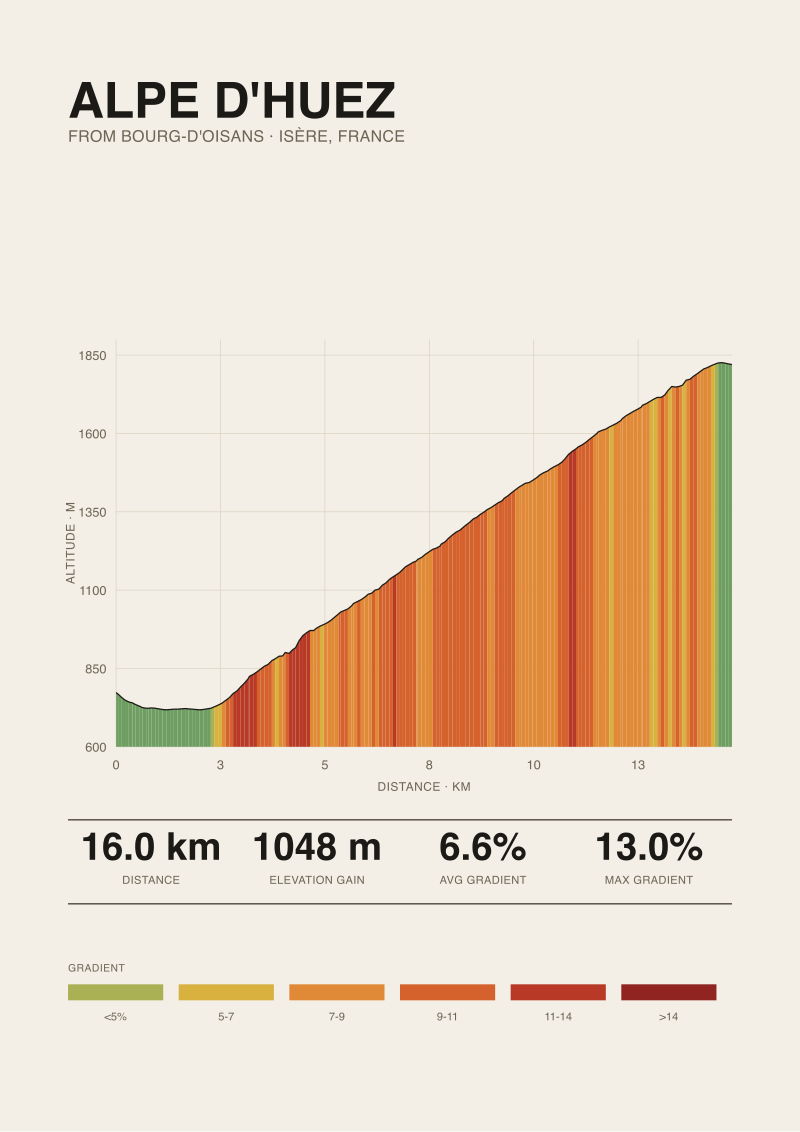
The mathematics are worth doing explicitly. Assume, for the sake of argument, that the climb contains 2 km of road at 18 percent. That segment alone accounts for 2,000 × 0.18 = 360 metres of vertical gain — 28.5 percent of the total in 17.6 percent of the distance. The remaining 9.37 km must then average (1,261 − 360) ÷ 9,370 = 9.6 percent. That is still a hard gradient — closer to Alpe d'Huez territory than to the Mortirolo's headline number. The rider's mental model of the climb has to change: it is no longer "11.1 percent for two hours." It is "9.6 percent for the long stretch, with fifteen minutes of 18 percent stitched somewhere into the middle of it."
The illustration is deliberately loose. The grounding elevation data we work from is OpenTopoData SRTM at 30-metre resolution, which resolves total gain accurately but smooths pitches shorter than its own grid. The 18 percent maximum is climbfinder.com's figure for the Mazzo side, not one we measured. But the arithmetic identity holds for any climb whose published maximum sits well above its average: the harder-than-average sections are compensated by easier-than-average sections, and the rider experiences both, in sequence, with no averaging kindly performed by the road.
This matters because effort does not scale linearly with gradient. A rider producing constant power slows down on steeper pitches and therefore spends more time inside the hard section than the ratio of distances suggests. At a steady 250 watts, a 75 kg rider on a 9 kg bike covers roughly 11 km/h on an 8 percent grade and roughly 7 km/h on a 14 percent grade. Per kilometre of road, the 14 percent section extracts something close to twice the minutes of suffering. Averages hide this compounding. Distributions do not.
The 11.1 percent number, in short, is a true description of the climb's overall shape and a poor description of any given minute inside it. That is the failure mode every summary statistic has when the underlying distribution is non-uniform. It is not the number's fault. It is the fault of treating the number as sufficient for the decisions that follow it.
 Passo del Mortirolo
The print from this article · from €29.95
View the print →
Passo del Mortirolo
The print from this article · from €29.95
View the print →
The Rule I Use Instead
The rule we use at the desk, when reading a climb for the first time, is to treat average gradient as a boundary condition and published maximum as a floor for the worst kilometre. Together they define the envelope. The envelope is not the ride. The ride is inside the envelope, and the shape of what is inside changes how the climb should be paced, geared, and remembered.
For the Mortirolo from Mazzo, that means starting with the four grounded numbers — 11.37 km, 1,261 m of gain, 11.1 percent average, 18 percent published max — and then asking a specific downstream question: what is the minimum possible spread in gradient that these four numbers permit? An 18 percent maximum against an 11.1 percent average forces a spread of at least 18 − 11.1 = 6.9 percentage points between the steepest and the gentlest sections. In practice, on real mountain roads, the spread is wider because gradients vary at finer resolution than any kilometre average captures. But 6.9 points is the mathematical floor. The road cannot be flatter than that spread requires.
That single realisation reframes gearing. A rider whose lowest gear allows sustained pedalling at 11.1 percent will still find themselves unable to turn the cranks at 18 percent unless they can produce roughly 60 percent more power at the moment the road pitches up. Most cannot. So the gearing decision is set by the maximum, not the average, and the average tells us only how long the rest of the climb lasts once the maximum has been survived. This is the opposite of how the numbers are usually read.
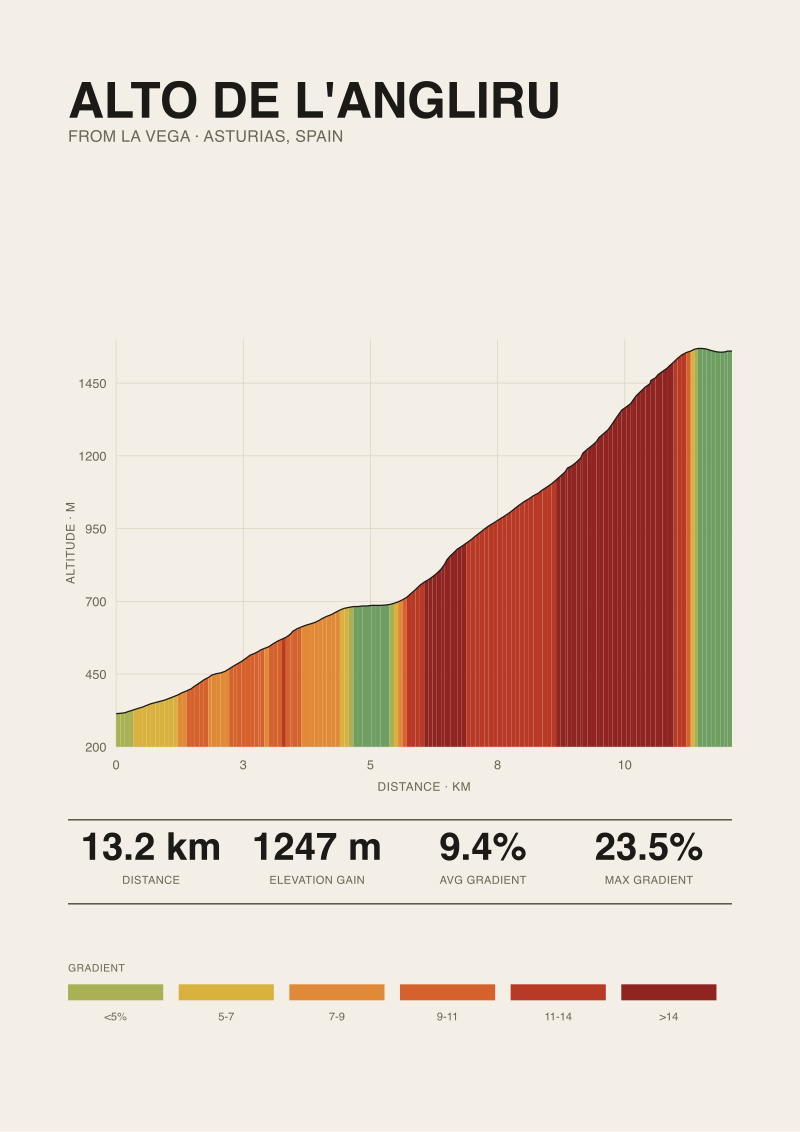
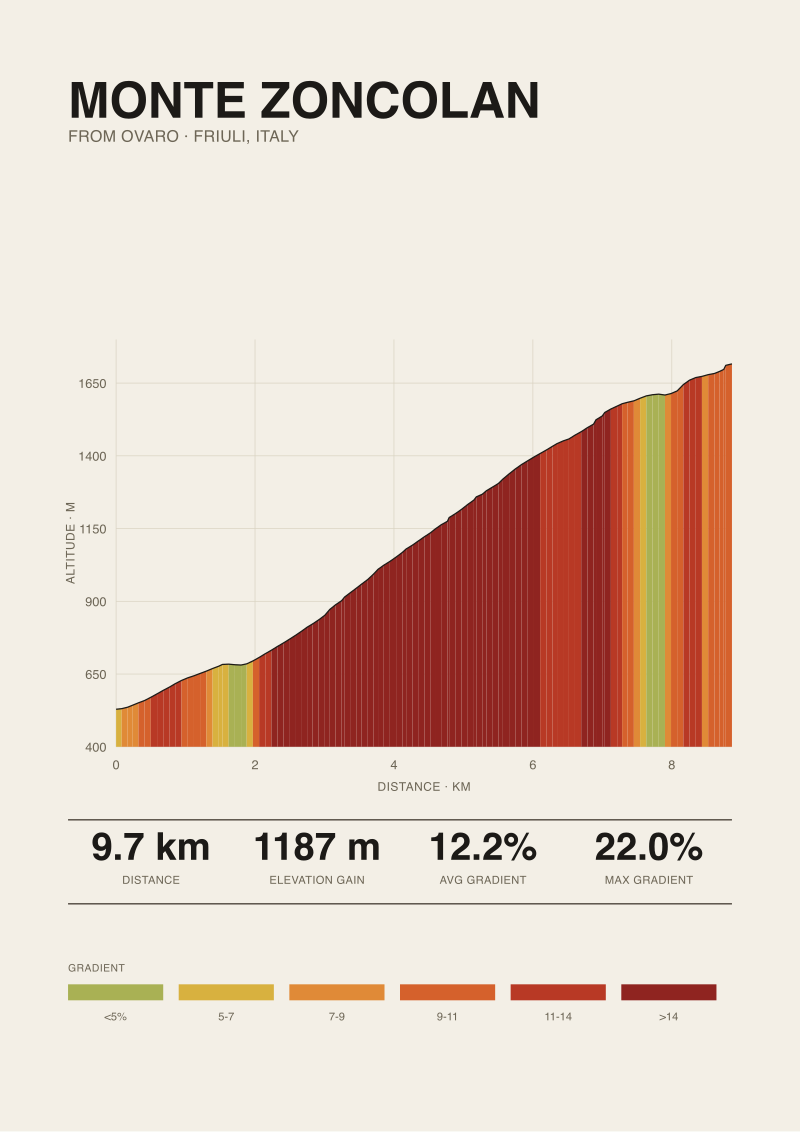
The rule generalises. For any climb where the ratio of published maximum to average exceeds about 1.5 — the Mortirolo's ratio is 18 ÷ 11.1 = 1.62 — the maximum determines gearing, the average determines pacing budget, and the two must be planned independently. For climbs where that ratio sits closer to 1.2, the average is a reasonable proxy for the whole road. The Mortirolo is not one of those climbs. Neither is the Angliru. Neither is Zoncolan.
We use the same framework when we draw a print of a climb. The profile is not the average; it is the sequence. If we rendered the Mortirolo as a uniform 11.1 percent slope, the print would fit the numbers and misrepresent the mountain. We draw the sequence because the sequence is what the rider actually rode.
When the Old Rule Still Wins
The average-and-maximum framing survives for one legitimate reason: it works for climbs whose distributions actually are close to uniform. A road that averages 6 percent with a published maximum of 7 percent is a road you can read from those two numbers alone. Most Category 2 and many Category 3 climbs in the French Alps fall into that group. So do the longer, gentler Pyrenean passes. If the plan is a ride around the Col d'Aspin or the Col de Peyresourde, the summary statistics are enough. There is no hidden distribution to uncover.
The framing also does its job when the reader's aim is not to plan an attempt but to place a climb inside a mental hierarchy. For that purpose, 11.1 percent tells you exactly what you need: the Mortirolo is harder than nearly everything else you have ridden. Whether its hardest kilometre averages 14 percent or 20 percent does not change the classification. The number is doing the work it was asked to do.
We are not arguing that summary statistics are the enemy. They are a reasonable first pass. For a rider actually planning to ride the Mortirolo from Mazzo, that first pass needs to be replaced with the profile itself, section by section. For everyone else, the four numbers are enough.
 Alpe d'Huez
The print from this article · from €29.95
View the print →
Alpe d'Huez
The print from this article · from €29.95
View the print →
From the collection
New climbs and 10% off your first print.
One email now with your code. No noise after.