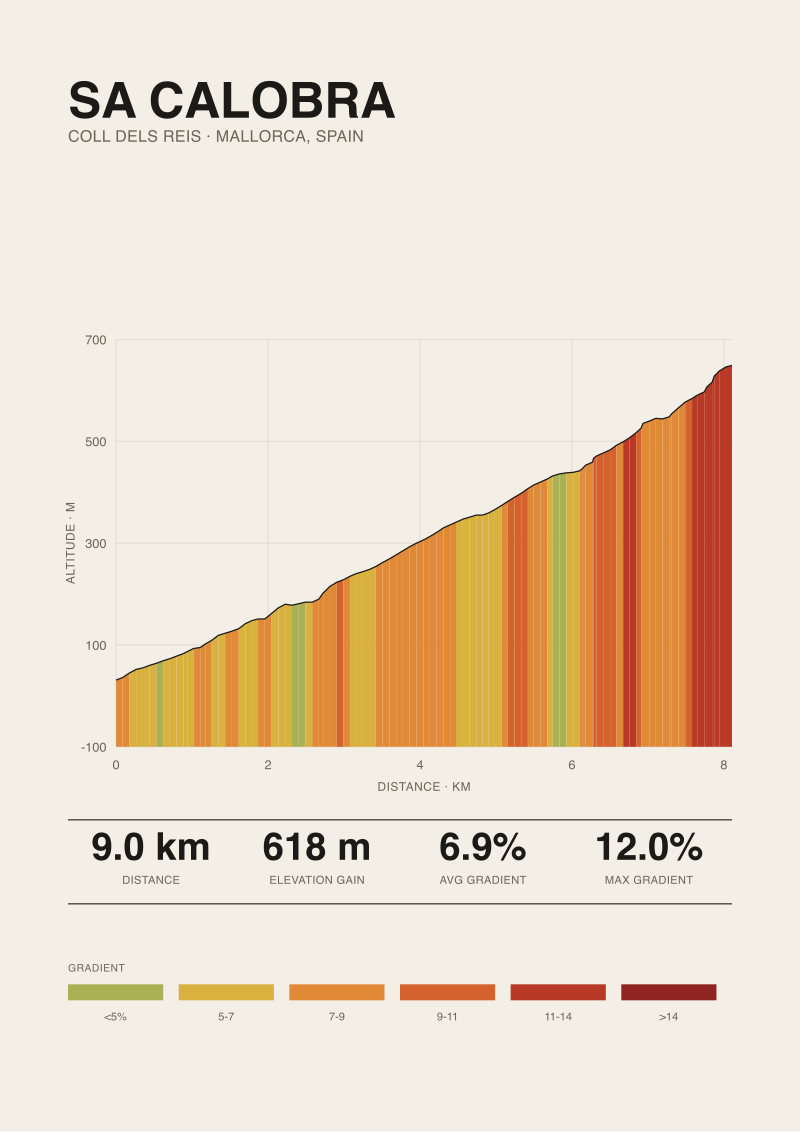
Nine kilometres, 618 metres of gain, 6.9 percent average from sea level at 31 metres to the Coll dels Reis at 649. Those are the measured numbers for Sa Calobra, drawn from OpenTopoData's 30-metre SRTM elevation grid — the road book, per climbfinder.com, cites a 12 percent maximum. Before you commit a morning to it, three questions decide whether the climb rewards you or grinds you. We will ask them in order, route you down a branch on each, and finish with a table that maps every combination to a plan. No folklore, no hairpin poetry — just the profile and what it demands.
Question 1: Are You Riding Sa Calobra as an Out-and-Back or a One-Way Descent?
This is the fork that decides everything else. Sa Calobra is a dead-end road: it drops from the Coll dels Reis to a cove and stops at the sea. There is no loop. You either descend the 9 kilometres, turn around at the port, and climb the same 618 metres back to the pass, or you take a boat from Port de Sa Calobra and skip the return. That single choice reshapes fuelling, pacing, timing, and how much of the day the climb owns.
The out-and-back is the honest ride: descend first, climb second, self-supported. The one-way descent — down the road, boat back to Port de Pollença via Sóller — turns Sa Calobra into a photo run rather than a climb. Both are legitimate. They are not the same day.
If Yes — You Are Doing the Out-and-Back
Treat the descent as a warm-up you will pay for. Nine kilometres losing 618 metres of altitude at 6.9 percent average is fast enough to cool your legs and slow enough to demand attention on the tighter hairpins. Take the descent in your climbing kit, arrive at the port with something to eat and something to drink, and turn around inside 15 minutes — long enough to reset, short enough not to stiffen.
The climb back is the entire point. Nine kilometres at 6.9 percent average puts most amateurs between 45 and 75 minutes of continuous effort — we will drill into that number in Question 2. The published 12 percent maximum lives in the steep ramps around the tie-knot switchback in the lower third, roughly kilometres 3 to 5 from the sea. Save something for those.
If No — You Are Descending Only, Boat Back
This is a defensible choice if you are riding a Mallorca loop and would rather use the climbing budget elsewhere — the Puig Major, the Coll de Sóller, the Femenia. But it is a tourism ride, not a Sa Calobra ride. You have not measured yourself against the profile; you have only seen the road.
If you take this route, book the boat in advance and check the timetable in the morning: the Sóller service runs seasonally and weather-dependent, and missing the last sailing turns a one-way plan into a 9-kilometre climb you had not planned to do — starting late, in whatever light and heat are left. That failure mode is more common than riders expect.
Question 2: Is Your Sustained Threshold Comfortable at 6.9 Percent for 45 to 75 Minutes?
The 6.9 percent average is the number to hold in your head. It is not the hardest gradient on the climb — the published maximum is 12 — but averages tell you the workload, and 6.9 percent for 9 kilometres from sea level is a real hour of climbing. Whether you can hold it steadily is the question that separates a controlled ascent from a compromised one.
There is a simple honesty test. On terrain you know, can you sit at threshold — the effort you could hold for an hour — while the road tilts up at 7 percent? If yes, you will meet Sa Calobra on its own terms. If no, you will meet it slower, and the ramps published at 12 percent will not feel like 12; they will feel like the wall you did not budget for.
If Yes — Threshold Is Steady at 6.9 Percent
Ride the climb at a genuine tempo. From the port at 31 metres to the Coll dels Reis at 649, treat it as a single sustained effort with two small internal moves: hold back through the lower third where the published 12 percent maximum sits, then unwind through the upper half as the road eases toward the average. Riders with steady thresholds tend to overpay early on Sa Calobra because the sea-level start feels neutral and the road looks photogenic. It is not neutral — it is 6.9 percent from metre one.
Gear so that your target cadence at the steepest published gradient still lets you breathe. The 12 percent ramp is short in the profile but decisive in the memory. Sit on it, do not stand for it, and let the road come back to you.
If No — Threshold Is Not Steady at 6.9 Percent
Ride it in three blocks and stop caring about time. Kilometres 1 to 3 at conservative effort — you are just leaving the sea. Kilometres 3 to 6 through the steepest published section, spinning the lightest gear you have, standing only to unweight, not to attack. Kilometres 6 to 9 as recovery-tempo, letting the profile ease back toward the average.
Water matters here more than fitness. A rider under threshold on a 6.9 percent grade in Mallorca sun burns more clock than a rider at threshold, and clock is heat. Two bottles up, one down. Do not skip this. The failure mode on Sa Calobra for riders whose threshold does not match the profile is not the gradient — it is the temperature they meet at kilometre 6 because they took 20 minutes longer than they planned.
 Sa Calobra
The print from this article · from €29.95
View the print →
Sa Calobra
The print from this article · from €29.95
View the print →
Question 3: Are You Arriving Before 9:30 or After?
Time of arrival is not a convenience question. Sa Calobra is a single-lane road inside a national park, and the traffic profile changes sharply through the morning. Coach tours from Port de Pollença and Alcúdia begin queueing at the top of the descent between 9:30 and 10:00. Once they are on the road, the 9 kilometres of hairpins that make the climb photogenic become 9 kilometres of two-way negotiation with vehicles that cannot yield.
The window matters more than the training. A rider who arrives at the Coll dels Reis at 8:15 gets an empty road down and mostly empty road up. A rider who arrives at 10:15 gets a working road in both directions. Both riders are riding Sa Calobra. They are not riding the same climb.
If Before 9:30 — You Get the Real Road
Descend on your own line. Climb without threading between camper vans. The photographs you have seen of Sa Calobra — the tie-knot switchback empty, the hairpin stack unbroken — are early-morning photographs. There is no other version.
Riders staying in Port de Pollença typically need to be rolling by 7:30 in high season, earlier if they want the Coll de Femenia climb en route to the Coll dels Reis. Riders on the Sóller side have a longer approach and rarely make the window without an alarm they will resent. The ride is worth resenting the alarm.
If After 9:30 — You Get the Working Road
This is not a reason to skip Sa Calobra. It is a reason to change the ride. Descend cautiously — assume every hairpin hides an oncoming coach — and treat the climb as a controlled effort in traffic rather than a paced test against the profile. Do not chase a personal time. You cannot ride a personal time on a road you are sharing with a coach that occupies both lanes at the apex.
If you have arrived late by accident — a slow breakfast, a mechanical, a group that did not roll — consider inverting the plan: descend, take the boat, come back another morning. The road will still be 9 kilometres at 6.9 percent tomorrow. It will be a different ride at 7:45 than it is at 10:45.
If Sa Calobra has already earned a place in your season, the studio's profile print of the climb — measured from the same SRTM data quoted at the top of this piece — lives at see the Sa Calobra print. It exists because the profile deserves to be read the way you read a page, not the way you read a postcard.
If You Answered Everything: The Decision Table
Three questions, two answers each, eight combinations. Read the row that matches your answers and take the recommendation as a starting point — not a verdict.
| Q1: Out-and-back? | Q2: Steady at 6.9%? | Q3: Before 9:30? | Recommendation |
|---|---|---|---|
| Yes | Yes | Yes | Ride it as a paced tempo effort — the profile on its terms, on an empty road. |
| Yes | Yes | No | Do the full climb but abandon time targets — ride controlled through shared traffic. |
| Yes | No | Yes | Three-block ride, lightest gearing, two bottles up — clean road buys you the time you need. |
| Yes | No | No | Reschedule. Late arrival plus under-threshold pace on 6.9% Mallorca sun is the compound risk. |
| No | Yes | Yes | Descend cleanly, boat back — but consider whether you are underusing your fitness today. |
| No | Yes | No | Legitimate tourism ride; confirm the boat timetable before you commit to the one-way. |
| No | No | Yes | Descend cautiously, boat back — the safest use of Sa Calobra without the climb budget. |
| No | No | No | Skip today. Book an earlier morning and decide between climb and boat with a clear head. |
The table treats Sa Calobra as a decision, not a rite. The road is 9 kilometres and 618 metres either way; what changes is what you bring to it and what conditions you meet. Every row above is a valid ride for the rider it fits. The failure is not on the road — it is in the row you did not read before you left the hotel.
FAQ
How long does climbing Sa Calobra actually take?
Nine kilometres at 6.9 percent average puts most amateur riders between 45 and 75 minutes of continuous effort from the port at 31 metres to the Coll dels Reis at 649. Trained riders on threshold pace tend toward the lower end. Riders below threshold on that gradient, especially in heat, drift toward the upper end and sometimes past it. Neither figure includes descent time or the turnaround at the port.
What is the maximum gradient on Sa Calobra?
The published maximum, per climbfinder.com's road-book figure, is 12 percent. That number sits in the steeper ramps of the lower third of the climb — roughly the tie-knot switchback area — and does not represent the sustained load. Our own profile, measured from OpenTopoData's 30-metre SRTM grid, produces the 6.9 percent average and the 618 metres of gain; peak-gradient figures are more sensitive to elevation data source than averages, so we cite the published 12 rather than a satellite-derived number.
Is Sa Calobra harder than it looks on paper?
On paper: 9 kilometres, 6.9 percent, 618 metres of gain. That is a mid-length, mid-gradient climb by Alpine standards. What is not on paper is that it starts at sea level in Mallorca sun, is entirely exposed, and finishes at a pass shared with morning coach traffic. The profile is honest — the day around the profile is what catches riders out.
Do I need to ride down Sa Calobra before I climb it?
Only if you are doing the out-and-back. The road is a dead-end at the sea, so any rider climbing from the port has descended first. The alternative — the one-way descent with a boat back from Port de Sa Calobra to Sóller — skips the climb entirely. Neither format is more legitimate than the other, but they are different rides and should be planned as such.
When should I start the ride to avoid traffic?
Coach traffic from Port de Pollença and Alcúdia typically begins arriving at the Coll dels Reis between 9:30 and 10:00 in high season. Riders who want an empty descent and a mostly empty climb aim to be at the top of the descent by 8:30 at the latest. From Port de Pollença that generally means rolling out by 7:30 or earlier if the Coll de Femenia is included on the approach.
What gearing should I run on Sa Calobra?
Gearing is a personal calculation, not a universal one, but the principle is straightforward: pick a bottom gear that lets you hold a comfortable cadence at the published 12 percent maximum without standing. Riders who match the 6.9 percent average at threshold generally have enough range on a compact plus a 30 or 32-tooth cassette. Riders below that threshold benefit from wider cassettes — the point is to keep breathing through the steep ramps, not to prove a gear choice.
Is there water or food on the climb?
Not on the road itself between the sea and the Coll dels Reis. There are cafés at Port de Sa Calobra at the bottom and options near the pass, but the 9-kilometre climb is unsupported. Two bottles on the bike for the ascent is the working minimum in summer conditions; one is enough in cooler months for riders confident of their pace. Plan the food you will eat at the port before you turn around.
Can I ride Sa Calobra in winter?
Yes, and many riders prefer it. Winter Mallorca means cooler temperatures, less coach traffic, and cleaner light on the hairpins. The trade-off is weather variability — the road is exposed and the descent is fast enough that a cold day at the pass becomes a very cold day at the sea. Check the forecast on the morning, not the evening before, and pack a wind layer you can descend in without regret.
From the collection
New climbs and 10% off your first print.
One email now with your code. No noise after.