The Stelvio is the harder climb. So is the Gavia. Both statements are defensible on the numbers, and the choice between them says more about how a rider defines hardness than about the mountains themselves.
We drew both profiles from the same source — OpenTopoData's SRTM 30-metre elevation model — and measured them the same way, from the base of each canonical ascent to the summit sign. Prato allo Stelvio to the Passo dello Stelvio. Ponte di Legno to the Passo di Gavia. Same instrument, same method, two answers that refuse to converge into a single verdict.
What follows is the honest version of that comparison. Not a winner. A breakdown of what each climb costs you, in the specific currencies mountains charge — kilometres, gradient, altitude, and the moment on the road where you notice you are no longer at sea level.
The Stelvio Is the Longer, Taller Climb, and Length Is a Kind of Hard
From Prato allo Stelvio, the Stelvio runs 25.04 km and lifts you 1,840 metres, from a start elevation of 908 m to a summit of 2,748 m. That is the entire climb, measured. There is no reasonable way to make it smaller.
The Gavia from Ponte di Legno is 18.42 km with 1,366 metres of gain. Six and a half kilometres shorter. 474 metres less climbing. The Stelvio is roughly 36 percent more climb by any integrated measure — length times average gradient, total energy lifted per kilogram of body mass, minutes above threshold if you climb both at the same power. Bigger by every yardstick that measures dose.
Length matters because it removes the option to hurt for a while and then recover. On a 45-minute climb, a strong rider can hold something painful the whole way. On the Stelvio, even at a modest pace, you are looking at 1h30 to 2h30 of continuous work. The 48 hairpins on the Prato side are not decoration — they are the physical form of the fact that this road had to climb 1,840 metres and used every one of them.
The Stelvio also finishes higher. 2,748 metres versus the Gavia's 2,610. That final 138 metres of altitude matters less than the fact that the whole top half of the Stelvio happens in air thin enough to be uncomfortable, and the last four kilometres in air thin enough to be a variable in your power output, not just an experience.
If harder means larger dose of sustained effort, this argument is settled. The Stelvio is objectively the bigger climb. The kilometres, the metres, the time, the total joules of gravitational work — none of them are close.
The Gavia Is the Steeper Climb, and Steep at Altitude Is a Different Kind of Hard
The averages hide the argument. The Stelvio averages 7.3 percent. The Gavia averages 7.4 percent. On paper, they are twins. In reality, that shared number describes two profiles that behave nothing alike.
The Gavia's published maximum gradient, according to climbfinder's Ponte di Legno road-book figure, is 16 percent. The Stelvio's, from the same source on the Prato side, is 14 percent. Two percentage points sounds like nothing until you are on the pitch, at which point it becomes the entire ride. A 16 percent ramp above 2,000 m is a different physiological event than a 14 percent ramp at 1,600 m — and the Gavia has more of both.
The other number that decides this argument is the one nobody quotes: start elevation. The Stelvio begins at 908 m. The Gavia begins at 1,244 m. By the time you turn onto the Gavia road, you are already higher than most of the climbs in the Alps ever finish. Half of the Gavia is spent at altitudes where the Stelvio has not yet reached its own halfway point.
That has a physiological consequence you can feel and roughly quantify. Air density at 1,244 m is about 3.5 percent lower than at 908 m — small in isolation, meaningful compounded over 18 kilometres of climbing that never drops back below it. From the start of the Gavia to the summit, you spend the entire ride at altitudes where the Stelvio spends only its final third.
Then there is the road itself. The Gavia's narrowness, the single-lane sections, the lack of protection above the treeline — none of that shows up in a gradient chart. But the mental cost of pedalling a 12 percent section on a road that does not give you room to weave is real, and it is not something the Stelvio, with its wider engineered switchbacks, asks of you in the same way.
If harder means peak intensity delivered in an environment that punishes you for being there, the Gavia has the stronger case. Not by a landslide, but clearly, and on the metrics that most closely predict which climb ends with you off the bike walking.
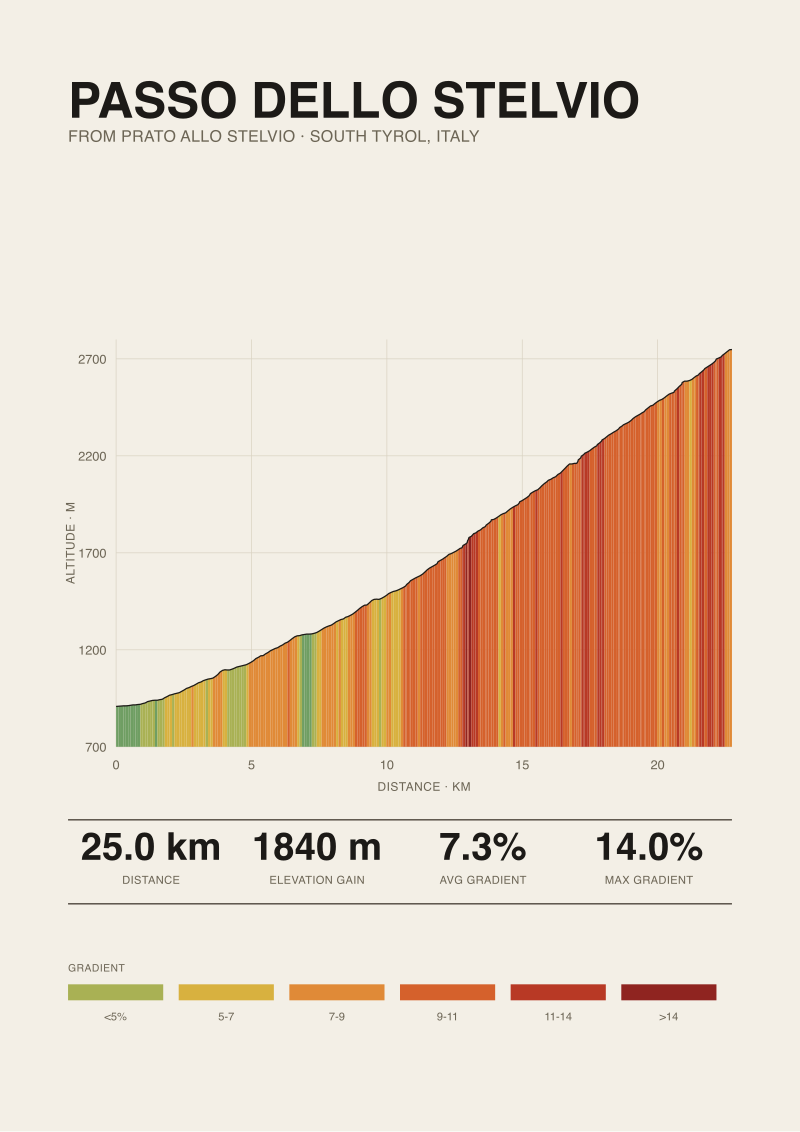 Passo dello Stelvio
The print from this article · from €29.95
View the print →
Passo dello Stelvio
The print from this article · from €29.95
View the print →
The Word "Harder" Is Doing Too Much Work in This Question
This is where the comparison stops being clean. "Harder" is a compound of at least four things that these two climbs allocate differently: dose, peak intensity, altitude, and environmental exposure. The Stelvio wins on dose. The Gavia wins on peak intensity and altitude. Exposure depends on the day and refuses to be a number.
The honest answer to which climb is harder is: harder for whom, on what day, using what definition. A time-trialist who lives on threshold and can defend a steady 250 watts for two hours will find the Stelvio the more demanding day, because it asks for that steady output uninterrupted. A rider whose ceiling is spikier — strong for ten minutes, fragile for two hours — will find the Gavia the harder ride, because the 16 percent ramps ask for something the Stelvio never quite does.
The one comparison that always tilts to the Gavia is weather. Ponte di Legno to the pass runs through terrain that produces its own weather system, and the top is genuinely alpine in a way that Stelvio's top, for all its altitude, isn't quite. The 1988 Giro stage that broke on the Gavia in a June snowstorm is not a random anecdote — it is a data point about what this climb can do to a rider even when the profile is unchanged.
We should also name the limit of our own data. Our profiles are drawn from a satellite elevation model with 30-metre resolution. That means our maximum gradient figures — the ones we can measure directly from the surface — smooth out short ramps that a rider absolutely notices. The 16 percent figure on the Gavia comes from a road-book source, not from our own measurement, and the same is true of the Stelvio's 14. On the very question of which climb has the meaner steep sections, we are quoting other people's numbers rather than our own. A rider comparing these two by feel will always weight the steep pitches more than a satellite-drawn average admits.
None of this settles the argument. It just shows that the argument has been fought, for decades, on ambiguous ground — because two climbs designed by geology to hurt in different ways cannot be reduced to one number.
This piece started as an attempt to answer which climb is harder and turned into an argument about what the question is actually asking. The mountains don't care what you call them. But if you are going to ride both — and if you have prints of their profiles on your wall as a way of holding onto them between trips, the reason we make the Stelvio and Gavia climb prints in the first place — the more useful question is the one this comparison hands you next: on the day you ride each of them, which of your own limits are you going to meet? That is not a question about the roads. It is a question about you, and it is the one worth asking before you plan the trip.
FAQ
How much longer is the Stelvio than the Gavia from their canonical starts?
Measured from Prato allo Stelvio to the pass, the Stelvio is 25.04 km. The Gavia from Ponte di Legno to the pass is 18.42 km. That is a difference of 6.62 km, or roughly 36 percent more distance on the Stelvio. The Stelvio also gains 474 more vertical metres — 1,840 versus 1,366 — so the total climbing dose is meaningfully larger on the Stelvio, not just marginally.
Which climb has the steeper average gradient, and does the difference matter?
The averages are almost identical. The Gavia averages 7.4 percent, the Stelvio 7.3 percent, both measured from our OpenTopoData SRTM profiles. That 0.1 point gap is inside the noise of any real-world variable and should be ignored. What matters is that the shared average hides two very different profile shapes: the Stelvio's gradient is more uniform, the Gavia's more spiky. Two climbs can share an average and share very little else.
What are the published maximum gradients on each climb?
Both figures we cite come from climbfinder's road-book data, not from our own elevation measurements. The Gavia from Ponte di Legno is listed at 16 percent maximum. The Stelvio from Prato is listed at 14 percent. Our SRTM elevation model at 30-metre resolution cannot resolve short pitches accurately enough to publish our own maximum figure, which is why we lean on the road-book source for that specific number.
How much does the Gavia's higher start elevation change the ride?
The Gavia begins at 1,244 m, the Stelvio at 908 m. That 336-metre head start means the Gavia rider spends the entire climb at altitudes the Stelvio does not reach until roughly its halfway point. Air density at Gavia's base is about 3.5 percent lower than at Stelvio's base — small on paper, accumulated over 18 km of climbing that never drops back below it. It also means the summit-metre gap (2,748 vs 2,610) understates how much of each ride happens in thin air.
Where do your elevation numbers come from, and why might they differ from road-book figures?
Every measurement we publish for length, elevation gain, average gradient, start elevation and summit elevation comes from OpenTopoData's SRTM 30-metre satellite elevation model, run over the canonical route between named points. Road-book figures — the sort printed on official signs or aggregated by climbfinder — are typically surveyed or municipality-published. The two sources can disagree by a few metres of elevation gain or a tenth of a percent of average gradient. Neither is wrong; they are measuring the same road with different instruments.
If a rider could only do one of these climbs, which one delivers the harder day?
It depends on what the rider fears more. If the fear is duration — the long slow grind where power has to hold for two hours — the Stelvio is the harder day, because it will not let you off. If the fear is peak gradient at altitude, and the specific sensation of a 12-to-16 percent ramp above 2,000 m on a narrow road with no shelter, the Gavia is the harder day. The two mountains are not asking the same question, which is why the argument between them has never resolved.
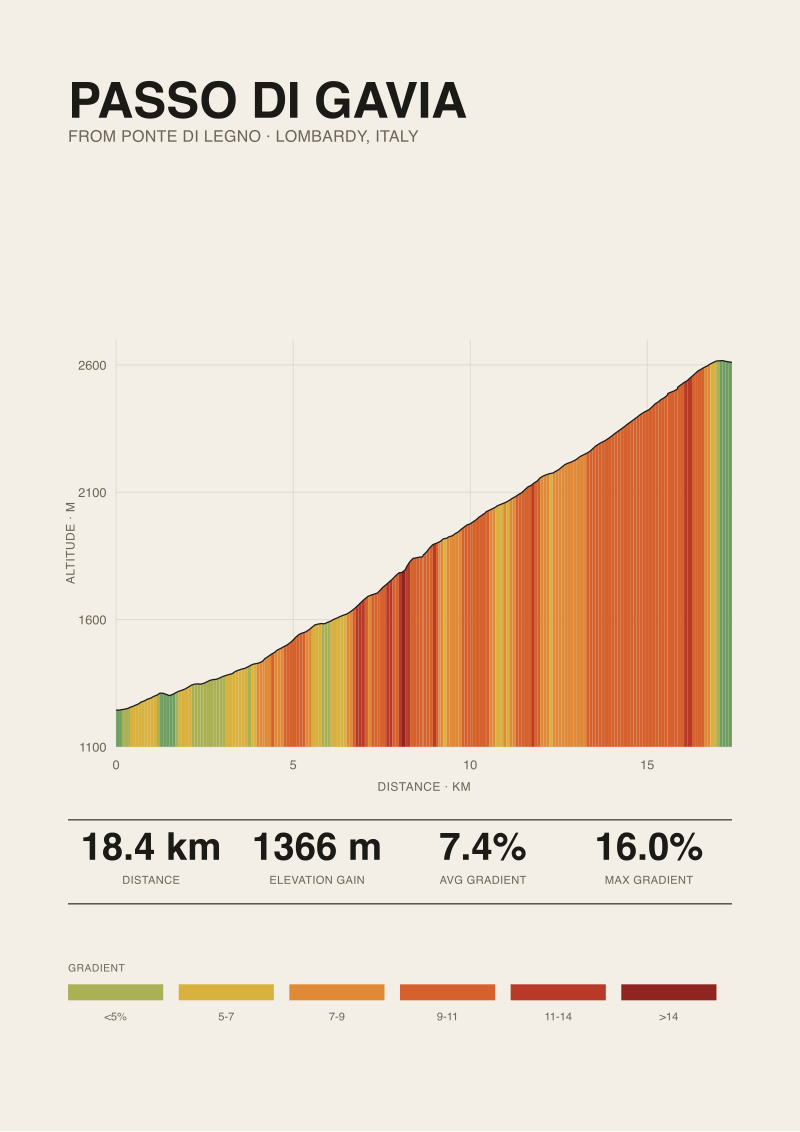 Passo di Gavia
The print from this article · from €29.95
View the print →
Passo di Gavia
The print from this article · from €29.95
View the print →
From the collection
New climbs and 10% off your first print.
One email now with your code. No noise after.