On 5 June 1988 the Giro d'Italia sent a full peloton over Passo di Gavia into a blizzard, at a summit our elevation data measures at 2,610 metres above sea level. The race jury had the forecast and it started the stage anyway. This is not a story about grit. It is a story about a preventable cold-injury event that the sport has since laundered into folklore, and the profile of the mountain explains almost all of it.
TL;DR
- A 2,610 m summit in early June, wet and below freezing.
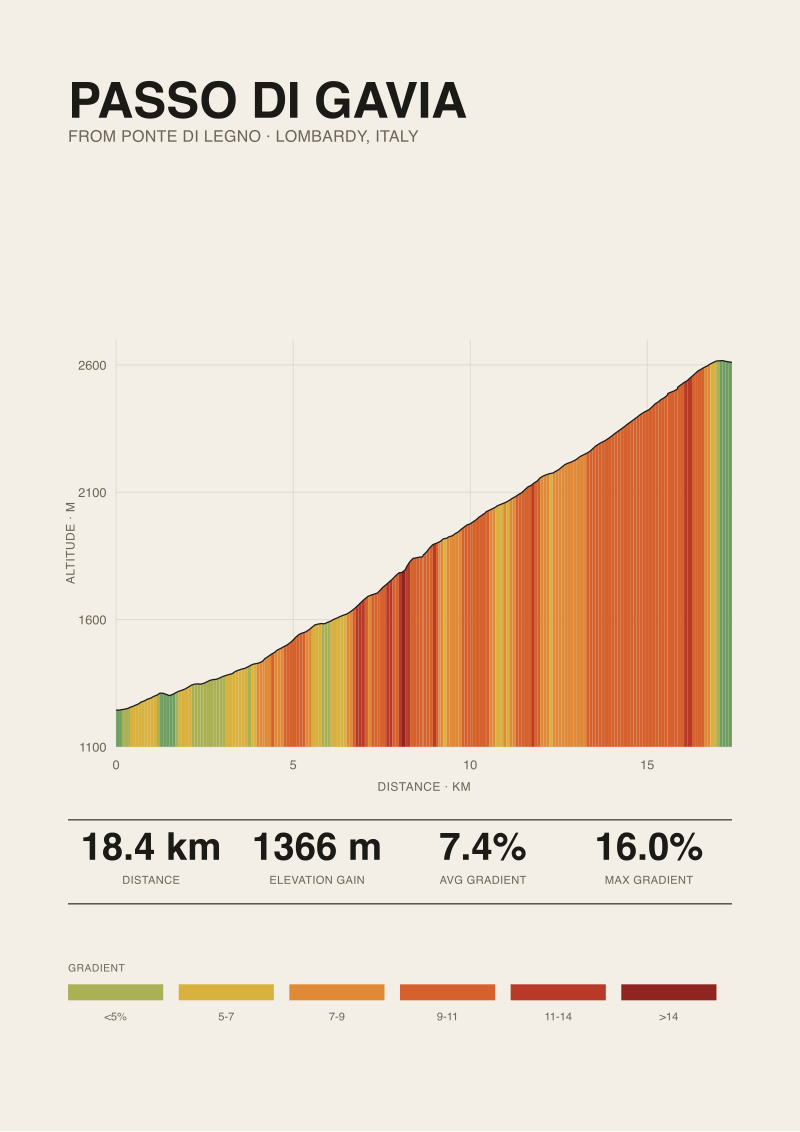
- An 18.42 km climb averaging 7.4% with a published 16% ramp.
- A 20+ km descent to Bormio with no shelter after the col.
Red Flag #1: A 2,610-Metre Summit in Early June
The Gavia summit from Ponte di Legno sits at 2,610 metres by our SRTM 30 m readout. In the Alps, that altitude is above the reliable early-season freezing line. Above 2,500 m the standard-atmosphere temperature is roughly 15 °C lower than the valley floor.
On 5 June 1988, the valleys around Bormio and Ponte di Legno were sitting in single-digit Celsius rain. Do the vertical arithmetic and the col surface is at or below zero, with precipitation. That was not a surprise emerging mid-stage. That was a calculable, foreseeable state before the flag dropped.
The organiser's decision, in effect, was to route a bike race across the freezing line at its most exposed point in the country. Not a training camp. A grand tour stage with GC riders in short-sleeve jerseys, timed for maximum television.
Red Flag #2: The Ponte di Legno Start Was Already at 1,244 m
Ascent-side, Gavia is misleading in its raw length. The climb from Ponte di Legno is 18.42 km with 1,366 m of gain. But the base of that climb already sits at 1,244 metres. The peloton did not climb from a warm valley to a cold pass. It rode from a cool foot to a very cold roof, with only 1,366 vertical metres of gradient work between the two.
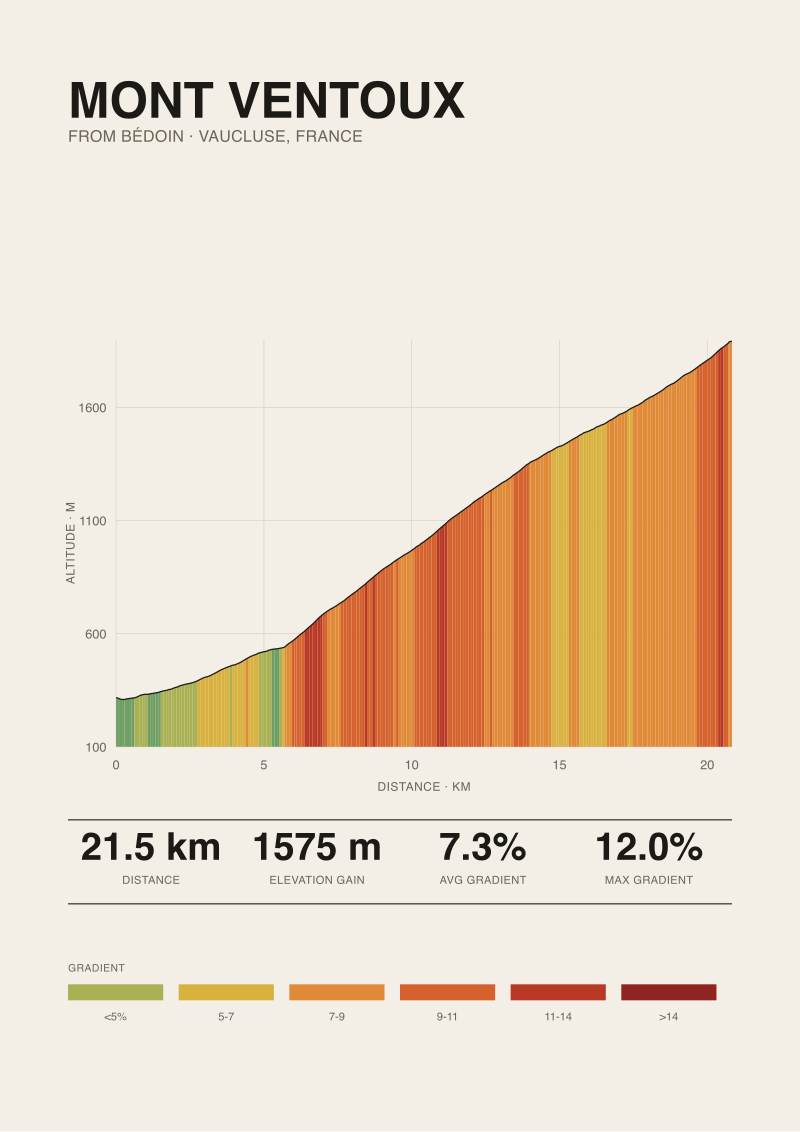
That matters because there is no descent-and-recovery buffer between valleys and the danger altitude. Compare Mont Ventoux from Bédoin, which begins at 317 m and finishes at 1,892 m: a rider on Ventoux spends most of the climb below altitudes where June exposure kills. On Gavia in 1988, the rider was above 1,500 m within twenty minutes of the stage's decisive climb starting.
 Passo di Gavia
The print from this article · from €29.95
View the print →
Passo di Gavia
The print from this article · from €29.95
View the print →
Red Flag #3: The 16% Ramp Sits Where You Cannot Afford It
The published maximum gradient on Gavia from Ponte di Legno is 16% (climbfinder.com). Our average across the ascent is 7.4%, which means those steep ramps are compressed into a small section of the climb where cadence collapses and pace drops.
At 16%, on a snowed-on road surface, at 2,400 m of altitude, a rider is producing near-threshold power at 6–8 km/h. That combination — high effort, low speed, wet clothing, thin air — is the exact envelope where core temperature falls fastest despite the workload.
The classic assumption that climbing keeps you warm assumes forward speed generating airflow you can control. At single-digit km/h in freezing precipitation, riders are effectively standing still in a wind tunnel of their own body heat loss.
Red Flag #4: The Real Problem Was the Descent, Not the Climb
Every account of the 1988 stage focuses on the summit. The profile says the summit was the least of the medical problem. From 2,610 m, the road drops toward Bormio via Santa Caterina Valfurva — a descent of over 20 km with almost no built shelter and no valley warming until below 1,500 m.
Riders who had been generating 300+ watts up the last kilometres of Gavia crossed the col wet, then had to lose 1,300 vertical metres at speeds of 40–70 km/h without producing meaningful heat. Wind-chill at those speeds and altitudes drops effective temperature well below air temperature.
The 16% ramp is what the highlights show. The unbroken 20 km freezing descent is what actually caused the hypothermia cases the race doctors treated in Bormio.
Red Flag #5: The Kit Provisioning Failure
We limit ourselves to what is broadly established about the stage: several riders started or crested Gavia in short-sleeve jerseys and light gloves, and it was the neutral-service musettes at the summit — plastic bags, newspaper, whatever was to hand — that kept some of them functional on the way down.
The provisioning was field-improvised, not planned. That is a structural comment, not a moral one. If a race organiser is going to send a peloton over 2,600 m in wet cold, the correct baseline is mandatory warm kit at the last feed before the base of the climb, and staffed warming stations at the summit. In 1988 neither existed on Gavia.
The bag-of-newspaper image is the folklore. The absence of protocol is the actual story.
Red Flag #6: There Was No Neutralisation Threshold
Modern grand tours operate, at least informally, with an "extreme weather protocol": a set of conditions under which a stage is shortened, rerouted, or neutralised. That protocol exists in 2026 precisely because of stages like this one.
In 1988, the jury had no publicly documented altitude/temperature threshold that would trigger a shortening. The decision to send the peloton over Gavia was discretionary and, by the profile evidence, indefensible. A summit at 2,610 m with precipitation and forecast temperatures at or below zero should have been an automatic reroute over a lower col or a short-stop finish before the climb.
The absence of the threshold is what should be remembered. The riders' response to that absence — improvised, brave, nearly catastrophic — is a downstream fact.
Red Flag #7: The Overall Standings Were the Real Reason
Gavia's summit was the penultimate climb of the stage that saw Andy Hampsten take the maglia rosa and effectively decide the 1988 Giro. That outcome is why the stage is remembered as canonical rather than as a scandal.
Post-hoc, that framing rewards the jury's decision to run the stage. A GC-decisive stage becomes evidence that the mountain "worked". This is the wrong direction of causation. The mountain was going to decide the Giro whether ridden that day or two days later at a rescheduled window. What the specific date and weather added was medical risk, not sporting content.
Every subsequent organiser who has looked at a forecast and thought "the crowd is already there, the TV is booked, we run it" is drawing from the 1988 precedent. That is the flag.
Red Flag #8: The Precedent Never Went Away
Grand tours have shortened or neutralised high-altitude stages several times since 1988, and each time the reference point in the pressroom is the 1988 Gavia stage — either as the reason to neutralise, or as the reason not to. The mountain became a rhetorical instrument.
The problem with treating one stage as folklore is that it obscures the underlying arithmetic. Gavia from Ponte di Legno is 18.42 km at 7.4%, topping out at 2,610 m. Those numbers do not change with the calendar. In early June, they describe a climb whose upper third is regularly at the freezing line. In late July, they describe one of the great Alpine climbs of a summer racing season. The number that decides which of those it is on a given day is the forecast, not the folklore.
The Verdict
The 1988 Gavia stage is remembered as heroic. Read against the profile, it was an organisational failure with a heroic response. The mountain — 18.42 km, 1,366 metres of gain, 2,610 metres of summit, a 16% published ramp — did exactly what its numbers predicted. The blizzard, likewise, did what a June system at 2,600 m does. What went wrong was the decision to run the stage into that combination without a neutralisation threshold or a kit protocol.
The correct memorial is not "great stages are hard". The correct memorial is that the sport now has extreme-weather protocols because of what nearly happened that afternoon between the Ponte di Legno base and the Bormio finish. We measured Gavia's profile before drawing it, and if the print is on your wall — ours lives at /shop/ — the story it carries is not about weather. It is about the shape of the road and the day the road stopped being negotiable.
FAQ
How long is the Gavia climb from Ponte di Legno?
From Ponte di Legno the ascent measures 18.42 km with 1,366 metres of elevation gain, averaging 7.4% across its full length. The base sits at 1,244 metres and the summit at 2,610 metres, per our OpenTopoData SRTM 30 m readout. Published road-book figures put the maximum gradient at 16% on the Ponte di Legno approach (climbfinder.com). The average number is misleading in isolation because the gradient is concentrated in ramps rather than distributed evenly.
What was the actual date of the 1988 Giro Gavia stage?
The stage in question ran on 5 June 1988, during that year's Giro d'Italia. The finish was in Bormio, with Gavia serving as the decisive climb before the descent to the line. Andy Hampsten took the overall race lead on the day; the stage win went to Erik Breukink. These outcomes are broadly established public record. The specific medical figures — how many riders were treated for hypothermia, exact core temperatures — vary between accounts and we prefer to describe the conditions rather than cite disputed numbers.
Was the 1988 stage the coldest ever run at a grand tour?
We would not claim that without measured summit-temperature data from every comparable stage, and no complete comparative dataset exists. What we can say from the profile is that a 2,610 m summit in the first week of June, with precipitation at the col, is a foreseeable freezing-line event. Later grand tour stages have equalled or exceeded the altitude but under different atmospheric conditions. The 1988 stage is exceptional less for absolute temperature than for the decision to run it into those conditions without a neutralisation protocol.
How does Gavia compare to Stelvio for exposure at the summit?
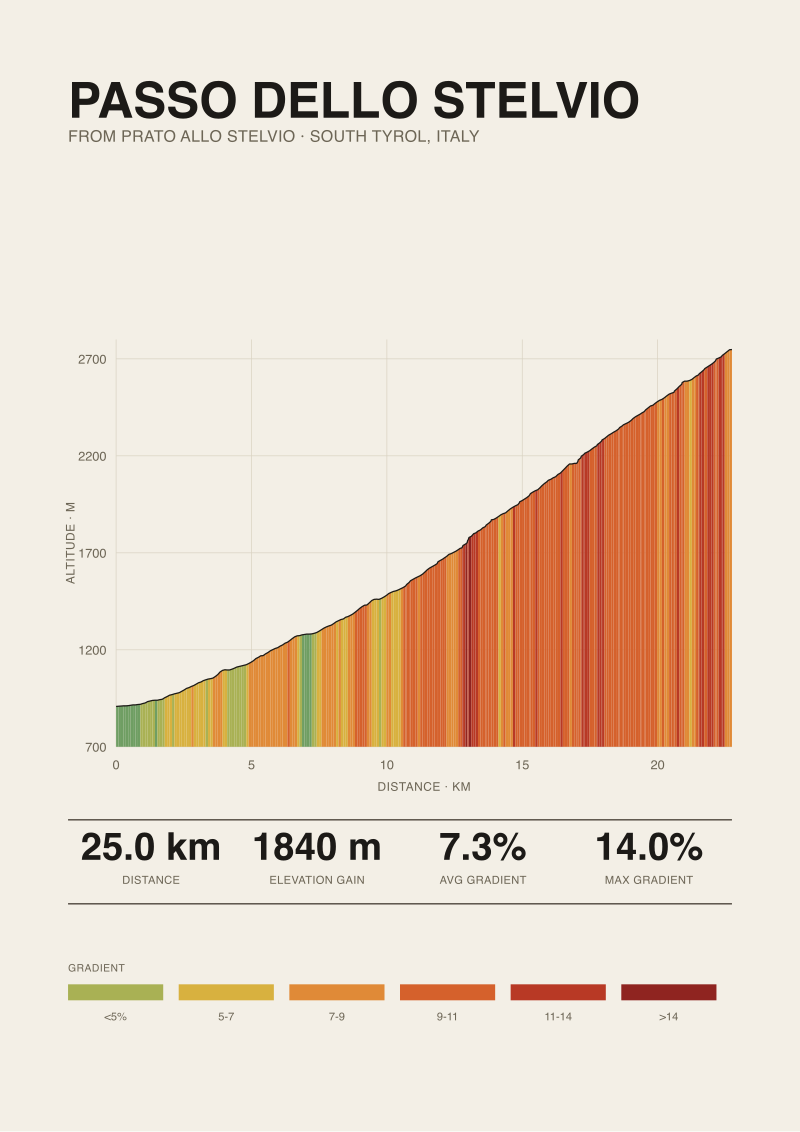
The Passo dello Stelvio from Prato allo Stelvio summits at 2,748 metres, 138 metres higher than Gavia, across 25.04 km at 7.3% average. On paper Stelvio is the more exposed mountain. In practice, the difference in early-season risk is small: both cols sit well above the freezing line and both have long descents into deep valleys with no meaningful shelter until the road drops below 1,500 metres. If a grand tour is running a June date across either, the protocol should be the same.
Why does the 1988 Gavia stage still get referenced today?
Because it sits at the intersection of a decisive GC outcome and a near-catastrophic medical situation, and the sport has never fully resolved which of those two things is the primary lesson. Race organisers cite it when defending decisions to run high-altitude stages in marginal weather. Rider representatives cite it when arguing for firmer neutralisation thresholds. The 2,610 m summit and the 16% published ramp do not care which side wins the argument — they set the physical conditions that any future decision has to reckon with.
 Passo dello Stelvio
The print from this article · from €29.95
View the print →
Passo dello Stelvio
The print from this article · from €29.95
View the print →
From the collection
New climbs and 10% off your first print.
One email now with your code. No noise after.