Of the four grand-tour classics we've measured from Prato allo Stelvio, Bédoin, Luz-Saint-Sauveur and Ponte di Legno, the highest published maximum gradient is sixteen percent. That's the Gavia, and only for a stretch you can bounce over in a couple of minutes. The other three cap out at fourteen or twelve. Not one of them touches twenty.
We say this because "what gear ratio for twenty percent gradient climbs" is a query that arrives with a hidden assumption: that the reader's target climb actually goes there. Sometimes it does — the Mortirolo, the Angliru, the Zoncolan are famous for a reason. But most of the time, the twenty-percent figure in the reader's head is a road-book anecdote misremembered, or a Strava segment fingerprint on a fifty-metre pitch, or a friend's summit story that grew in the retelling. It depends. Let us walk through three scenarios — three hypothetical riders, three real climbs from our profile library — and see where the gearing question actually lives.
Scenario 1: The Ventoux Preparer
Picture a rider training for Mont Ventoux from Bédoin. Not a professional. A committed amateur who rides four times a week, does one long weekend ride, and has picked Ventoux as the summer trip because it's iconic and the flight to Marseille is cheap. She's been in cycling forums. She's read that "you need at least a 34x32" and that "some riders bring a 32x32." She's asked about twenty-percent gearing.
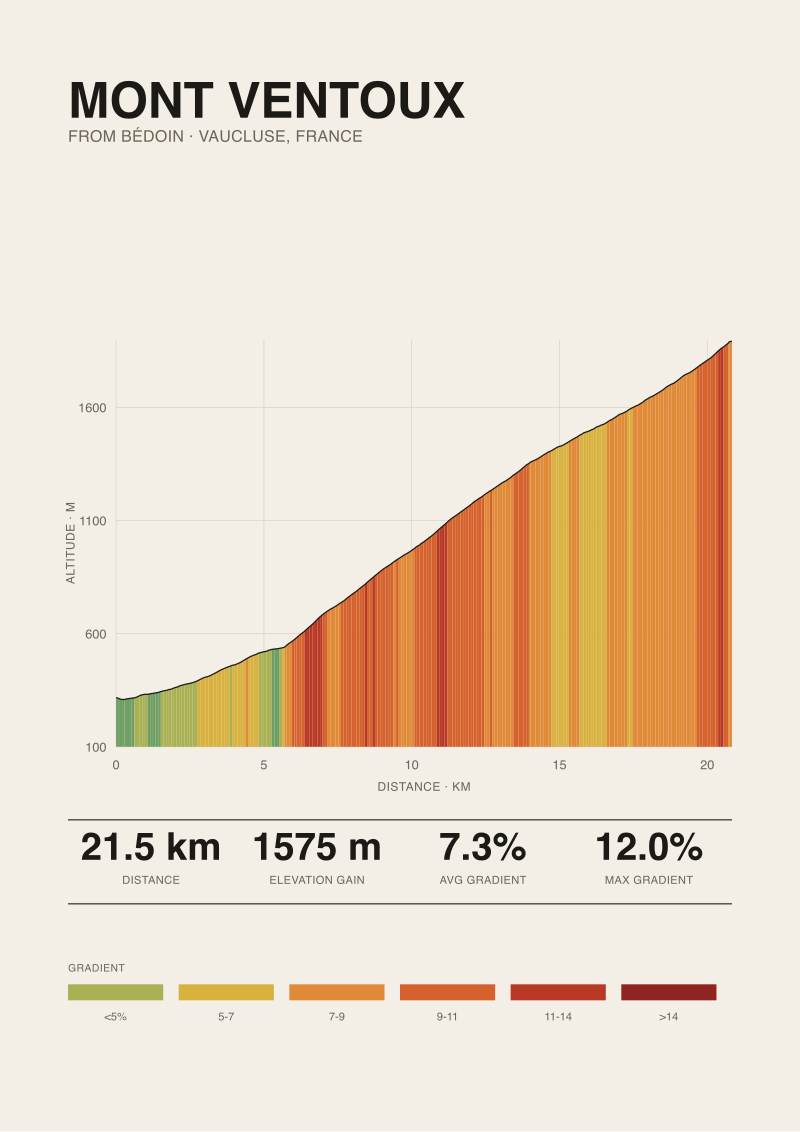
Bédoin's profile, measured from OpenTopoData SRTM 30m elevation data, is 21.51 km with 1,575 metres of gain, averaging 7.3%. The published maximum gradient is 12%. That number comes from climbfinder.com; it corresponds to the steepest section in the forest, before Chalet Reynard. Twelve percent, not twenty.
The gearing decision is not really about the 12% kicker. It's about grinding 21 kilometres at an average that never lets up. A rider on 34x28 pushing around 220 watts sustains roughly 11 km/h on a 7.3% grade — call it two hours to the top. That's two hours at a cadence that will hover in the 60-70 rpm range on the steeper pitches. If she can hold that, the gear is fine. If she can't, the gear is fine for the average and wrong for her legs, which is a different problem than "the climb has a 20% wall."
The upgrade to 34x32 buys her about a 10-rpm cadence increase at the same wattage on the steepest pitches. That is real, and it is what she should buy. What she does not need to buy is a gravel-bike 42-tooth cassette or a mountain-bike derailleur for a climb whose maximum is twelve. The problem she is solving is duration at 7-9%, not survival at 20%.
The distinction matters because the market for "twenty-percent gearing" pushes riders toward setups that are worse everywhere else on the climb. A 30x50 gear gives you nothing on the tempo pitches after Chalet Reynard, and it gives you nothing when the average is what's actually breaking you. She should buy the 32-cassette, ride the average, and stop reading forum threads about pitches her climb does not have.
Scenario 2: The Stelvio Rider
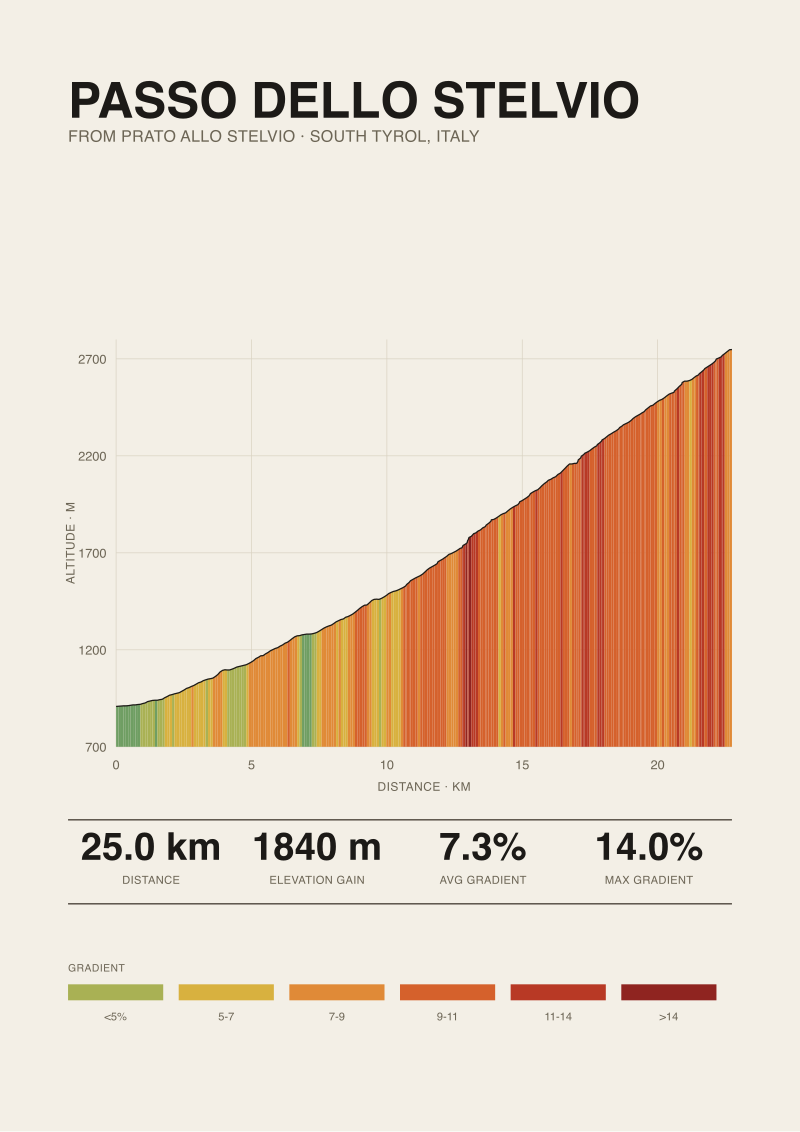
Imagine a rider planning the Stelvio from Prato allo Stelvio. He rides in the Dolomites twice a year, is comfortable on 34x30, and has done Ventoux without a mechanical or a walk. Twenty-five kilometres from Prato at 7.3% average, 1,840 metres of gain, summit at 2,748 metres. Published maximum: 14%.
Fourteen, not twenty. The gearing question here is not the 14% ramp — he has survived 12% on Ventoux and 14% is one cog different from that. The question is the summit elevation. At 2,748 metres, air density has dropped roughly 20% from sea level, and functional power at that altitude, for a rider who lives near it, is around 10% below his valley numbers. For a rider who flew in from Amsterdam three days ago, it is worse.
Do the arithmetic. Twenty-five kilometres at 7.3% would take him around two hours and fifteen minutes at his usual valley power. On the Stelvio, above 2,000m for the last hour of the climb, the same effort will feel like an 8% slope while producing 90% of the wattage. Effectively, from the treeline up, he is climbing something that gears out closer to 8.5% for the last 800 metres of gain.
The upgrade to 34x32 or 34x34 is not vanity. It is the altitude correction. It gives him a cadence cushion he can use to pace the final hairpins without cracking. The 14% kicker near Trafoi is annoying but brief. The 25th kilometre at thin air is what the compact cassette actually solves.
None of this is about twenty percent. Nobody has ever climbed the Stelvio from Prato and complained that a 20-tooth rear ring wasn't low enough. The complaint is about the last forty-five minutes, at altitude, when the average gradient hasn't changed but the rider has.
 Passo dello Stelvio
The print from this article · from €29.95
View the print →
Passo dello Stelvio
The print from this article · from €29.95
View the print →
Scenario 3: The Gavia Attacker
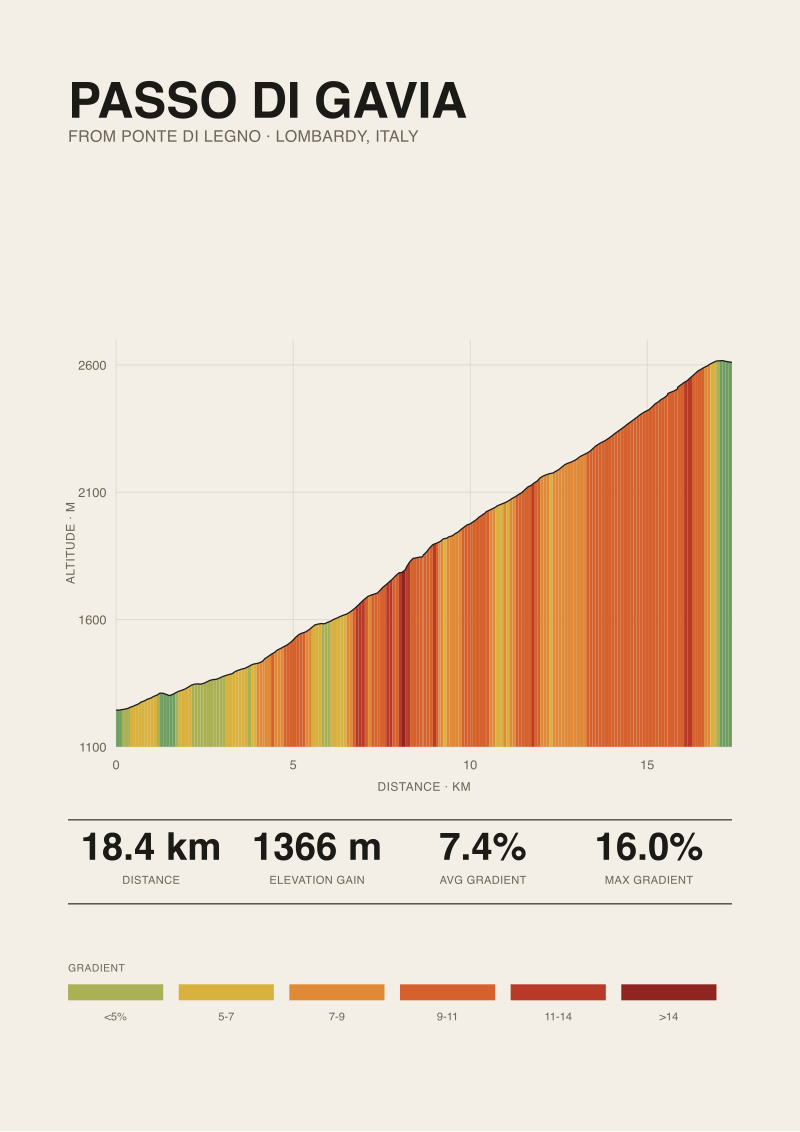
Now consider a rider whose target is the Gavia from Ponte di Legno. She has done Stelvio last year, she wants a climb with a real edge, and she has read that the Gavia is 16% at its steepest. Our measurements confirm the published number: 16% max from Ponte di Legno, per climbfinder.com. Length 18.42 km, gain 1,366 metres, average 7.4%, summit 2,610 metres.
Sixteen is not twenty. But it is closer to twenty than anything we've measured on the other three, and this scenario is where the query starts to make sense. On a 16% pitch, a rider at 220 watts on 34x30 pushes around 40 rpm. Forty rpm is not spinning; it is grinding, and grinding at 16% for even 300 metres is a different physiological event than sustaining 8% for an hour.
Here the argument for 34x32 or 34x34 is not the average, and it is not altitude, though altitude is present. It is the 16% section itself. A cassette that lifts her from 40 rpm to 50 rpm on that pitch is worth more than the same jump would be on Ventoux, because 50 rpm at 16% is the difference between finishing the pitch on the bike and finishing it on foot.
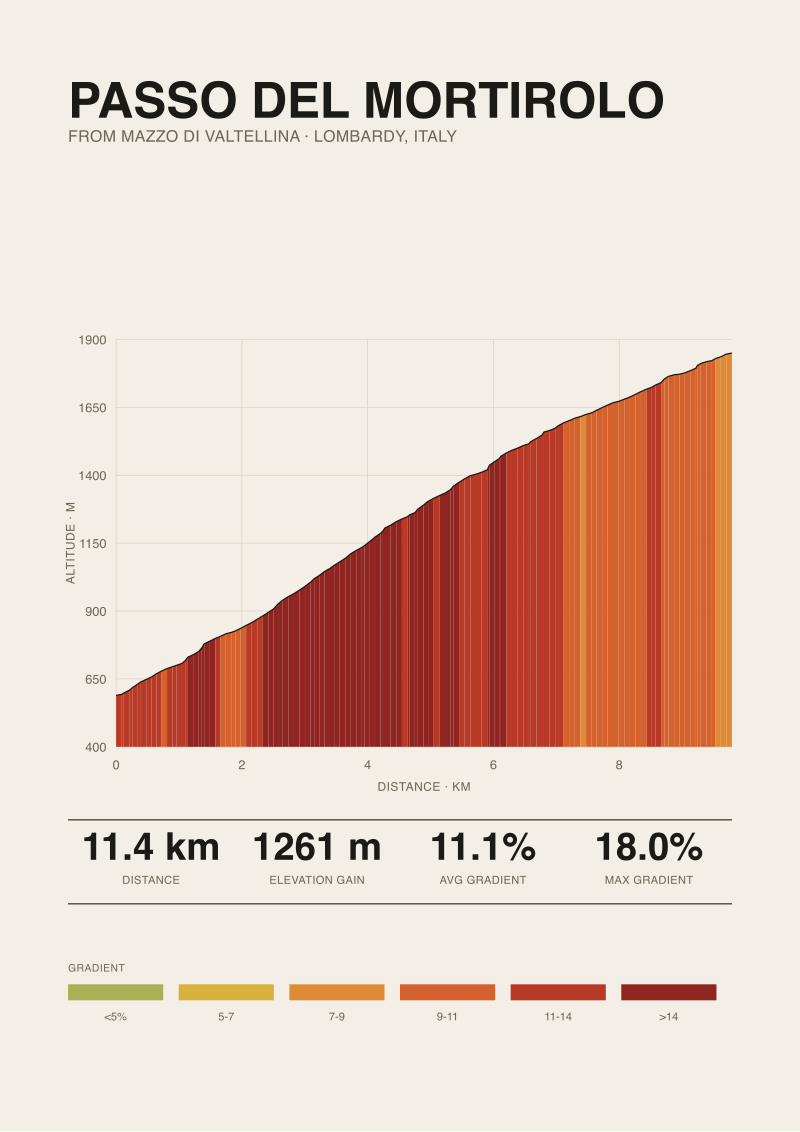
If she were riding the Mortirolo — a climb we have not measured, and whose numbers we will not quote — the 20% question would apply directly. On the Gavia from Ponte di Legno, at a measured 16% max, the honest gearing recommendation is a 32-cassette if her usual setup is 28, a 34 if she wants the cushion, and not a mountain-bike drivetrain designed for a mountain she is not climbing.
What All Three Share
None of the three climbs in our grounded profile library reaches 20% at its published maximum. Ventoux is 12, Tourmalet is 12, Stelvio is 14, Gavia is 16. Four grand-tour classics, all famous for what they do to the human body, and not one of them requires a cassette designed for a wall.
What they share is the 7.3-7.4% average — a number that sits just below the threshold where a compact double becomes uncomfortable for a fit amateur, and just above the threshold where the same amateur can hold cadence on 34x28 for two hours. That average is the actual gearing question. The kicker gradients — 12, 14, 16 — are what the sales pitch for a 32-cassette leans on. But the reason a rider will buy the 32-cassette and never regret it has almost nothing to do with the maximum and almost everything to do with keeping legs alive across an average that never releases.
The pattern is this: riders search for twenty-percent gearing because they have anchored on the worst two minutes of a climb they have not ridden. The gearing they actually need is a compact double with a 32 or 34 cassette, matched to the average, forgiving on the kickers, and forgiving on altitude. That setup covers Ventoux, Tourmalet, Stelvio and Gavia with room to spare — and it covers a lot of Alpine passes we have not measured yet, whose published maxes cluster in the same 12-16 range.
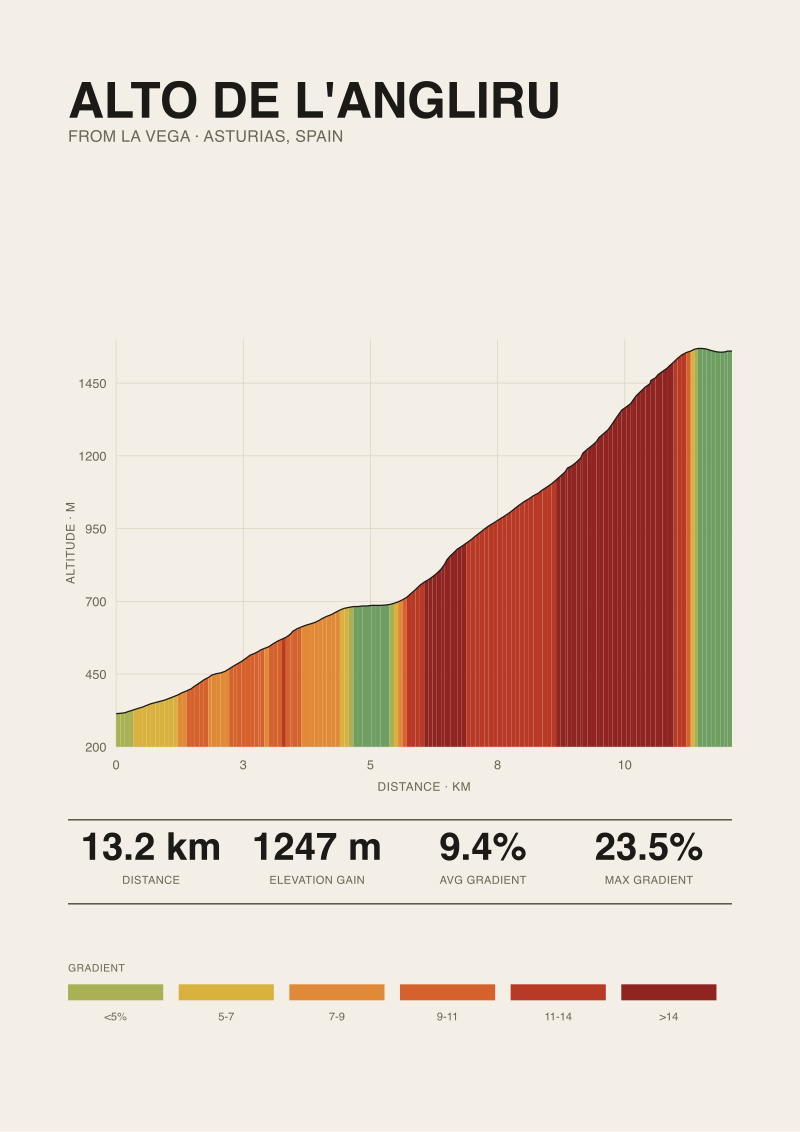
There is a category of climbs where the 20% question is legitimate. The Mortirolo, the Angliru, the Zoncolan — climbs we intend to add to our profile library and will not comment on until we have. Those climbs have measured pitches above 18%, and the gearing conversation for them is a different conversation, one that involves gravel derailleurs and drop-bar mountain-bike cassettes and honest reckoning about walking pace. If your target climb is one of those, the query makes sense. If your target climb is Ventoux, it does not.
 Mont Ventoux
The print from this article · from €29.95
View the print →
Mont Ventoux
The print from this article · from €29.95
View the print →
Which Scenario Is You
Look at the climb you are actually training for. Find its measured length, average gradient, and maximum gradient — from an elevation-data source, not a Strava anecdote. If the maximum sits at 12 or 13%, you are the Ventoux preparer: buy the 32-cassette for cadence on the average, not for survival on a wall. If the climb is long and finishes above 2,500m, you are the Stelvio rider: the gearing you need is an altitude correction, not a gradient correction. If the maximum sits at 16% and you have already done climbs at 12-14%, you are the Gavia attacker: the 32 or 34 buys you the pitch itself, which is the honest use.
If your climb is Mortirolo, Angliru, Zoncolan or something similarly known to break 18%, you are asking the right question and this article is not the article for you. Ours will follow when we have measured them.
1,575 metres of vertical gain on Mont Ventoux, averaged over 21.51 kilometres. That number — 1,575 — is what should decide whether you are shopping for a cassette to handle twenty-percent walls or one to handle two hours of seven-and-a-half percent. It is the second problem. The math is closed.
FAQ
What gear ratio actually handles a real 20% pitch on a road bike?
For a fit amateur riding at around 220 watts, a 20% pitch on 34x28 forces cadence into the low 30s — grinding territory. A 34x32 lifts it to the low 40s. To hold anything resembling a spin, riders bring 34x34 or 34x36, or move to a gravel-style 40-tooth cassette with a long-cage derailleur. Below that, cassette choice matters less than whether the pitch lasts 30 metres or 300 metres.
Do any of the four climbs in your profile library actually require sub-compact gearing?
No. Ventoux from Bédoin (12% max), Tourmalet from Luz-Saint-Sauveur (12%), Stelvio from Prato (14%) and Gavia from Ponte di Legno (16%) are all rideable on a standard compact double with a 32-cassette for a fit amateur. Sub-compact 46/30 chainrings are a comfort choice for the Stelvio's or Gavia's high-altitude finish, where thin air eats power, not a survival requirement based on gradient alone.
Why does your grounded data cap at 16% when road books quote higher numbers on some of these climbs?
Our profile numbers come from OpenTopoData SRTM 30m satellite elevation, which smooths over very short pitches — a 40-metre 20% ramp inside a 200-metre 8% stretch will read as 10-12% averaged. Published road-book maximums, like the 16% climbfinder.com figure we cite for the Gavia, come from finer-grain surveys and often reflect the steepest 100-metre segment. Both numbers are correct answers to different questions, and we cite each explicitly rather than mixing them.
Is a 1x setup a good idea for European high-mountain climbs?
1x drivetrains work mechanically but sacrifice the closely-spaced ratios that let riders fine-tune cadence on long, steady 7-8% sections. The four climbs in our library are all averaged-effort climbs, where holding a specific cadence for two hours matters more than range. A 2x compact double with a 32 or 34 cassette gives more usable, closely-spaced ratios for those efforts than most 1x setups tuned for a 42-tooth extreme.
Does altitude change what gearing I should bring to Stelvio or Gavia?
Yes, indirectly. Air density above 2,000m reduces sustainable power by roughly 10% for an acclimatised rider and more for a visitor. That effective power loss makes an unchanged 7.3% grade feel closer to 8% for the last hour of the Stelvio. The correction is a lower gear — 34x32 instead of 34x28 — so cadence stays in a sustainable range while the body produces fewer watts. It is a gear you buy for elevation, not for gradient.
Why don't you cover the Mortirolo, Angliru or Zoncolan here?
Because we haven't measured them yet. The Climb Prints desk works from OpenTopoData SRTM 30m profiles we've generated ourselves; quoting road-book figures we haven't verified would be exactly the kind of secondhand statistic we tell readers to distrust. Those three climbs are in the library queue. Until they're in, we won't put numbers on them.
If I'm training only on Zwift, how should I calibrate for the real climb?
Zwift's default gradient scaling underreads compared to real-world grades, and cadence patterns on a trainer don't match the balance and heat-load of the road. The gearing you can sustain indoors on a virtual 8% is often one to two cogs lower than what you'll want on the same real gradient at altitude. Bring a bigger cassette than your Zwift performance suggests, especially for climbs above 2,000 metres.
What about the print in the shop — should the gear ratio question influence which climb I hang on the wall?
Only if the answer to it changed which climb you actually rode. The prints at /shop/ are of the climbs themselves — Stelvio, Ventoux, Tourmalet, Gavia — rendered from the same OpenTopoData profiles quoted above. The print is a record of the road, not the drivetrain. If you rode it on 34x28 and it broke you, and next time you'll bring 34x32, the print is the same.
From the collection
New climbs and 10% off your first print.
One email now with your code. No noise after.