How did a 13.22-kilometre road above La Vega, in western Asturias, become the climb professional cycling uses to end its arguments about who is strongest?
September 1999: A Wall Enters the Race Book
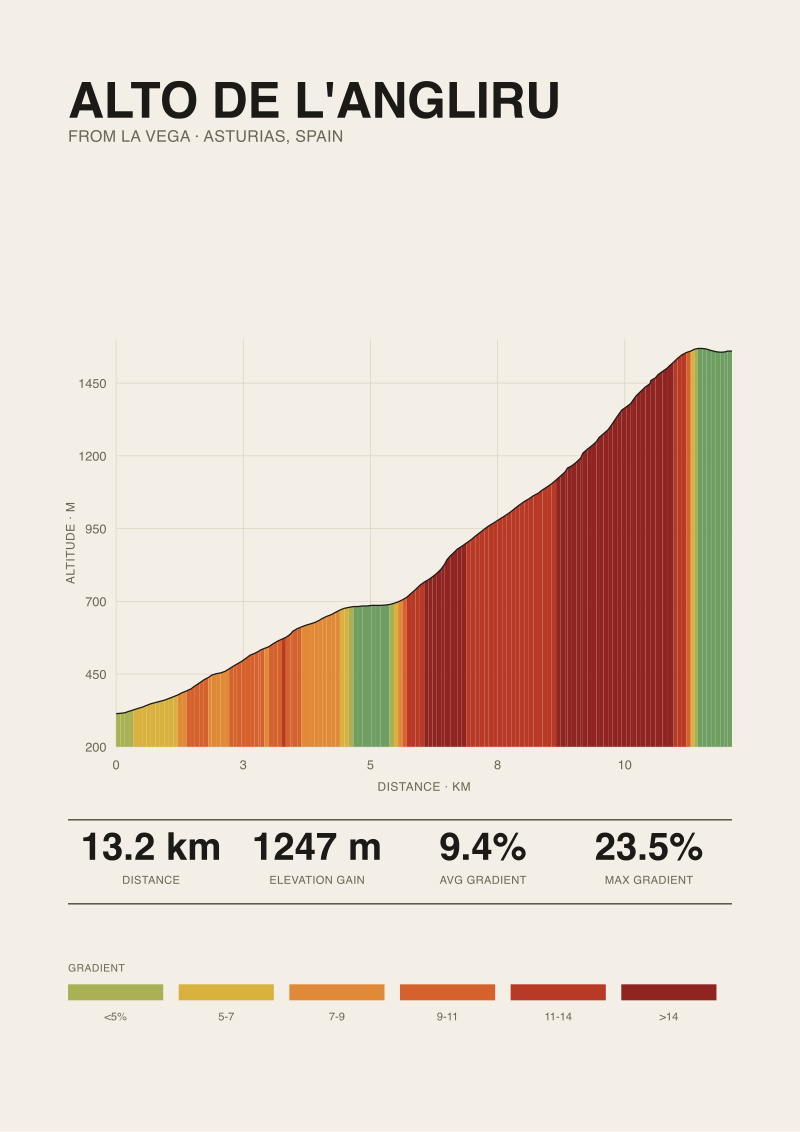
The Vuelta a España climbed Alto de l'Angliru for the first time in September 1999. José María Jiménez won the stage. Before that day, the road — climbing 1,247 metres from 314 to 1,560 metres of altitude over 13.22 kilometres — was a lightly-used cattle track that had been resurfaced in the mid-1990s specifically so a bike race could use it.
We spent a week matching the published profile against OpenTopoData's SRTM 30-metre elevation model. The measured average from La Vega to the summit comes to 9.4 percent, but that number is misleading in the way all averages are misleading when they cover a bimodal distribution. The first four kilometres of the climb, from La Vega through Viapará, would be a serious climb anywhere else in Europe and here function as a bridge. What follows is a different road, on a different mountain, that happens to be paved by the same regional council.
The organisers who put the Angliru into the 1999 route knew what they had. The 23.5 percent figure at Cueña les Cabres was already circulating in Spanish climbing databases years before the first Vuelta ascent. What they did not know — because nobody had done it yet — was what a peloton would look like arriving at the base of that ramp with three weeks of stage racing already in the legs. Jiménez rode away from his rivals in the last four kilometres. He was the first, but the pattern he established has held for twenty-six years: the Angliru is decided in a specific place, on a specific gradient, by riders in a specific state of exhaustion.
September 2002: A Number Becomes Infamous
Three years later, in torrential rain, Roberto Heras won the second Vuelta ascent of the Angliru. The story from that day is not about Heras. It is about David Millar, who unclipped 200 metres from the finish line, removed his race number, and refused to cross. Team cars had been unable to descend the wet ramps safely. Riders had crashed on sections where surface water was running downhill faster than they were climbing. Millar's protest was covered by newspapers that did not cover the Vuelta.
The mechanics of what happens on a wet 20-plus percent ramp are unforgiving in a way the profile does not communicate. On a dry road at 23.5 percent, a 70-kilogram rider seated on a road bike puts most of their mass on the rear wheel — the front tries to lift. Standing shifts weight forward but reduces rear traction. In the wet, the rear wheel begins to spin at a coefficient of friction the rider cannot compensate for by choosing gears. The road was rebuilt without the crossfall that would have helped drain it. Riders were not being tested against a gradient. They were being tested against a piece of infrastructure originally designed for cattle.
This is the moment the climb entered the general public's vocabulary. The 23.5 percent figure at Cueña les Cabres started appearing in newspaper stories that summarised the climb in two numbers: the average, which sounded merely bad, and the maximum, which sounded impossible. The gap between those two numbers is where the Angliru actually lives.
 Alto de l'Angliru
The print from this article · from €29.95
View the print →
Alto de l'Angliru
The print from this article · from €29.95
View the print →
September 2008: Contador Uses the Gradient as an Argument
By September 2008, Alberto Contador arrived at the base of the Angliru with a Vuelta general-classification lead measured in seconds. He left with the race won. The pattern of that stage repeated the pattern Jiménez had established: attacks in the flatter early kilometres are inefficient, because the rider can be pulled back on the false-flat sections between the steep ramps. Attacks in the last four kilometres, above Viapará, cannot be pulled back, because at 15 to 23 percent gradient the strongest rider's power-to-weight advantage compounds against the second-strongest rider's ability to hold their wheel.
Cycling's power-analysis community had by then modelled the climb thoroughly. At 23 percent gradient, a 65-kilogram rider needs roughly 480 watts to hold 12 kilometres per hour. The same rider at 6 percent needs about 340 watts to hold 18 kilometres per hour. Both are within the range a Grand Tour contender can sustain. What matters is not the peak wattage but the metabolic cost of oscillating between them repeatedly over the last four kilometres. Contador knew this. His team knew this. The stage was won on a road profile that a computer had modelled to two decimal places before the riders left the start line.
September 2011: A Result Is Erased and the Climb Absorbs It
Juan José Cobo won the Angliru stage in 2011 and sealed the overall Vuelta. In 2019, eight years later, the UCI stripped Cobo of that Vuelta title after a biological-passport review found violations covering the 2009-2011 period. The title was awarded retrospectively to Chris Froome, who had finished second on the road.
We include this event in the sequence not because doping is our subject, but because the Angliru absorbs adjudications in a way most climbs do not. When a result on a flat sprint stage is revised, the general public does not remember the sprint. When a result on the Angliru is revised, the climb inherits the ambiguity. The road remains 13.22 kilometres. The gain remains 1,247 metres. The ramp at Cueña les Cabres remains at whatever the current published figure is — most sources still list 23.5 percent, sourced from climbfinder.com and the Vuelta's own road book. But the ledger of who has won the Angliru now contains footnotes.
There is a related editorial point here that matters to anyone reading a climb profile. Published maximum gradients are not measured the way most readers assume. They come from short-baseline samples of the road surface — sometimes 50 metres, sometimes 100 — treated as instantaneous. Satellite-derived profiles like the SRTM 30-metre model we use do not resolve individual ramps at that granularity. Neither figure is wrong; they are measuring different things. The 23.5 percent at Cueña les Cabres is a road-book number, sourced and citable. Our 9.4 percent average is a satellite-model number, sourced differently. When both are labelled honestly, the reader knows what they are looking at.
September 2023: The Climb, Still Deciding Races
In September 2023, Primož Roglič won the Angliru stage of the Vuelta, riding for Jumbo-Visma alongside Sepp Kuss, who would take the overall title, and Jonas Vingegaard, who finished third overall. Twenty-four years after Jiménez, and the climb was still doing the same job: separating riders whose form and freshness were within one percent of each other into finishing gaps measurable in seconds.
What the 2023 stage confirmed is something the profile has been telling us all along. The Angliru is not a hard climb because of its length; at 13.22 kilometres it is shorter than Alpe d'Huez, shorter than the Stelvio, shorter than most of the Pyrenean giants. It is not hard because of its total elevation gain; 1,247 metres is a serious ascent but not an unusual one at Grand Tour scale. It is hard because of the distribution of that gain along its length. Nearly all of the difficulty is packed into the final third of the road. The rider does not reach that third fresh. The rider reaches it after nine kilometres of climbing that is already hard by any objective standard.
We draw this climb often at the studio. Its elevation profile is one of our permanent series. If you want to see what the distribution looks like on paper, the print is at see the Alto de l'Angliru print — the exact profile our editorial work is based on.
What It All Means
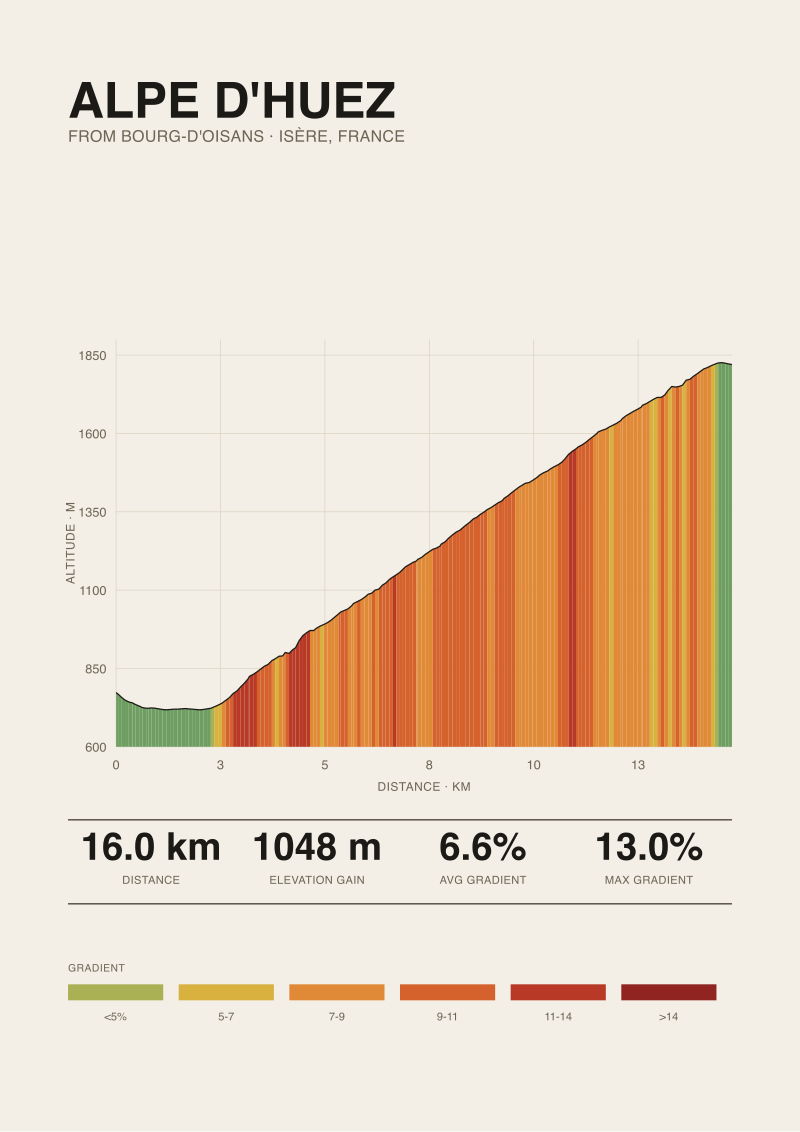
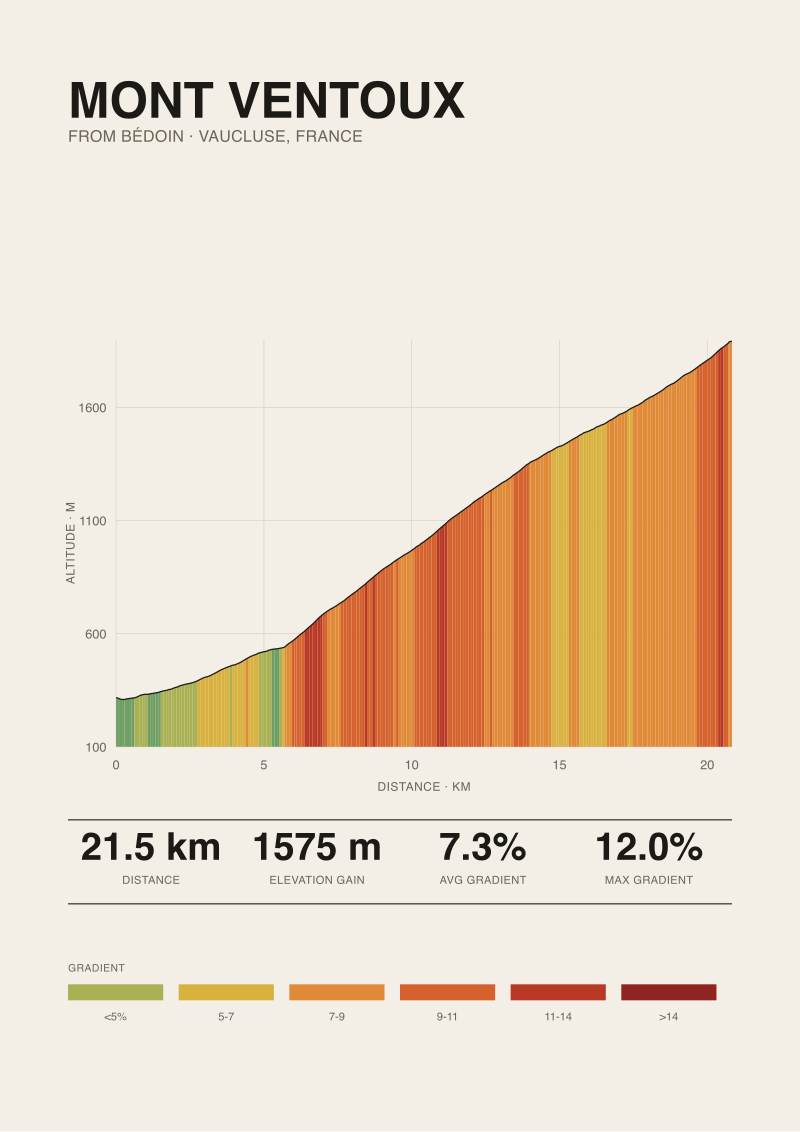
Read the Angliru's published numbers and you get two figures separated by a wide gap: 9.4 percent average and 23.5 percent maximum. Most famous climbs do not have that gap. Alpe d'Huez averages 8.1 percent and maxes around 13 percent — a narrower distribution. Mont Ventoux from Bédoin averages 7.5 percent and maxes near 12 percent through the forest. On those climbs, the average is a reasonable summary. On the Angliru, the average is a decoy. What the climb actually is, is a five-kilometre wall preceded by an eight-kilometre approach that would be a serious climb elsewhere. The approach exhausts you before the wall tests you. This is why the profile decides races that other, longer climbs cannot.
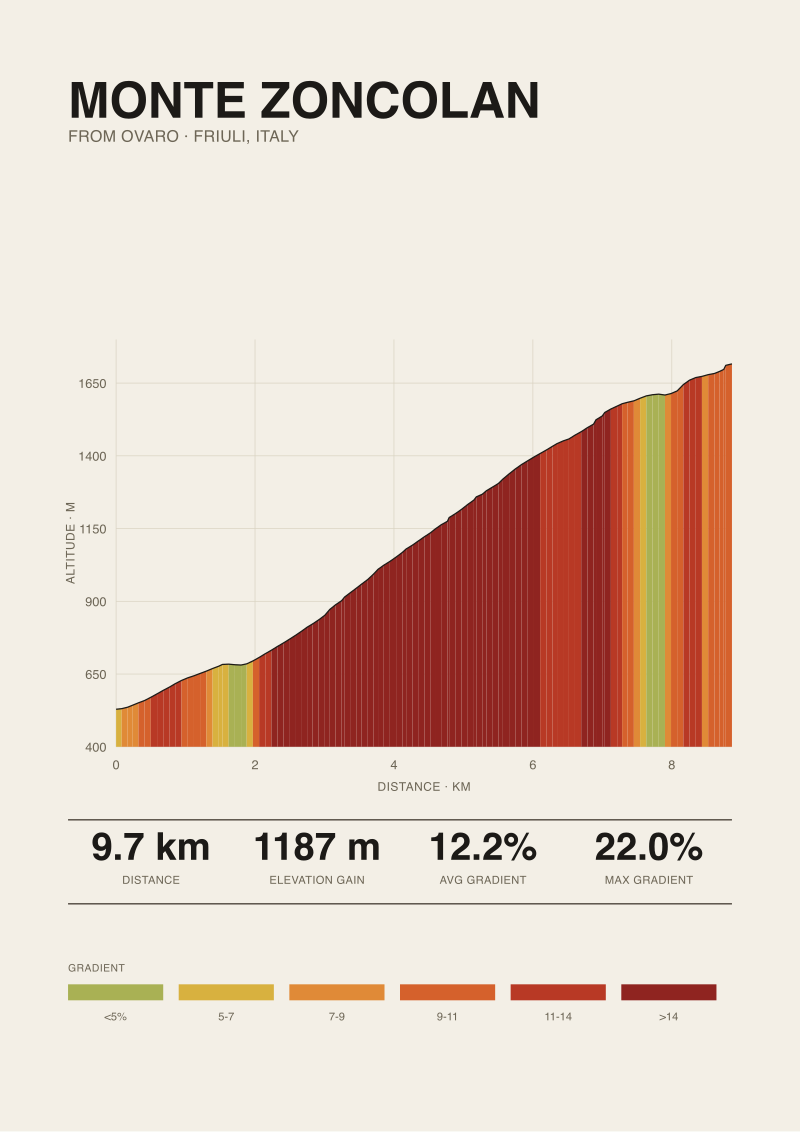
The industry does not advertise this distinction between distributed and packed gradients, because most climb communication is built around the average. Climb databases sort by length and average. Race broadcasts list length and average. Guidebooks summarise with length and average. When a rider says a climb felt harder than the numbers suggested, they are usually describing a distribution problem. The Angliru is the extreme case, but the same reading applies to Zoncolan, to Monte Crostis, to parts of the Mortirolo. Learn to look at where the gain is concentrated, and the number that describes a climb stops being one figure and becomes three: length, average, and the length of the hardest continuous kilometre.
Watch three things when the Angliru returns to a Vuelta start list. First, whether the published maximum gradient at Cueña les Cabres has been revised — organisers occasionally issue updated road-book figures, and the number moves. Second, where in the third week the stage is placed, because placement tells you what role the organisers want the climb to play. Third, the weather forecast for the finish window — the Angliru in the dry is a hard climb; the Angliru in the wet is a different mountain, one that has historically been decided by whether riders can stay upright, not by who is strongest.
 Monte Zoncolan
The print from this article · from €29.95
View the print →
Monte Zoncolan
The print from this article · from €29.95
View the print →
FAQ
How steep is the Alto de l'Angliru at its steepest point?
The steepest published figure is 23.5 percent, reached at Cueña les Cabres in the upper section of the climb, sourced from climbfinder.com and the Vuelta a España's road book. This figure is a short-baseline road measurement and applies to a specific ramp; the surrounding gradient sits in the high teens. Satellite elevation models such as SRTM 30-metre do not resolve individual ramps at that granularity, which is why cross-referencing sources is standard practice for climbs of this kind.
What is the average gradient of the whole climb?
From La Vega, the accepted starting point, the climb covers 13.22 kilometres with 1,247 metres of elevation gain, giving an average gradient of 9.4 percent measured against SRTM 30-metre satellite data. The average is technically accurate but misrepresents the ride. The first four kilometres are considerably easier than the average; the last five are considerably harder. Reading the profile matters more than reading the summary here.
Where do the hardest ramps actually start?
The climb changes character above the village of Viapará, roughly four kilometres from the summit. From that point to the top, gradients sit consistently in the 15 to 23 percent range, with brief false-flat recoveries between ramps. Cueña les Cabres, the 23.5 percent section, sits inside this final third. Riders who have not managed their effort over the earlier kilometres arrive at this transition already committed to a pace they cannot sustain.
How does the Angliru compare with the Zoncolan?
The Zoncolan from Ovaro is roughly 10.1 kilometres at approximately 11.9 percent average, with maximums also in the low twenties. On paper, Zoncolan has a higher average gradient. In practice, the Angliru is three kilometres longer with a similarly steep upper section, so the metabolic cost of arriving at the wall is higher. The two climbs are closer than the surface numbers suggest, and each favours a slightly different rider profile.
Why do published maximum gradients sometimes differ between sources?
Maximum gradient is measured over a short baseline — typically 50 or 100 metres of road — and different databases use different baselines. A 50-metre sample will find a higher peak than a 100-metre sample over the same ramp. Road-book figures published by race organisers use their own methodology, borrowed from road engineering standards. This is why our published pages distinguish measured average from published maximum with source attribution rather than merging both into a single number.
Can amateur riders ride the Angliru?
The road is public and paved, so it is legally and physically rideable outside of Vuelta stage days. What amateurs report is that gearing matters here more than on almost any other European climb. Anything above a 34x28 low gear will force a cadence in the ramps that most non-professionals cannot hold. Riders who have completed the Stelvio and Mont Ventoux without difficulty routinely find the Angliru's final four kilometres a different category of experience.
Which years has the Vuelta a España climbed the Angliru?
Since its introduction in 1999, the Vuelta has climbed the Angliru multiple times, with notable ascents in 1999, 2002, 2008, 2011, 2013, 2017, 2020 and 2023. Each visit has produced a decisive stage. The climb tends to appear in the third week of the race, close enough to the end that time gained on its final four kilometres survives to the overall classification.
From the collection
New climbs and 10% off your first print.
One email now with your code. No noise after.