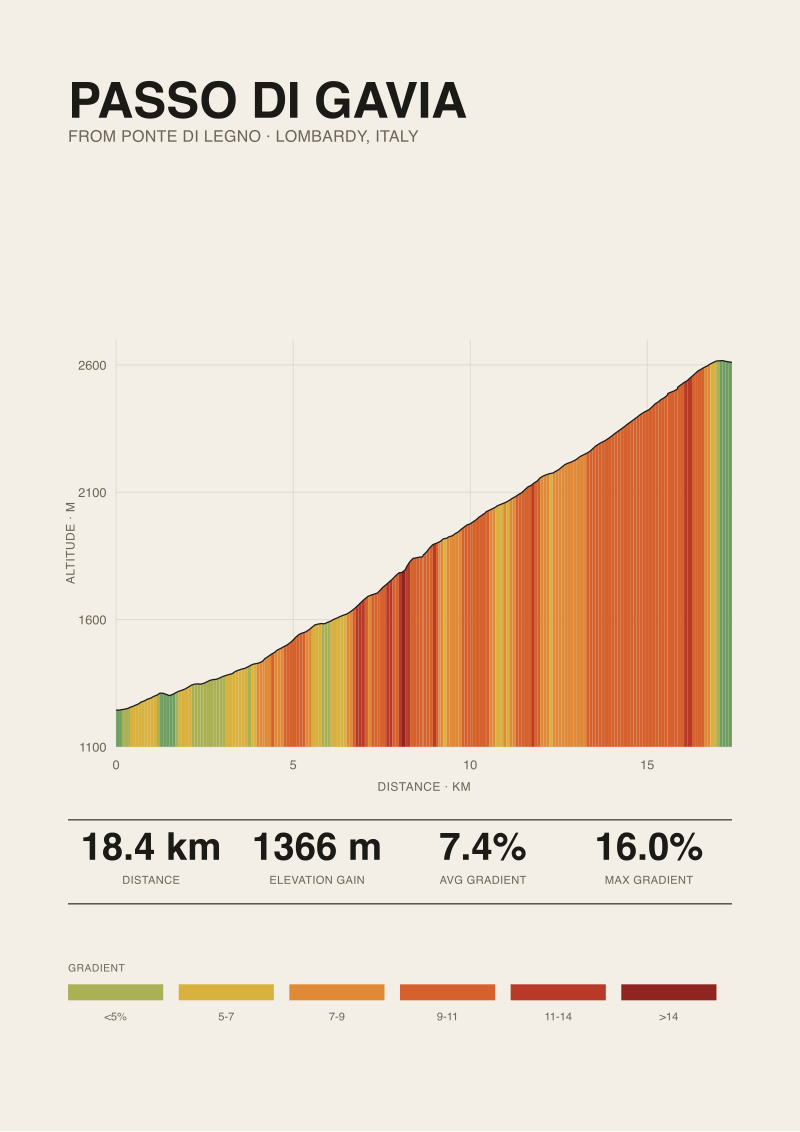
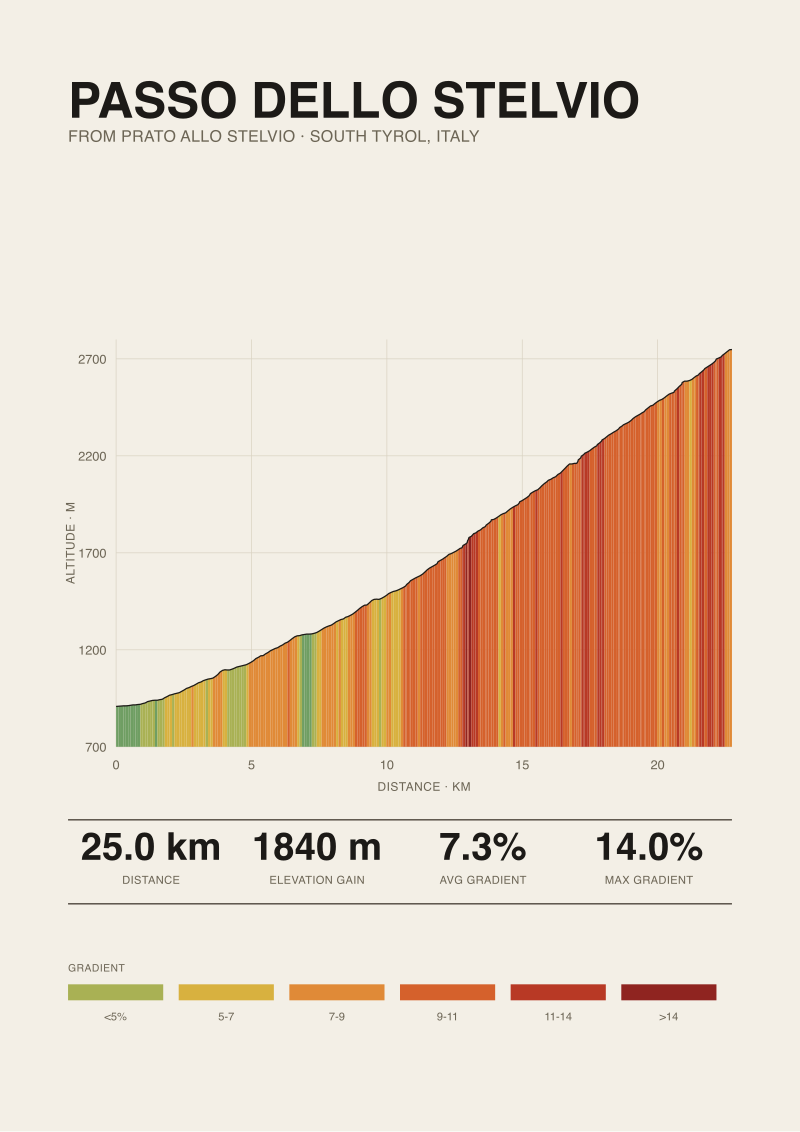
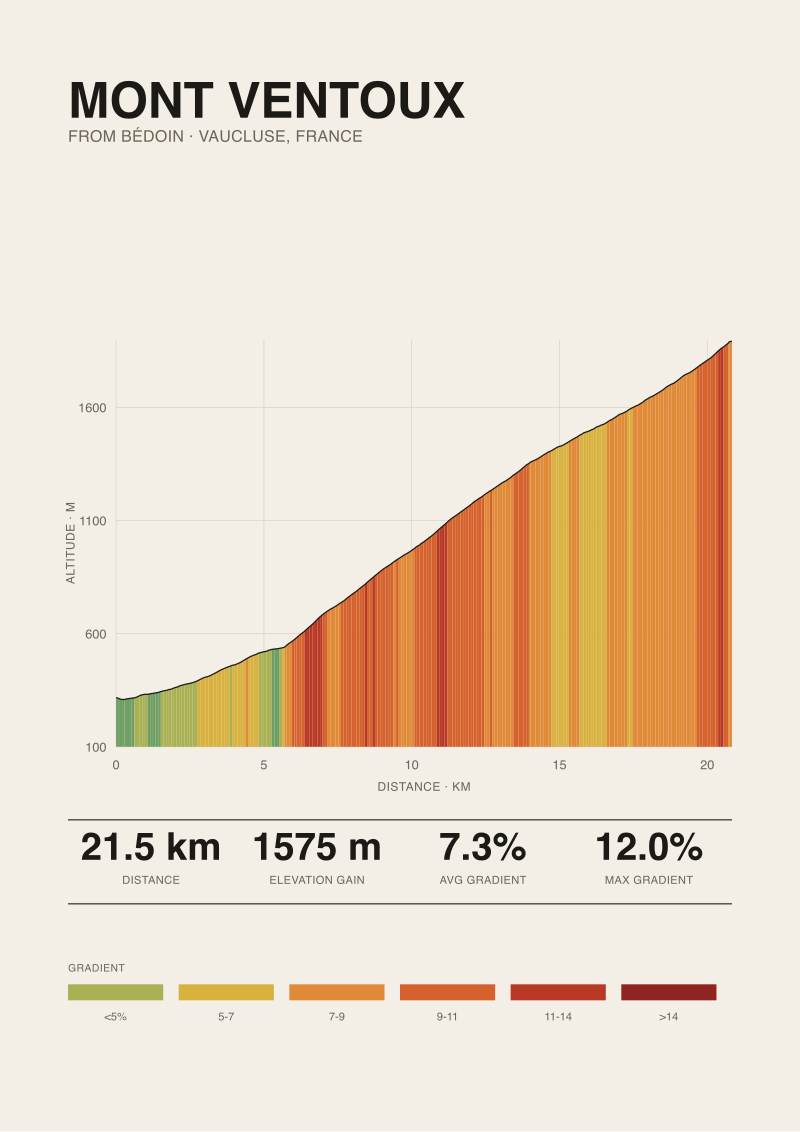
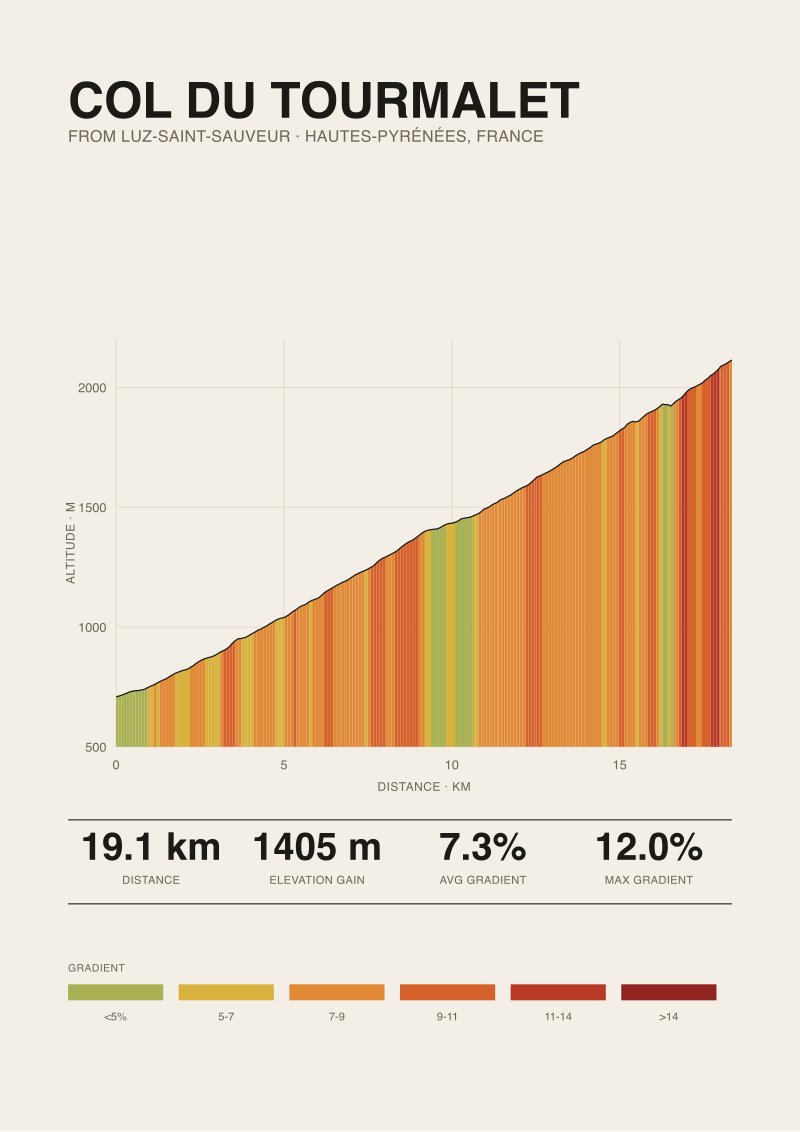
We pulled the numbers on four European climbs everyone calls hard. The maximum gradient on Passo di Gavia from Ponte di Legno, per climbfinder.com, is 16 percent. On Passo dello Stelvio from Prato allo Stelvio, it is 14 percent. On Mont Ventoux from Bédoin and on Col du Tourmalet from Luz-Saint-Sauveur, both are 12 percent.
If you had asked us which of the four is the steepest before we opened the file, we would have said Stelvio, because that is the one the marketing sells. The receipt says Gavia. That answer, once you sit with it, is more interesting than it sounds.
What the Numbers Actually Say
Here is what the profile data returns, straight from the elevation source (OpenTopoData SRTM 30m) with the published maximum gradient from climbfinder.com sitting next to it.
Passo dello Stelvio from Prato allo Stelvio: 25.04 km at 7.3 percent average, 1,840 metres of vertical gain, summit at 2,748 m. Published max gradient: 14 percent.
Mont Ventoux from Bédoin: 21.51 km at 7.3 percent average, 1,575 metres gained, summit at 1,892 m. Published max: 12 percent.
Col du Tourmalet from Luz-Saint-Sauveur: 19.12 km at 7.3 percent average, 1,405 metres gained, summit at 2,114 m. Published max: 12 percent.
Passo di Gavia from Ponte di Legno: 18.42 km at 7.4 percent average, 1,366 metres gained, summit at 2,610 m. Published max: 16 percent.
Three of the four sit at exactly 7.3 percent average. Gavia is a rounding hair steeper on average, at 7.4. If you were choosing your holiday by average gradient alone, you would call them all interchangeable and go home. The average gradient is telling you almost nothing.
The maximum gradient is where they separate. Ventoux and Tourmalet share a ceiling of 12 percent, which by road-bike standards is hard but honest — a gradient you can hold for a minute or two before it releases. Stelvio adds two points to that ceiling. Gavia adds four.
Sixteen percent is a different category. It is not "steeper than 12." It is the number where cadence collapses on a 34x28 or 34x30 and the ride becomes a body-weight problem. If you are ranking these four climbs by how ugly a single ramp can get, the order is Gavia, then Stelvio, then Ventoux and Tourmalet in a shared last place. That is the receipt.
What Nobody Mentions
Every number above the published-max line comes from someone else's measurement. Ours does not. This distinction gets waved past in most climb writing, and it is where the honest work starts.
Our length, gain, average gradient, start and summit elevations come from OpenTopoData SRTM 30m — satellite elevation data sampled every 30 metres along the road. That is a plot of the mountain as the satellite sees it. The published maximum gradient, in each case here, is climbfinder.com's figure, and climbfinder builds its maxima from GPS traces and known road-book data. The 16 percent on Gavia is specifically the Ponte di Legno approach.
The two measurements do not always agree at the ramp level. Satellite elevation smooths across 30-metre spans, which means a 50-metre wall at 18 percent inside a longer stretch at 6 percent will render, in the SRTM view, as maybe 10 or 11 percent over the surrounding metres. The road book — which is closer to what a rider actually feels through the pedals — records that same stretch by its worst step.
This is why so many riders finish the Gavia insisting it was steeper than the profile printout showed. It was. Their bodies were reading the ramp. The satellite was reading the average of the ramp and the fifty metres around it.
We do not say this to trash SRTM data. We use it to draw prints because the smoothed profile is the shape of the mountain, and the shape is what belongs on the wall. But when the question is "what is the steepest bit," the honest answer is: the printed profile is a low-pass filter, and the road book is often more truthful about the worst thirty seconds of your climb.
Which is a long way of saying: Gavia's 16 percent, on climbfinder's road-book measurement, is a real thing. It just does not survive as a 16 in the satellite view.
 Passo di Gavia
The print from this article · from €29.95
View the print →
Passo di Gavia
The print from this article · from €29.95
View the print →
The Real Cost
Put a number on the gap. What does four extra points of maximum gradient actually cost the rider?
On a 12 percent ramp, an untrained 75 kg rider climbing on a 34x30 (roughly 32.6 gear-inch low) needs to hold about 260–280 watts to keep cadence in the 65 rpm range. That is threshold for a fit amateur and above threshold for most riders on holiday. It is survivable in short bursts because 12 percent stretches on Ventoux and Tourmalet arrive as clean, exposed switchbacks with recovery grades in between.
On a 14 percent ramp — Stelvio's ceiling near the top of the Prato allo Stelvio ascent — the same 75 kg rider needs closer to 320 watts to hold the same cadence. Because the ceiling arrives after 20-plus kilometres of climbing on the way to a 2,748 m summit, aerobic capacity is already down 8–12 percent versus sea level. The math starts eating you.
Now the 16 percent on Gavia from Ponte di Legno. Same rider, same gear: you are looking at roughly 370 watts to hold 65 rpm. Nobody on a road bike is holding 370 watts for a minute above 2,000 m on the fourth hour of a ride. The cadence collapses to 45 rpm, which drops the wattage requirement to about 260, and now you are grinding a gear too big for your legs at a heart rate that leaves nothing for the last kilometres of climbing to the 2,610 m summit.
That is the cost of four points of max gradient, expressed in the currency the rider actually pays: not "harder" but "off the aerobic system entirely for the worst kilometre of the day." The average gradient buries this. The published maximum surfaces it. Which is why, for planning a trip around these four, the max column is the honest column.
If You Only Remember One Thing
Three of these four climbs are 7.3 percent average, and one is 7.4. If you plan by average, you will book a week around Stelvio because it is the tallest, and be surprised on the Gavia when a ramp you did not respect breaks your legs at 2,000 m.
Plan the other way. Watch three signals when you read a climb profile from now on. First, does the source distinguish satellite-measured average from road-book maximum — if not, the profile is smoothed and the worst ramp is hiding. Second, where does the peak gradient sit on the profile — the same 16 percent is a different problem at kilometre 3 with fresh legs versus kilometre 14 at altitude. Third, does the writer name the elevation source at all — if the article uses numbers without a source line, treat the numbers as decoration. When a profile earns your respect on all three, we probably have it in the shop.
 Passo dello Stelvio
The print from this article · from €29.95
View the print →
Passo dello Stelvio
The print from this article · from €29.95
View the print →
FAQ
Which of these four is the steepest road climb?
On published maximum gradient, Passo di Gavia from Ponte di Legno at 16 percent, per climbfinder.com. Passo dello Stelvio from Prato allo Stelvio comes next at 14 percent. Mont Ventoux from Bédoin and Col du Tourmalet from Luz-Saint-Sauveur share third place at 12 percent. On average gradient the four are within 0.1 point of each other, which is why the average is misleading for this question.
Why do satellite-measured profiles disagree with published road-book maximum gradients?
Because satellite elevation data — in our case OpenTopoData SRTM 30m — samples the road every 30 metres and averages across each span. A short, brutal ramp inside a longer, gentler section gets smoothed into the surrounding kilometres. Road-book figures are closer to what a rider feels through the pedals because they are recorded at the ramp itself, not averaged across it. Both are valid; they answer different questions.
Are all four climbs actually ridable on a standard road bike?
Yes, with compact gearing. The 16 percent on Gavia from Ponte di Legno will punish anything above a 34x30 for a rider who is not already climbing regularly at threshold. Stelvio's 14 percent sections arrive after 20 kilometres of climbing on the way to 2,748 m, so gear choice matters more than it looks on paper. Ventoux and Tourmalet at 12 percent maximum are within reach for a fit amateur on 34x28.
Are Mont Ventoux and Col du Tourmalet really the same difficulty on paper?
On the metrics available here, close enough to be indistinguishable. Both from their canonical approaches sit at 7.3 percent average and 12 percent maximum. Ventoux climbs 1,575 metres over 21.51 km; Tourmalet climbs 1,405 metres over 19.12 km. Ventoux carries more total gain and finishes lower, which means more of the pain happens with usable oxygen. In pure profile terms they are peers.
How much does summit altitude change the effective difficulty?
Substantially. Aerobic power drops roughly 1 percent per 100 metres above 1,500 m for most riders. Stelvio finishes at 2,748 m and Gavia at 2,610 m, so both extract an extra 8–12 percent off the top of the fitness you brought. Tourmalet at 2,114 m loses about 6 percent. Ventoux at 1,892 m loses about 4 percent. Altitude belongs next to gradient in any honest difficulty conversation.
Why is the average gradient identical across three of the four?
Because average gradient is a division: total gain over total length. When length and gain scale together, the average holds steady. All three landing at exactly 7.3 is partly a coincidence of route length and partly the geology of alpine and pyrenean pass roads, which were engineered to a gradient a horse-drawn cart could handle. The maximum gradient tells you where the road engineers had to give up.
Where do these numbers actually come from?
Length, elevation gain, start and summit elevations and average gradient are computed from OpenTopoData SRTM 30m satellite elevation data along the ascent route. Maximum gradient in each case is the published figure from climbfinder.com, with the specific ascent noted where relevant (Gavia is from Ponte di Legno). We keep the two sources labelled separately because they measure different things.
If I could only ride one of the four, which teaches the most about climbing?
Gavia from Ponte di Legno, because the profile forces the rider to confront the gap between average and maximum gradient inside a single climb. You get 18.42 km at 7.4 percent that feels manageable for most of the ascent, and then a ramp at 16 percent that recalibrates what the average was hiding. Every other climb here rewards fitness. Gavia rewards attention to the profile.
From the collection
New climbs and 10% off your first print.
One email now with your code. No noise after.