Ask any cycling forum which climbs under ten kilometres deserve billing next to the Stelvio, and the argument writes itself: length is a distraction, and a nine-kilometre wall at double-digit gradient buries a rider in a way twenty-five kilometres at seven percent cannot. It is a compelling case, and the numbers we measure do not obviously refute it — the Stelvio from Prato allo Stelvio runs 25.04 km at a 7.3 percent average to a 2,748-metre summit, and climbfinder puts its maximum at fourteen percent. But our profile data on four European monuments suggests the sub-10km argument is right for a reason its advocates rarely name.
The version of the argument that turns up most often runs like this. Length is a proxy the sport uses because it is easy to print on a road sign. What actually breaks a rider is the moment the gradient stops relenting — the ramp that arrives after the legs are already loaded and refuses to give them back. If that ramp lives inside a nine-kilometre climb, it will hurt more than a twenty-kilometre climb whose gradient never crosses double digits, because the short climb never allows a rider to settle into the rhythm the long one grants by geometry alone.
It is a good argument. It is also the argument every rider who has ridden a proper wall makes the first time they see the profile of one printed next to a longer climb they respected. The Muro di Sormano, the Angliru's Cueña les Cabres section, the Zoncolan from Ovaro — these are the exhibits the sub-10km advocates hold up, and they hold up well. The case is not that the long climbs are easy. The case is that length flatters them in the pub-argument metric.
We have spent long enough measuring climbs from elevation data — SRTM 30-metre satellite grids run against the actual road corridor — to have a view on where this argument lands and where it does not. It lands somewhere useful. It just does not land where its defenders think.
Why This Is Actually True: The Case for the Sub-10km Climb
Start with what the sub-10km camp gets right, because it is more than a rhetorical device. Human physiology does not care about kilometres. It cares about the sustained wattage per kilogram a rider is holding, for how long, and how far above threshold that number sits. A climb whose gradient never leaves the six-to-eight percent band is a climb a trained rider can sit inside their zone on. The suffering is real, but it is metered. The rider chooses the pace the climb permits and pays what the pace costs.
A wall does not permit a pace. On a sixteen-percent ramp, a rider on a standard road setup is not choosing between hard and comfortable — they are choosing between the gearing that fits the gradient and the gearing that does not, and if the gearing does not fit, the choice collapses to standing on the pedals at a cadence that empties the tank. The Gavia from Ponte di Legno, in our measurements, gains 1,366 metres over 18.42 kilometres at a 7.4 percent average, and climbfinder reports its published maximum at sixteen percent. The average is what a rider budgets for. The maximum is what they actually pay when they hit that section. If a nine-kilometre climb is essentially the maximum-gradient section of a Gavia stripped of the friendlier kilometres around it, then yes — that nine kilometres will hurt in a way length cannot describe.
There is also the compression argument. On a long climb, the memorable ramps arrive spaced out — a rider recovers between them, and each ramp is metabolically fresh relative to the one before. On a short, steep climb, there is no recovery real estate. The whole climb is the ramp. Muscle glycogen and cardiovascular ceiling collide inside a compressed window, and the climb ends before the body has room to adapt. This is a legitimate observation and it is why any honest cyclist who has ridden a proper wall will nod when the sub-10km case is made.
But here is what that framing misses entirely: the argument compares the wrong climbs to the wrong climbs.
Where It Breaks Down: What Our Profile Data on Stelvio, Ventoux, Tourmalet and Gavia Shows
The sub-10km argument treats the great alpine and pyrenean monuments as if their case rests on length. It does not. Look at what the numbers actually show, side by side, from our measured profiles on the four climbs in front of us.
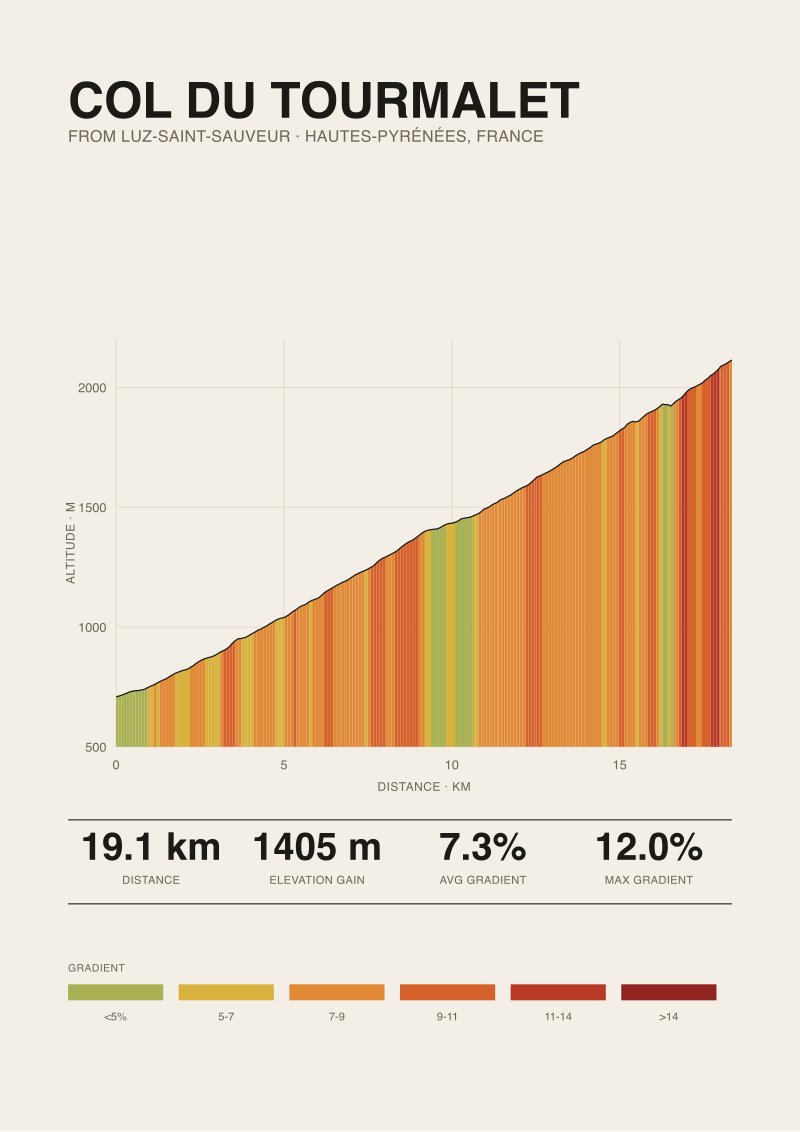
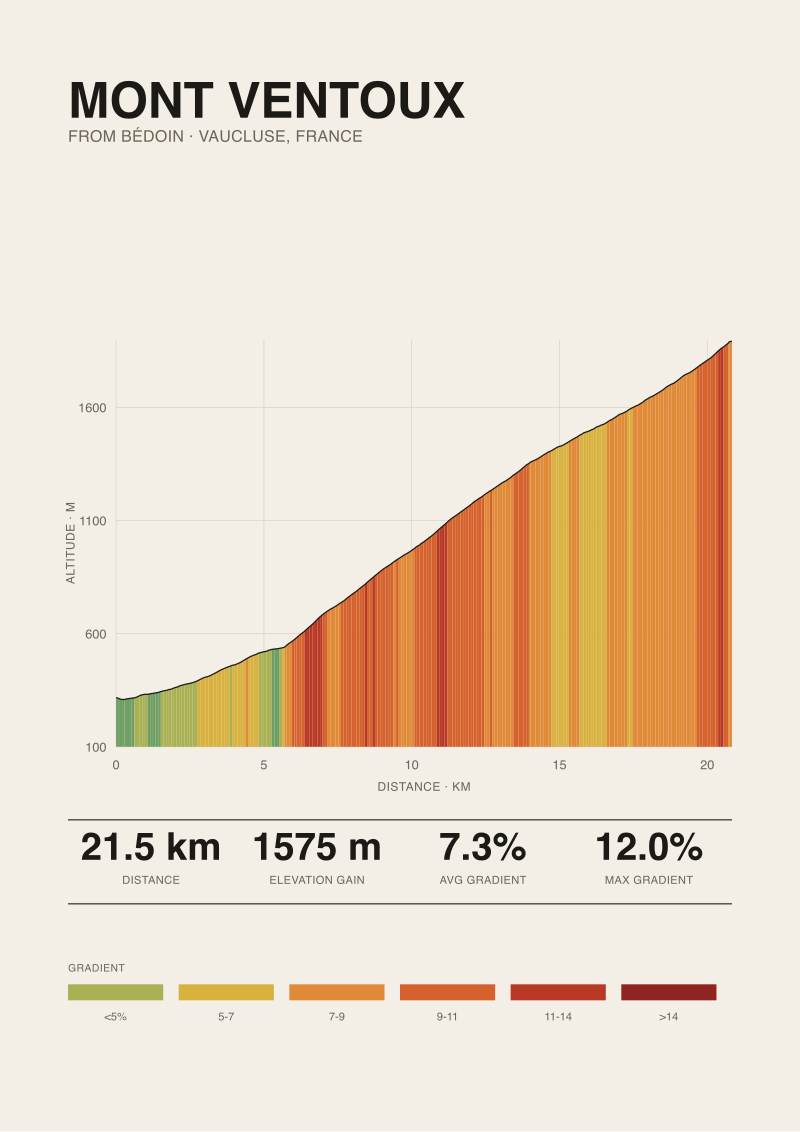
The Stelvio from Prato allo Stelvio: 25.04 km, 1,840 metres of gain, 7.3 percent average, from 908 metres to 2,748. Ventoux from Bédoin: 21.51 km, 1,575 metres, 7.3 percent average, from 317 metres to 1,892. Tourmalet from Luz-Saint-Sauveur: 19.12 km, 1,405 metres, 7.3 percent average, from 709 to 2,114. Gavia from Ponte di Legno: 18.42 km, 1,366 metres, 7.4 percent average, from 1,244 to 2,610.
Three of these four monuments hold their average gradient to a decimal point of each other. That is not a coincidence of curation — that is the geometry of what a paved road up a real mountain looks like when it is engineered to be climbable at all. Roads that average double digits over twenty kilometres do not get built, because they cannot be graded. The sub-10km camp compares these long climbs to walls and concludes length is doing the flattering, but the fair comparison is what the long climbs deliver that the walls do not: elevation gain, altitude, and duration under load.
The Stelvio gains 1,840 metres. The Gavia summits at 2,610. Ventoux tops out at 1,892 metres in a place where the road is exposed to Mistral winds that do not exist on a nine-kilometre wall in an Italian forest. Tourmalet is 19.12 kilometres of continuous work at 2,114 metres of summit altitude. A sub-10km climb, however severe, is by definition finished before altitude begins to matter and before the duration of the effort itself becomes the thing being tested.
There is also the profile-versus-road-book gap the numbers force us to be honest about. Our SRTM 30-metre elevation data reads the road corridor as it actually exists. Published maximum gradients — the fourteen percent on Stelvio, the twelve on Ventoux and Tourmalet, the sixteen on Gavia — come from climbfinder, which draws on road-book and rider-reported figures. These are not the same measurement. Road-book maxima are frequently spot readings taken at signposts. Our satellite-derived data averages across a grid cell. The published sixteen on the Gavia from Ponte di Legno is credible; whether it is a hundred-metre section or a five-hundred-metre section, we do not claim to resolve from a 30-metre grid. The sub-10km argument leans hard on maximum-gradient numbers, and those numbers deserve more scrutiny than the argument usually gives them.
What our profiles show is not that walls are less hard than monuments. It is that walls and monuments test different things, and the sub-10km camp has been quietly using one metric — peak gradient — to declare victory on a comparison the metric does not actually adjudicate.
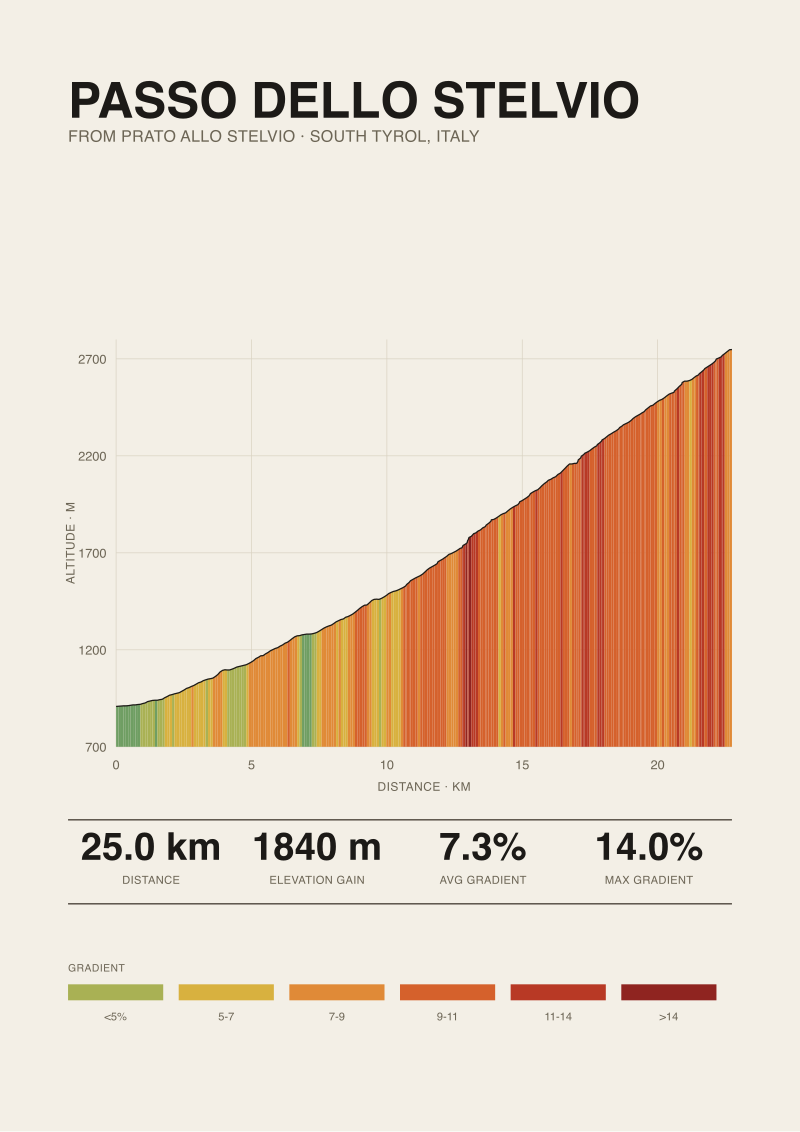 Passo dello Stelvio
The print from this article · from €29.95
View the print →
Passo dello Stelvio
The print from this article · from €29.95
View the print →
The Rule I Use Instead: Gradient-Kilometres, Not Kilometres
The rule that survives this argument, in our experience of measuring climbs before drawing them, is not length and not maximum gradient. It is gradient-kilometres — average gradient multiplied by length, which is really just elevation gain in different clothes. It is the single number that predicts how much of a rider a climb will demand, and it collapses the length-versus-steepness argument into something you can compare across profiles honestly.
By that metric, the Stelvio at 1,840 gradient-kilometres — really, 1,840 metres of gain — sits above Ventoux at 1,575, Tourmalet at 1,405, and Gavia at 1,366. A nine-kilometre climb at ten percent average delivers 900 gradient-kilometres. A twelve-kilometre climb at nine percent delivers 1,080. Both are severe. Neither reaches the Stelvio's number, and neither reaches the Gavia's. That is not the long climbs being flattered — that is the metric that actually predicts what a rider will pay lining up with what a rider actually pays.
This is not a new observation in principle. Riders who plan their seasons around specific mountains have always used elevation gain as the anchoring number, because they know that is what the body remembers the next day. The pub argument uses maximum gradient because it is dramatic and it prints well. The training log uses gain because it is honest. Our profiles keep landing on the same conclusion the training logs did: what matters is the integral under the curve, not the tallest single spike.
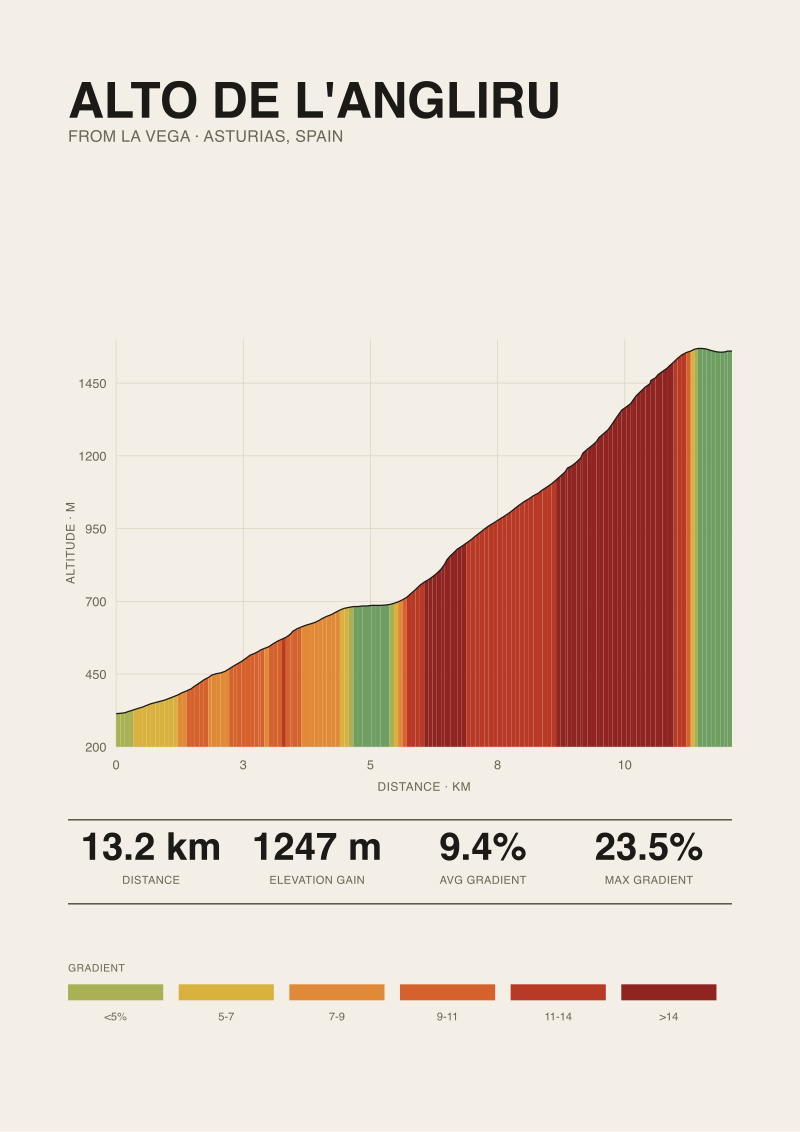
There is a corollary that follows from this and it is where the sub-10km argument gets its second wind, legitimately. If gradient-kilometres is the metric, then a truly severe short climb can outscore a mediocre long climb. A ten-kilometre climb at twelve percent delivers 1,200 gradient-kilometres — more than the Tourmalet, more than the Gavia. That climb, if it exists as a paved road (and the Angliru's steepest sections plus the run-in do approach this arithmetic), does belong in the conversation with the monuments. What it does not do is displace them, because the monuments still hold altitude and duration as separate axes the metric does not capture.
Gradient-kilometres is the floor of the argument. Altitude and duration are the ceiling. The sub-10km camp wins on the floor when the wall is severe enough. It cannot reach the ceiling by definition.
When the Old Rule Still Wins: Duration Is Its Own Category
The concession the metric forces is worth stating plainly. Duration under load is a physiological test that gradient-kilometres does not fully describe. A climb that takes a rider ninety minutes at threshold is not the same test as a climb that takes them forty minutes at threshold, even if both climbs demand roughly the same total work. The forty-minute climb is a VO2 test. The ninety-minute climb is a threshold-plus-nutrition-plus-cooling test, and the last thirty minutes of it recruit systems the first sixty did not.
The Stelvio, Ventoux, Tourmalet and Gavia are all long enough that they belong to that second category for almost any rider. A sub-10km climb, however brutal its gradient, does not. It cannot. This is not a defect of the sub-10km climb — it is simply a different exam. The rider who wants to know what their long-duration ceiling looks like has to ride a climb long enough to test it, and no wall shorter than about forty minutes of climbing will do that job. Length is not a proxy for suffering, but it is a proxy for exam duration, and duration is the axis the old rule was quietly measuring the whole time.
If a print of one of these four climbs would sit well on your wall, our shop has them measured and drawn from the same profile data this piece is arguing from — climb prints of the Stelvio, Ventoux, Tourmalet and Gavia are there.
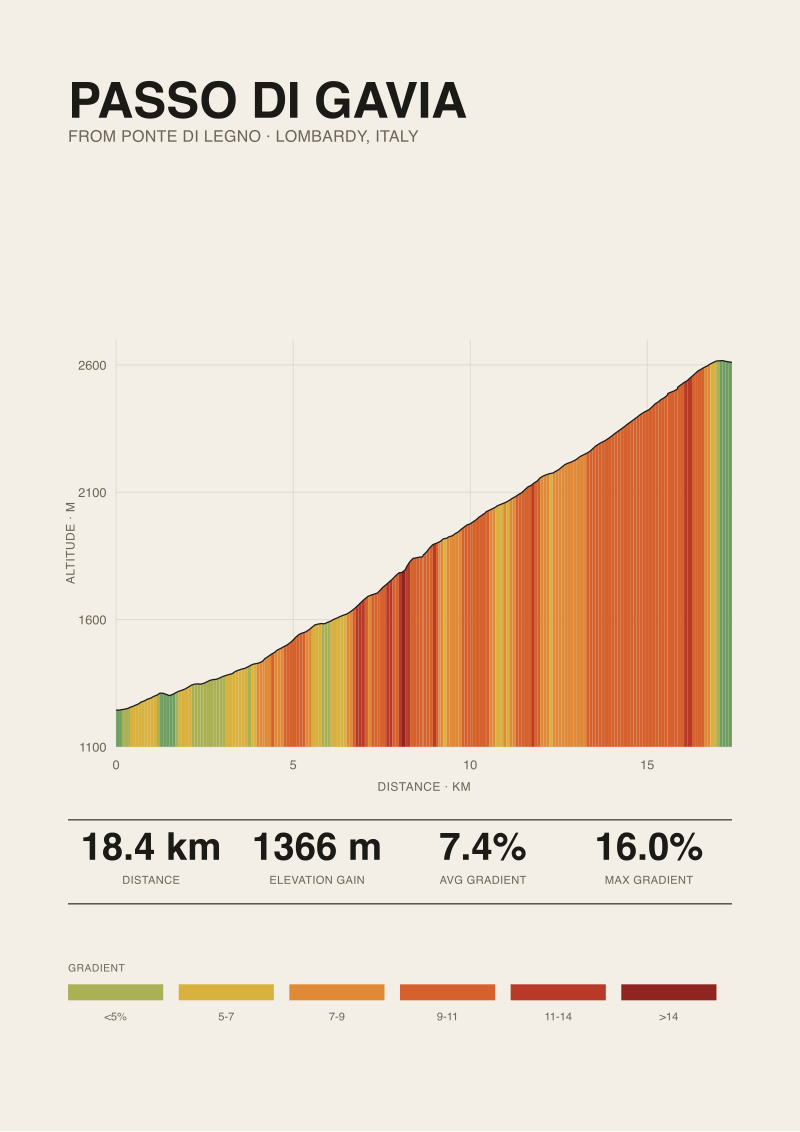 Passo di Gavia
The print from this article · from €29.95
View the print →
Passo di Gavia
The print from this article · from €29.95
View the print →
FAQ
Why do the Stelvio, Ventoux and Tourmalet all average almost exactly 7.3 percent?
Because engineered mountain roads converge on similar averages when the terrain is graded to be climbable at all. Our measured profiles put Stelvio from Prato allo Stelvio at 7.3 percent over 25.04 km, Ventoux from Bédoin at 7.3 percent over 21.51 km, and Tourmalet from Luz-Saint-Sauveur at 7.3 percent over 19.12 km. The Gavia from Ponte di Legno is 7.4 percent over 18.42 km. This is what alpine road engineering looks like as a physical constraint.
How do you reconcile the published maximum gradients with your satellite-derived profiles?
We treat them as different measurements. Our elevation data comes from OpenTopoData's SRTM 30-metre grid read along the actual road corridor — good for length, gain, and average, less precise for spot maxima. The published maxima we cite (14% Stelvio, 12% Ventoux, 12% Tourmalet, 16% Gavia) come from climbfinder, which draws on road-book figures. When the two disagree, we name both and let the reader decide which one matters for their question.
Is the maximum gradient really the number that decides how hard a climb feels?
No, and this is the whole argument of the piece. Maximum gradient tells you about one section, not the whole climb. Elevation gain — the integral of the profile — is a better predictor of what a climb costs a rider over its full length. A sixteen-percent ramp on the Gavia matters because it arrives inside 1,366 metres of total gain; the same ramp in isolation on a two-kilometre climb is a different physiological event entirely.
What is a gradient-kilometre and why prefer it to just quoting length?
Gradient-kilometres is average gradient multiplied by length in kilometres, which resolves to elevation gain in metres. It is the same number training logs have used forever. We prefer it in these arguments because it collapses the length-versus-steepness debate into a single comparable figure — the Stelvio's 1,840, the Ventoux's 1,575, the Tourmalet's 1,405, the Gavia's 1,366 — that a nine-kilometre wall has to actually reach, not just wave at.
Do sub-10km climbs deserve to be listed alongside the alpine monuments?
Some do, on the gradient-kilometres metric — a ten-kilometre climb averaging twelve percent delivers 1,200 metres of gain, which puts it in the Tourmalet's neighbourhood on that axis. What no sub-10km climb can do is match the monuments on altitude or duration. The Stelvio summits at 2,748 metres, the Gavia at 2,610. Those are separate exams a short climb cannot sit for by definition.
Why does climb duration matter as a separate axis from total gain?
Because physiology changes at the ninety-minute mark in ways it does not at forty. A climb long enough to be a threshold-plus-nutrition-plus-cooling test recruits fuel and thermoregulation systems a shorter effort does not. The four climbs in our measured set — Stelvio, Ventoux, Tourmalet, Gavia — are all long enough to sit that exam. A wall shorter than roughly forty minutes of climbing tests a different system, however severely.
Which of these four climbs is the hardest, then, by your metric?
By gradient-kilometres, the Stelvio from Prato allo Stelvio at 1,840 metres of gain over 25.04 km. The Ventoux from Bédoin is second at 1,575 metres. Tourmalet from Luz-Saint-Sauveur is 1,405, Gavia from Ponte di Legno is 1,366. Add altitude and the ordering shifts — the Gavia summits at 2,610 metres, higher than Ventoux or Tourmalet — but the total-work ranking is unambiguous from our measured profiles.
From the collection
New climbs and 10% off your first print.
One email now with your code. No noise after.