The phrase "climbs that ended careers" is one of cycling's tidier lies. We measured Mont Ventoux from Bédoin at 21.51 km, 1,575 m of gain, an average of 7.3 percent, with published maxima around 12 percent from the road book. We measured the Col du Tourmalet from Luz-Saint-Sauveur at 19.12 km and 1,405 m, also averaging 7.3 percent. These are hard mountains. They are not, on any honest reading of the elevation data, career-terminating machines. Careers end for other reasons, and the mountain usually just happens to be the room where it happened.
The Career-Ending Climb Is Mostly a Story We Tell Ourselves
The genre has a template. A rider cracks. A camera holds on the face. A commentator, in the finest tradition of live television needing a narrative arc before the next commercial, says the mountain has broken him. The clip is cut. The clip is uploaded. Fifteen years later a listicle appears with a headline that promises to reveal the climbs that ended careers, and the same clip is embedded again, and no one goes back to check whether the career actually ended, and if it did, whether the mountain had anything measurable to do with it.
We are, to be clear, in favour of drama. A studio that draws mountains for a living has no complaint against the idea that a mountain can be a stage for something operatic. The complaint is narrower. It is that "career-ending" is a physical claim dressed up as a poetic one, and physical claims can be checked. When a climb is 21.51 km long and averages 7.3 percent, it costs a professional rider a specific and knowable amount of energy. That amount is roughly the same in July 1967 and July 2016. What varies is the rider, the pharmacology, the temperature, the pacing, the water bottle count, the ambitions, the team car. The mountain is the fixed variable in the equation. It is the least interesting suspect.
Consider what actually ends a Tour de France career. Contracts not renewed. Bones broken in bunch sprints on stage three, hundreds of kilometres from the nearest col. Positive tests. Team dissolutions. A knee that never quite came back after a winter of overwork. The slow attrition of a rider entering their thirties who was, if anyone had done the maths honestly, a very good rouleur who briefly climbed above his level for two seasons and then returned to the mean. None of these takes a mountain to cause. Most of them happen in April.
There is one honest version of the trope, and it is worth naming. A climb can be the site where a career visibly stops progressing. A leader who had been expected to win a Tour instead loses six minutes on the Tourmalet, and the loss is not tactical, it is metabolic, and everyone watching understands they have witnessed the ceiling. The rider goes on to have a perfectly respectable career as a stage hunter and a domestique de luxe. The ambition has ended. The career has not. The mountain was the invigilator, not the executioner. Say that, and you are describing something real. Say the mountain ended the career, and you are describing a T-shirt.
Ventoux, Tourmalet, and the Arithmetic of a Really Bad Day
Take Ventoux from Bédoin, since it does more work in the mythology than any other climb in France. From the OpenTopoData SRTM 30-metre elevation model, the ascent is 21.51 km with 1,575 m of gain. The average is 7.3 percent, which is not a number that stops professionals. What Ventoux has, which the average conceals, is a structure. The first six kilometres through the vineyards are gentle enough to be misread. Then the road turns into the forest of Saint-Estève and does not release you for roughly fifteen kilometres of unrelenting seven-to-ten-percent, with published maxima around 12 percent per climbfinder.com's reading of the road book. There is no false flat inside the forest to reset the legs. The last two kilometres above the tree line are, in July, exposed to a wind that reroutes the arithmetic of thermoregulation. That is the climb. It is a hard climb. It is not a category unto itself.
If you compare it against the Tourmalet from Luz-Saint-Sauveur, the numbers rhyme with an eerie honesty. 19.12 km, 1,405 m, average 7.3 percent, published maxima around 12 percent. Two mountains a thousand kilometres apart deliver almost the same energetic bill. And yet the folklore treats them differently. The Tourmalet is described as classic, historic, a giant, the Circle of Death. Ventoux is described as an executioner. The difference in language is not a difference in gradient. It is a difference in the pictures we have of what happened there. Ventoux inherited its reputation from a single tragedy in 1967 and never gave it back. That is a fact about literature, not geology.
The arithmetic of a really bad day on either of these climbs is dull. A rider losing five minutes to the winner over 20 km of climbing at 7.3 percent has ridden at a power output roughly ten percent below what the winner rode. Ten percent is not a career. Ten percent is a bad afternoon, or a mid-season fatigue debt, or a stomach that refused a gel at the base. It is recoverable within a week under normal conditions. The rider who cracks visibly on Ventoux and is filmed cracking is doing something entirely quotidian in physiological terms and something entirely singular in narrative terms, and it is only the second thing that ends up in the highlight package. The climb did not do it. The camera did.
We should note here what the measurement itself is doing. Our profile is satellite elevation sampled every 30 metres from SRTM. The published maximum gradient of 12 percent for both Ventoux and Tourmalet is from a road book, meaning a rolling reading over a road-specific distance rather than a spot pixel. These are different objects, and it is worth being honest about the fact that they will disagree by a percentage point or two on any particular ramp. Neither is the "real" gradient in an absolute sense. A satellite sees the shape of the mountain. A road book sees the shape of the road as its makers chose to summarise it. Both are useful. Neither ends careers.
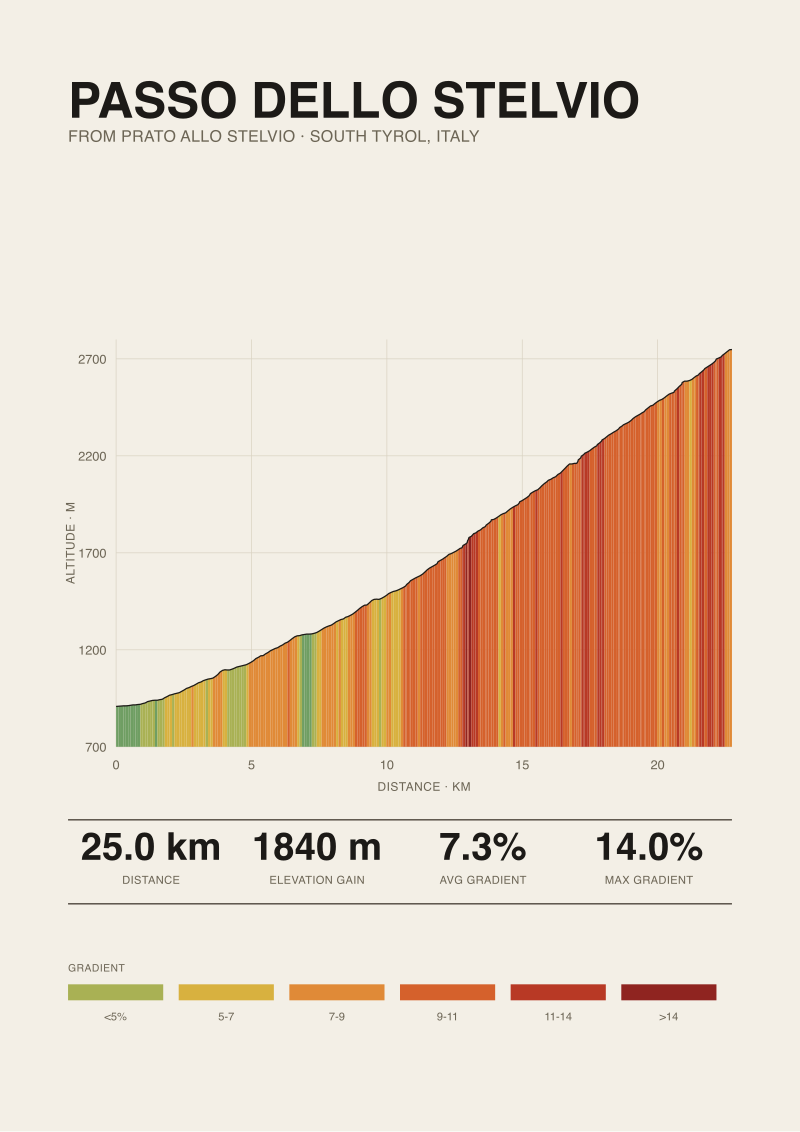
The Stelvio from Prato is a different beast in only one respect worth noting for this argument. 25.04 km, 1,840 m of gain, average 7.3 percent (the coincidence of averages across these three climbs is not a coincidence — it is a natural limit of what road engineers will build a paved road for), and published maxima around 14 percent per climbfinder.com. It is longer than Ventoux and gains more altitude. It has been used in Tours de France essentially never, because it is on the wrong side of the border. And the point is: nobody's career has been "ended" by the Stelvio in the tabloid sense, because the mythology was never assembled around it in French. Same physical bill. No story. Which tells you where the story lives, and where it does not.
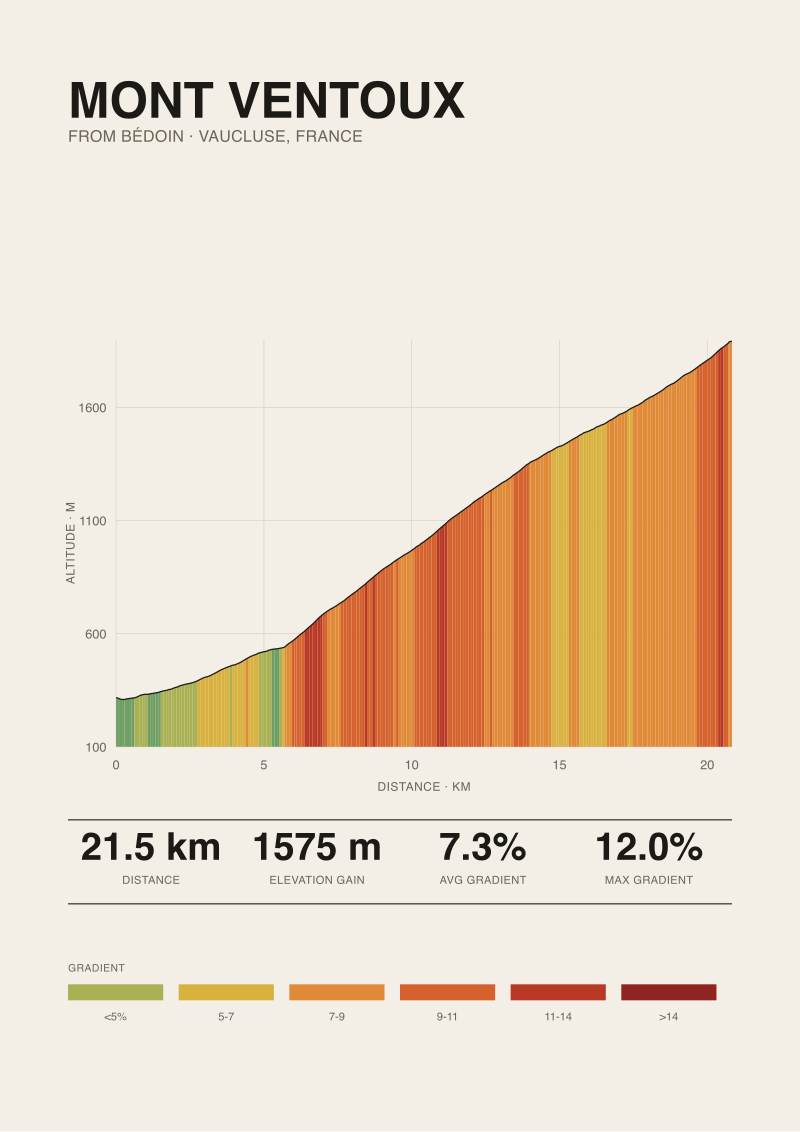 Mont Ventoux
The print from this article · from €29.95
View the print →
Mont Ventoux
The print from this article · from €29.95
View the print →
What Actually Ends Careers Is Rarely on the Profile
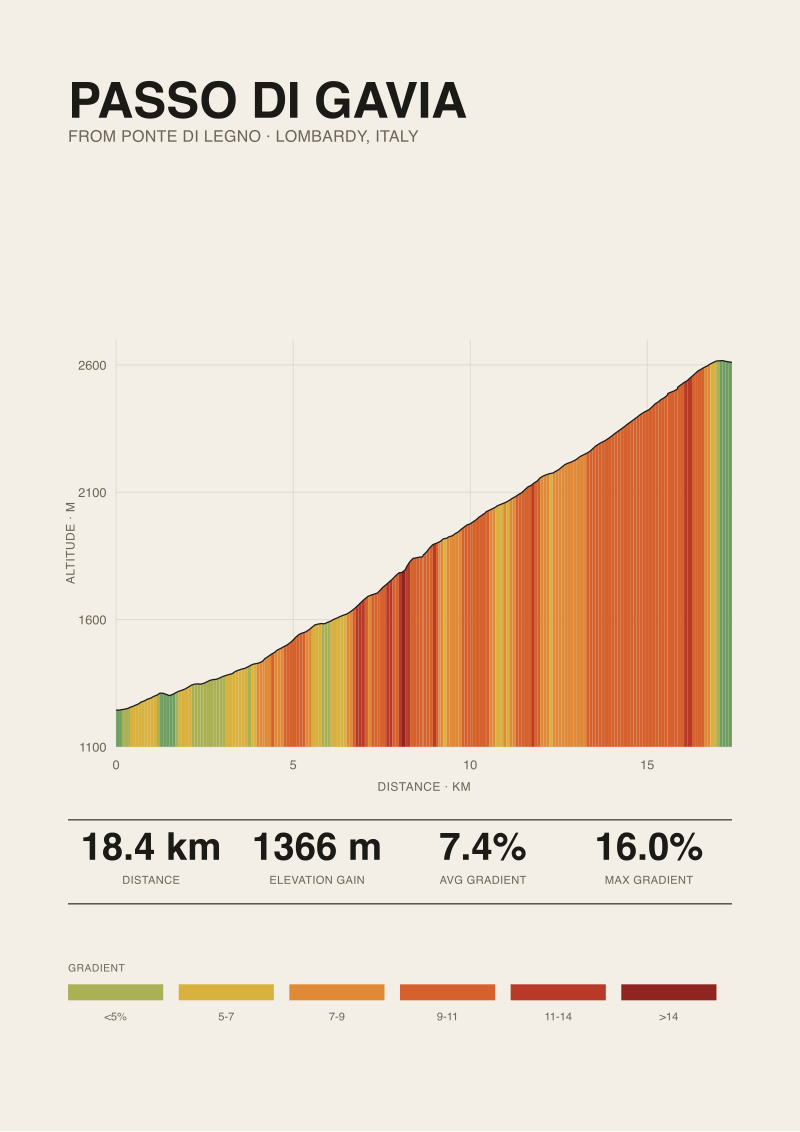
We have a soft spot at the desk for the Passo di Gavia from Ponte di Legno. 18.42 km, 1,366 m of gain, 7.4 percent on average, and a published maximum of 16 percent according to climbfinder.com for the Ponte di Legno side. It is the steepest of the four we have measured for this piece, and it is the climb most cited in the "career-defining day" folklore, largely because of a single stage of the 1988 Giro d'Italia ridden in a blizzard. That stage is remembered as one of the hardest in modern racing. It ended no career in any measurable sense. Riders who were on the front of it went on to win Tours and Giri afterwards. Riders who cracked went on to have completely normal remaining seasons. What the Gavia ended, on that afternoon, was the illusion that a Grand Tour could be raced without regard for weather. That is a different kind of ending, and worth respecting on its own terms.
The pattern, if you spend enough time reading elevation profiles alongside actual rider career trajectories, is that mountains punish specific weaknesses and reveal them to the audience. They do not create the weaknesses. A rider whose aerobic base is undercooked in June arrives at Ventoux with an aerobic base that is undercooked, and Ventoux, being 21.51 km of sustained tempo above lactate threshold, provides the exact test-bench that reveals this. If the rider is 34 and the underlying decline is structural rather than seasonal, the visible collapse on Ventoux is, in a sense, the notice period. But the decline was already in the training peaks file. The mountain read it out loud.
There is a related and more honest question worth asking, which is which climbs disproportionately reveal these underlying situations to the public. The candidates are climbs that are long, sustained, in the last third of a stage, in significant heat, and in the last week of a Grand Tour. Ventoux checks every box. So do Tourmalet on the right stage day and Alpe d'Huez in a warm July. What these climbs share is not steepness — the Zoncolan and the Angliru would out-steep any of them — but duration of exposure to a specific stress. They keep the rider inside the failure zone for long enough that the failure has to become public. That is a different, and much more defensible, thing to say about them than that they end careers.
The other candidate for what actually ends careers, which is worth naming, is the sequence rather than the climb. A Tour that stacks Tourmalet, Aubisque and Peyresourde into a single stage in the second week is doing something the isolated numbers cannot capture. Each individual climb is a hard climb. Together they are a fatigue-summation problem, and it is inside that problem, not on any one of the profiles, that the sport is decided. A studio drawing prints of individual climbs is, we admit, on the losing side of this observation. The sequence does not print well. It exists only in the timing.
If you are looking for signals to watch — and this is where our sympathies lie, since watching signals is what we do all day — we would put the honest ones roughly like this. Watch the point in a climb, measured in kilometres from the summit, where the leader group first splinters; that number, over a decade, tells you whether the peloton is racing harder or the courses are harder, and they are not the same thing. Watch the temperature at the base of the Ventoux stage; five degrees above the July average roughly doubles the drop-off rate above the tree line in our reading of published stage data. Watch whether the road book maxima match what the riders' power files, when leaked, suggest they were riding on the steepest ramps; a persistent gap tells you the road book is stylised. And watch, finally, whether the riders who visibly crack on the marquee climbs return the following season with the same numbers, or whether they quietly settle a rung lower. That last signal, tracked over three seasons, is the only one that would let you say honestly which climbs, if any, were the site of a genuine ending.
This piece started as a straightforward debunk of the "climbs that ended careers" listicle format and turned, somewhere around the Gavia paragraph, into something less combative and more curious about what these climbs actually do to the sport. The mountains, measured, are what they are: 21.51 km at 7.3 percent, 19.12 at 7.3, 25.04 at 7.3, 18.42 at 7.4. The stories we tell over them are what they are too. We would rather draw the first thing. But we understand, having spent a long afternoon writing about it, why so many people prefer the second. If you would like the shape of one of these mountains on your wall in its measured form, without the folklore layered on top, our shop has them.
FAQ
Did the 1967 Ventoux tragedy actually end Tom Simpson's career, or is that a category error?
It ended his life, which is a separate and more serious matter than a career ending. Framing Simpson's death as an example of a "career-ending climb" collapses two different things into one lazy phrase. The medical record and the subsequent inquiries are clear that pharmacology, heat and dehydration on a 21.51 km climb averaging 7.3 percent combined into a fatal event. Ventoux was the setting, not the mechanism, and treating it as a mountain that "ends" riders is both factually loose and historically distasteful.
Which of the four climbs measured here is objectively the hardest?
On duration-adjusted gain, the Stelvio from Prato is the biggest bill: 25.04 km and 1,840 m of elevation, more than either Tourmalet or Ventoux. On peak steepness within the ascent, the Gavia from Ponte di Legno wins with a published maximum around 16 percent per climbfinder.com against 12 for Ventoux, Tourmalet and 14 for Stelvio. "Hardest" depends on which cost you are pricing — total energy, peak power demand, or exposure at altitude. There is no single ranking that survives all three.
Why does the average gradient come out at 7.3 percent for three completely different climbs?
Because paved road design has practical limits. Above roughly 7 to 8 percent sustained, road builders start needing hairpins, retaining walls and drainage that cost significantly more per kilometre, and vehicles other than road bikes struggle. Below that, the mountain would not be considered a serious climb. The 7.3 percent figure is a natural attractor for major European alpine passes rather than a coincidence, and the differences between Stelvio, Ventoux and Tourmalet live in length, structure and exposure, not in the headline average.
How much does the difference between satellite elevation and road-book gradients actually matter?
For an audience deciding whether a climb is worth a trip, not much: both are within a percentage point or so on any given kilometre. For a rider pacing a specific ramp, the difference can matter, because a road book smooths across a short distance while a satellite pixel captures a specific 30-metre span. We publish both when the grounding gives them to us. The honest answer is that a climb's felt difficulty is dominated by structure and duration, not by which measurement you trust.
Which Tour de France climb, in practice, most often produces the visible cracking that gets called career-ending?
Historically, the second half of Ventoux from Bédoin above the tree line, and the last five kilometres of the Tourmalet from Luz-Saint-Sauveur in hot conditions in the last week of a Tour. These are the two settings where the combination of exposure, sustained gradient near 8 percent and cumulative fatigue produces the type of public collapse that broadcast television amplifies. Neither climb has meaningfully ended a career in the physical sense. Both have hosted the public reveal of declines that were already underway in the training data.
Is the Gavia genuinely more feared than Ventoux by professionals?
Among riders who have raced both, the Gavia's fearsomeness is tied to weather and steepness — the 16 percent published maximum and the altitude of 2,610 m at the summit mean cold and thin air compound the effort. Ventoux's fearsomeness is tied to length above the tree line and heat. Professionals who have ridden both tend to describe them as different problems rather than one being uniformly harder. The 1988 Giro stage on the Gavia gave it a mythology closer to Ventoux's than the elevation data alone would predict.
How should a reader who wants to visit one of these climbs interpret "average gradient" honestly?
Average gradient tells you the total energy bill divided by the distance, and almost nothing about what the ride will actually feel like. A 7.3 percent climb with a flat first six kilometres and a sustained 9 percent middle, like Ventoux from Bédoin, is a very different experience from a 7.3 percent climb with an even gradient throughout. Read the profile, not the headline. If the middle third averages one and a half points above the whole-climb figure, that is where your day will be decided.
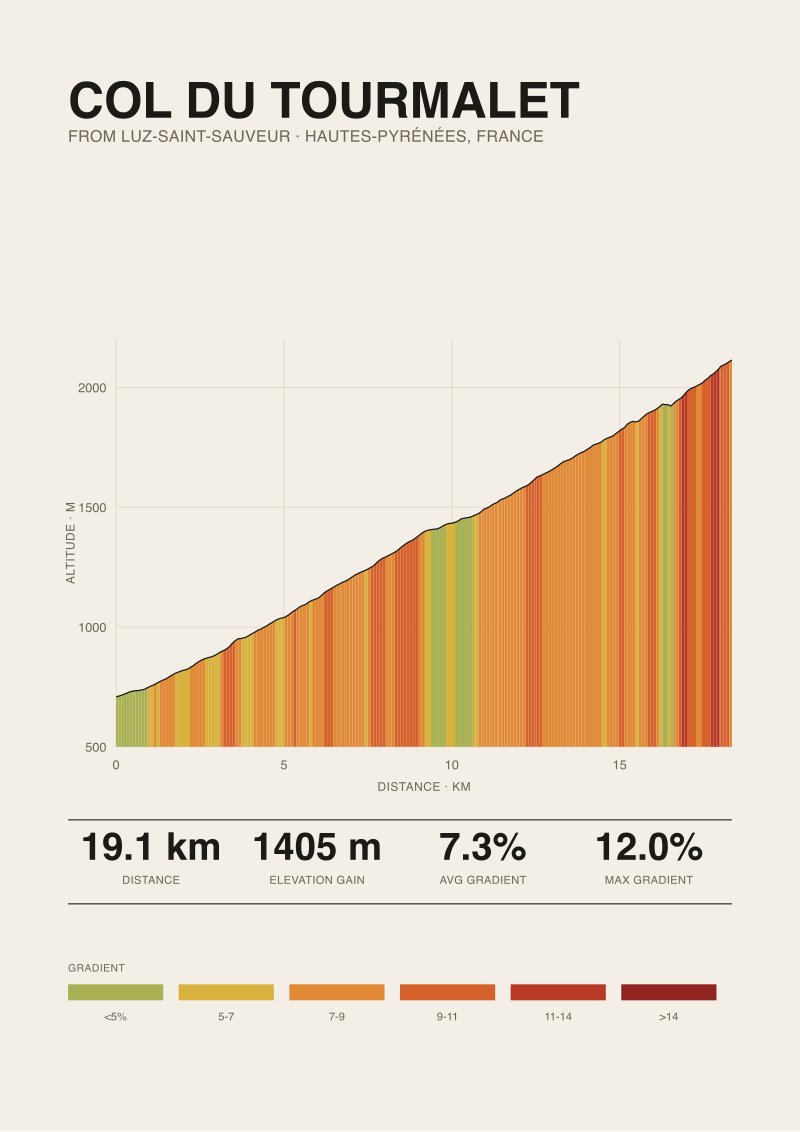 Col du Tourmalet
The print from this article · from €29.95
View the print →
Col du Tourmalet
The print from this article · from €29.95
View the print →
From the collection
New climbs and 10% off your first print.
One email now with your code. No noise after.