Two cycling destinations, one recurring question, and a comparison the internet almost always answers with vibes. Mallorca or Girona. The problem is that neither of them appears in our measured climb dataset — the profiles we have in front of us today are Stelvio at 25.04 km and 1,840 m of gain, Ventoux at 21.51 km and 1,575 m, Tourmalet at 19.12 km and 1,405 m, and Gavia at 18.42 km and 1,366 m, all averaging around 7.3 to 7.4 percent. That absence is the honest starting point for this piece, and it shapes what we can and cannot say next.
Mallorca and Girona Are Not the Same Kind of Climbing Problem
The first thing to say out loud is that these two destinations get compared as if they were competing hotels. They are not. They are two structurally different climbing environments, and most of the internet's arguments about which is "better" quietly assume the reader wants the same thing from each. They do not.
Mallorca is an island. Its climbing spine, the Serra de Tramuntana, runs along the northwestern coast and drops directly into the Mediterranean. The riding starts at sea level, so a climb that summits at even a modest altitude is doing the full vertical work from the water up. There is no gradual valley approach, no 400 m of altitude already banked before the road tilts. Compare that mentally to a climb in our dataset like the Tourmalet from Luz-Saint-Sauveur, which begins at 709 m and finishes at 2,114 m — a large climb, but one where the rider spent the drive gaining the first altitude for free. On Mallorca, the road pays for every metre.
Girona is not an island. It is a small Catalan city that happens to sit in a geographic position that gives a rider two entirely different climbing menus from the same coffee shop. To the east and south are the coastal ranges of Les Gavarres and the Massís de les Gavarres, giving short, rolling, endless-route riding on paved back-country roads. To the north and northwest, the terrain rises toward the Pre-Pyrenees and, eventually, the Pyrenees themselves — the same range that hosts Tourmalet 400 km further west. This means Girona is fundamentally a base town, not a climbing region in its own right. Its climbing character depends on which direction the rider points the front wheel that morning.
That structural difference produces two different weeks on the bike. A Mallorca week tends to be a repeating loop of the Tramuntana coast, with climbs threaded together into circuits, and the terrain doing most of the work of route design. A Girona week tends to be a fan pattern, with rides radiating out from a single town, each direction offering a different kind of day. Neither is superior. They are answers to different questions.
The comparison the vibes-based articles almost never make is the one that matters: the reference frame. If a rider's mental model of "a proper climb" is the four profiles we have measured — an HC-scale, 18-to-25-km ascent with 1,300 to 1,800 m of gain and a sustained 7-plus-percent average — then neither Mallorca nor Girona will meet that bar on their home roads. That is not a criticism of either destination. It is a category clarification. The bar itself belongs to the Alps, the Pyrenees, and the Dolomites, and the four measured profiles in front of us are what that bar looks like as data. Comparing a coastal Mediterranean climbing week to a Stelvio ascent is a genre error, not a ranking question.
What Our Grounding Actually Contains — and What It Does Not
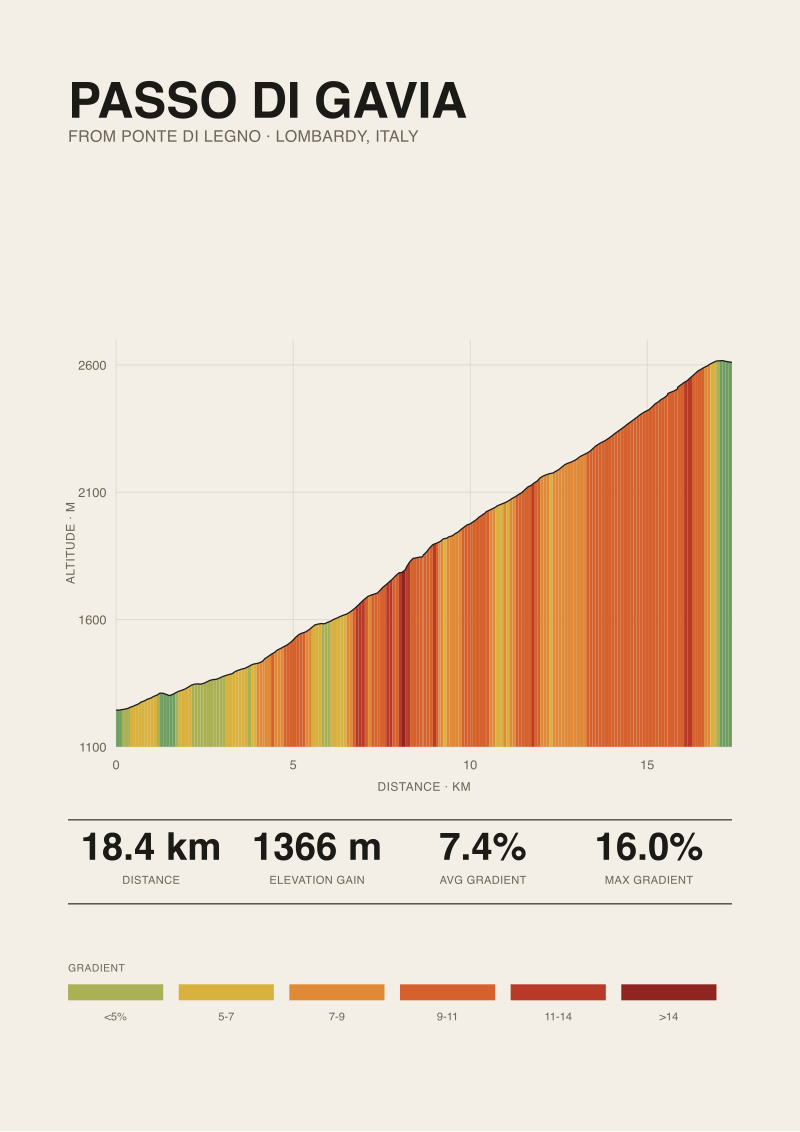
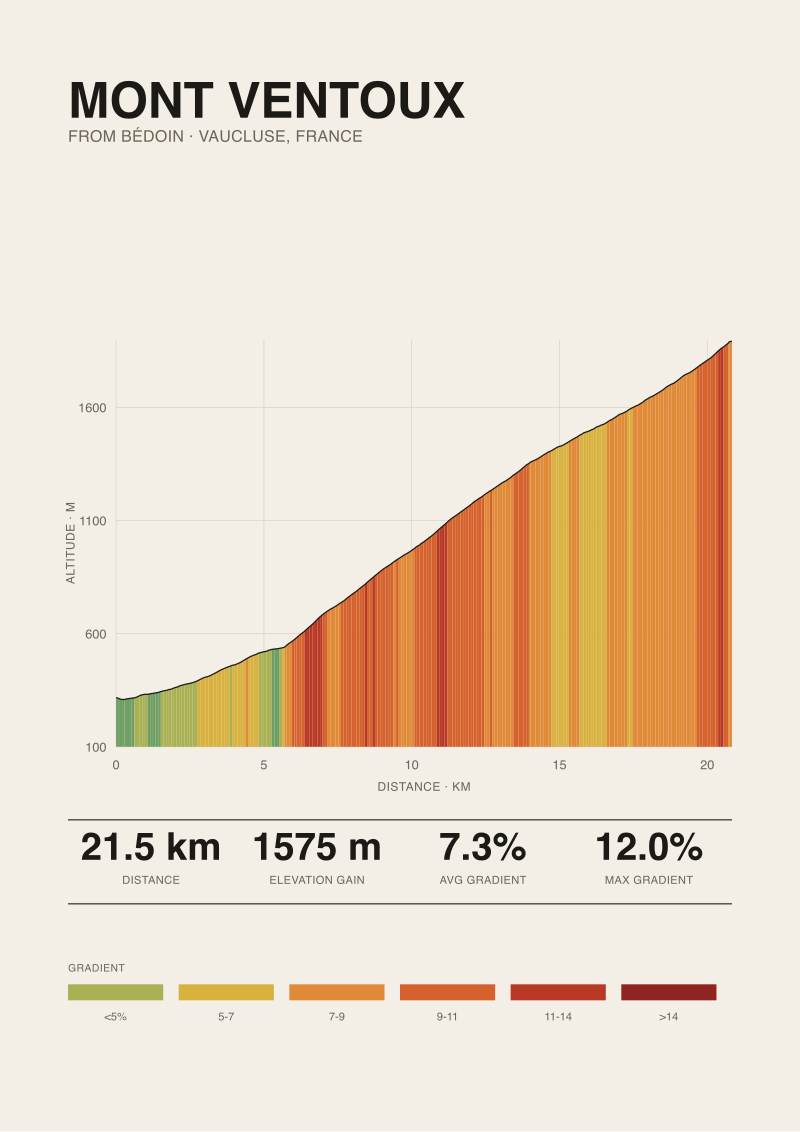
We should be direct about what the dataset in front of us can and cannot support, because this is where most cycling-destination comparisons quietly cheat. Our measured set today is four climbs. Stelvio from Prato allo Stelvio: 25.04 km, 1,840 m of gain, average 7.3 percent, summit at 2,748 m. Ventoux from Bédoin: 21.51 km, 1,575 m, average 7.3 percent, summit at 1,892 m. Tourmalet from Luz-Saint-Sauveur: 19.12 km, 1,405 m, average 7.3 percent, summit at 2,114 m. Gavia from Ponte di Legno: 18.42 km, 1,366 m, average 7.4 percent, summit at 2,610 m. Elevation data derived from OpenTopoData SRTM 30 m samples; published maximum gradients — 14 percent on Stelvio, 12 percent on Ventoux, 12 percent on Tourmalet, 16 percent on Gavia — sourced from climbfinder.com.
What that set describes, in plain terms, is a class of climb: high-mountain HC-scale ascents in the Alps and Pyrenees, all sustained around 7.3 to 7.4 percent, all with summits between 1,892 m and 2,748 m, all long enough that time-to-summit for a competent amateur is measured in hours rather than tens of minutes. That is a very specific genre of ride and it is not the genre that either Mallorca or Girona is famous for.
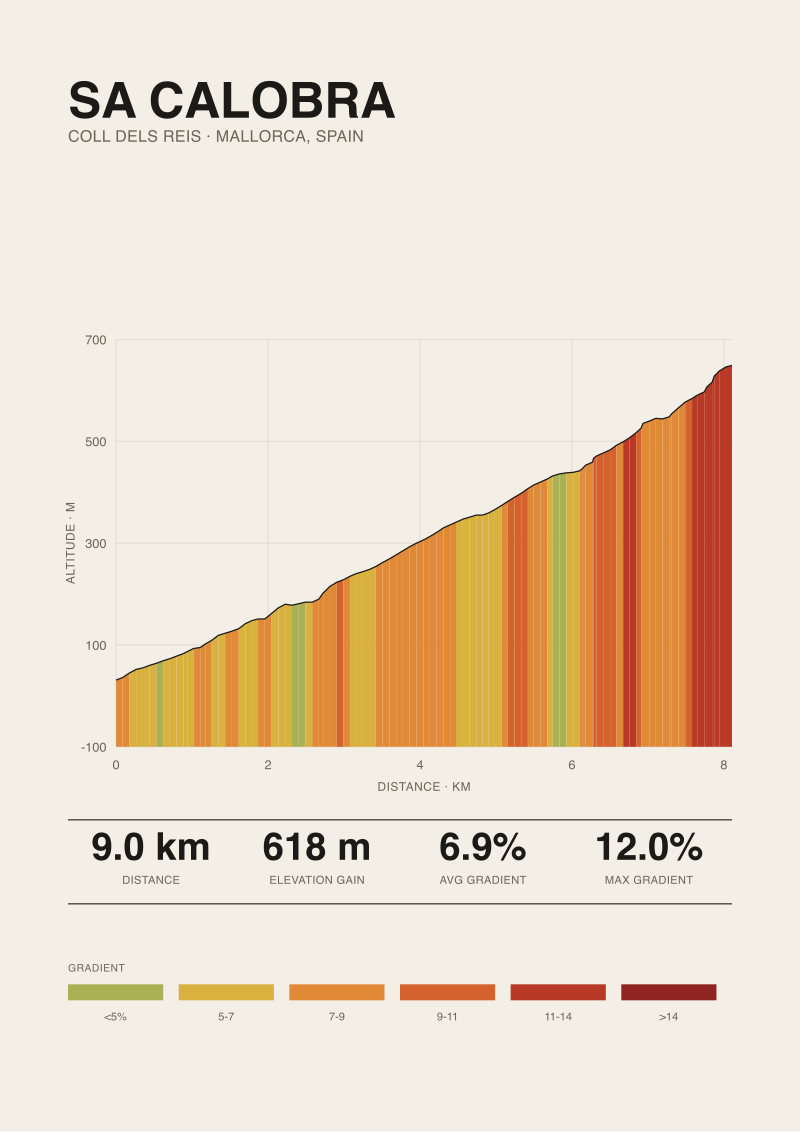
What the set does not contain is any measured profile of Sa Calobra, Coll de sa Batalla, Puig Major, Coll d'Honor, or the Coll de Sóller from either side — the climbs that would need to be in front of us to make grounded quantitative claims about riding the Tramuntana. It does not contain Rocacorba, Els Àngels, Mare de Déu del Mont, Sant Grau, or Santa Pellaia — the climbs that would need to be in front of us to make grounded quantitative claims about riding out of Girona. It does not contain Vallter 2000 or La Molina or any of the Pre-Pyrenean climbs a Girona-based rider might reach on a longer day. We have four profiles from three countries, none of them within 500 km of either destination in the query.
This is the point in a lesser article where the author would either quietly invent numbers or paste them from a route-planning website without saying where they came from. We are not going to do that. The measurement discipline of the studio is that a climb profile is the output of an elevation-data pipeline over a specific line, run on specific source data, with a specific method, and we do not have those pipelines run for the roads in question. Until we do, the honest position is that the character of Mallorca and Girona can be discussed as geography — because their geography is broadly established public record — but their climbs cannot be quantified in this piece with the same authority we bring to Stelvio or Gavia.
That admission is not a weakness of the argument. It is the argument. A comparison article that pretends to compare Sa Calobra and Rocacorba by average gradient, when the author has never measured either, is exactly the kind of content that trained the reader to distrust cycling media in the first place. Saying "we do not have that data yet" is more useful to a rider planning a trip than a confidently wrong number would be.
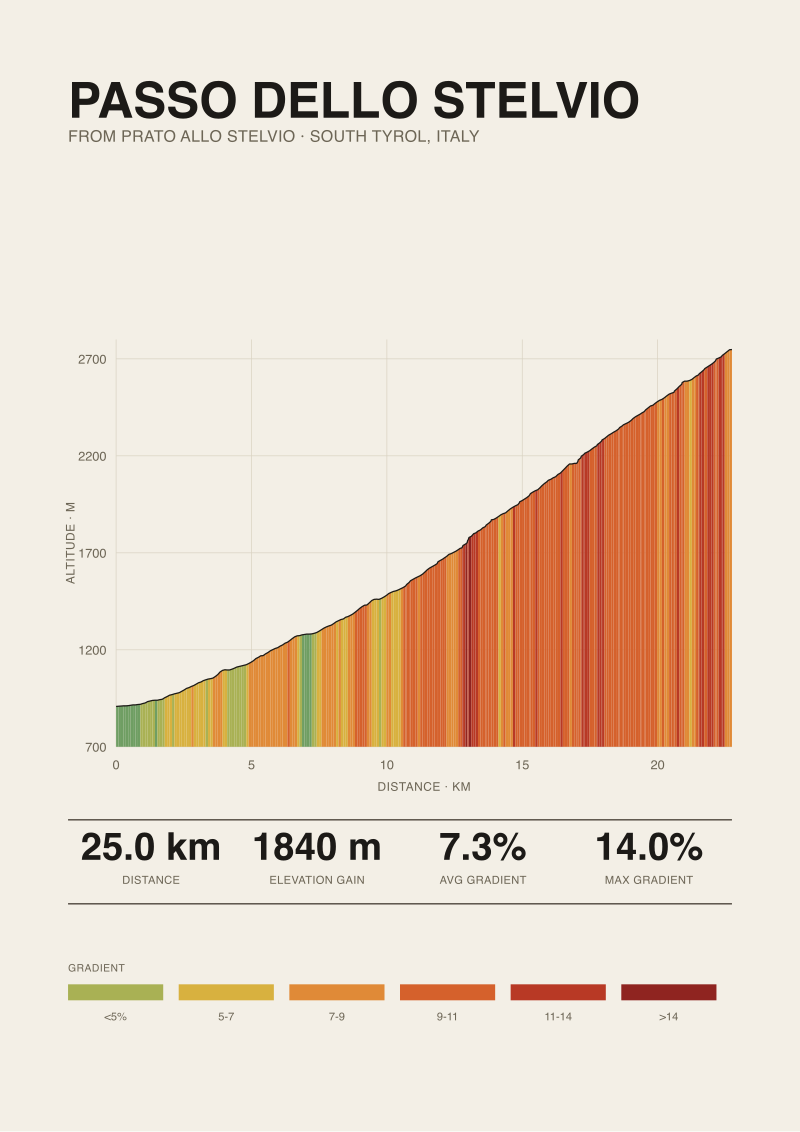 Passo dello Stelvio
The print from this article · from €29.95
View the print →
Passo dello Stelvio
The print from this article · from €29.95
View the print →
The Honest Verdict Depends on What You Came For
So where does that leave the actual question. It leaves it, as almost every serious cycling question leaves us, in the space of "it depends on what you came for" — and we can be specific about the axes.
If a rider is coming for climbing volume from a fixed base, with the road tilting up within twenty minutes of leaving the hotel, and a coastline as the visual reward, Mallorca is the more concentrated answer. The Tramuntana is essentially a linear supply of climbs stitched together by a single main road, and the geography does the route-design work. There is no thinking involved in stringing together a 2,000-m-gain day. The island is small enough that no ride requires a long transfer to reach the climbing. That is a specific and valuable proposition, and it is not what Girona offers.
If a rider is coming for training variety, for the ability to structure a two-week block that includes flat tempo days, rolling threshold days, coastal-range endurance days, and one or two big mountain days reaching toward the Pre-Pyrenees, then Girona is the more flexible answer. The city is a base, not a route. The variety is the product. That is a specific and valuable proposition, and it is not what Mallorca offers.
If a rider is coming for climbs that resemble what we have measured in this piece — Stelvio, Ventoux, Tourmalet, Gavia — neither destination is the answer. Neither has a 25-km ascent to 2,700 m at 7.3 percent. That is a bar set by tectonics, not by cycling culture, and the tectonics of the Balearics and coastal Catalonia do not produce it. A rider whose bucket item is a proper HC alpine climb should book a week around Bormio, Bédoin, or Luz-Saint-Sauveur and buy the plane ticket accordingly.
If a rider is coming for winter or shoulder-season riding that is genuinely warm and dry, Mallorca wins on latitude and coastal exposure, and this is the least contested claim in the entire comparison. Girona in February is a workable base for the professionally committed but a cold, wet gamble for the amateur booking two weeks off. This is a weather question, not a climbing question, and it is often the deciding one.
The comparison the vibes-based articles usually try to settle — "which one is better" — turns out to be the wrong shape of question. The shape that returns a useful answer is: what am I actually trying to buy with this trip, and does the destination's geography deliver it. On that framing, Mallorca and Girona are both correct answers to different questions, and the failure mode is picking one because a stronger rider on the internet said it was the one to pick.
This piece started as a straightforward comparison and turned into an argument about what a comparison can honestly claim without the underlying data. The four climbs in our dataset today are not in Mallorca or Girona, and the studio's measured-before-drawn discipline would not let us pretend otherwise. When the pipeline runs the Tramuntana and the roads north of Girona at the same SRTM-based resolution we used for Stelvio and Gavia, the next version of this argument will contain numbers where this one contains geography. If a Stelvio, Ventoux, Tourmalet, or Gavia is already on the wall of the rider's mental map, the prints of the measured profiles live at /shop/, and the day the Balearic and Catalan climbs join them, we will say so plainly.
FAQ
Is Mallorca or Girona better for a first European climbing trip?
Neither is universally better, and the framing hides the real decision. Mallorca is more concentrated and easier to plan: a fixed coastal base and climbs strung along a single mountain road. Girona rewards a rider who wants to design their own week from a menu of directions. A first trip usually goes better on Mallorca simply because the logistical friction is lower and the terrain does the route design for you.
Do Mallorca or Girona have climbs comparable to Stelvio, Ventoux, Tourmalet, or Gavia?
No, and the geography is the reason. The four profiles we have measured are HC-scale alpine and Pyrenean ascents of 18 to 25 km at around 7.3 percent, finishing above 1,890 m and, in the Stelvio's case, at 2,748 m. Neither the Serra de Tramuntana nor the coastal ranges around Girona produce sustained climbs at that scale. A rider whose target is a proper HC ascent should base near Bormio, Bédoin, or Luz-Saint-Sauveur instead.
Which destination is better for winter and early-season riding?
Mallorca, without much argument. It sits further south, its climbs are coastal rather than continental, and the temperature and rainfall profile in February and March is workable for amateurs on a two-week block. Girona is a viable winter base for professionals accustomed to cold-weather training, but the shoulder-season weather is a real gamble for a rider who has taken time off work and expects reliably dry roads.
Can I ride from Girona into the actual Pyrenees in a single day?
The geography allows it and riders regularly do, but "into the actual Pyrenees" is doing a lot of work in that sentence. A day ride from Girona reaches the Pre-Pyrenees comfortably; reaching the higher French-border ranges is a long day that most travellers plan around a car transfer or a multi-day loop rather than an out-and-back from the city.
Why does this article not contain measured profiles of Sa Calobra or Rocacorba?
Because we have not run our elevation-data pipeline over those roads yet, and the studio's rule is that a climb is only quantified in our own words once we have measured it ourselves against a specific source — currently OpenTopoData SRTM 30 m samples along a specific line. Pasting numbers from route-planning sites without that measurement discipline is exactly what we are trying not to do. When those pipelines run, the profiles will appear.
Is the average gradient a fair way to compare a Mallorcan and a Girona climb?
It is a starting point and not a finish line. Average gradient hides how a climb is distributed: whether the steep sections are early, middle, or late; whether they are sustained or spiked; whether there are flat recovery segments that inflate the length without adding load. Two climbs at an identical 7.3 percent average — which is exactly the case for Stelvio, Ventoux, and Tourmalet in our dataset — can feel like completely different rides. The same caution applies to any Mallorcan or Girona climb quoted by average alone.
Should I bring the same gearing to Mallorca and Girona?
Practically, yes for most amateurs — the sustained gradients on the marquee climbs in both regions sit within a range that a modern compact or sub-compact chainring with a wide-range cassette handles well. Neither destination is famous for the kind of sustained double-digit slabs that require unusually low gearing choices. The published maximum gradients we cite for our measured set — 14 percent on Stelvio, 16 percent on Gavia — are the kind of numbers that argue for low gears, and those numbers belong to a different class of climb than the ones a rider meets on Mallorca or around Girona.
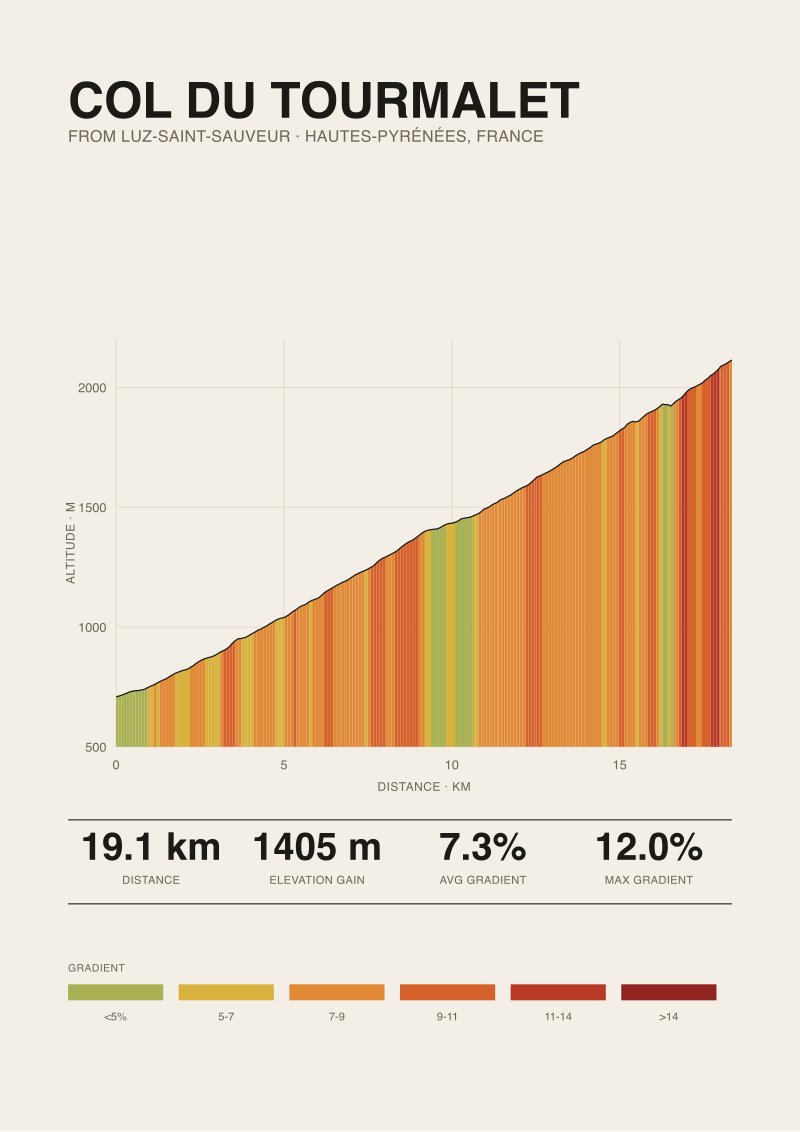 Col du Tourmalet
The print from this article · from €29.95
View the print →
Col du Tourmalet
The print from this article · from €29.95
View the print →
From the collection
New climbs and 10% off your first print.
One email now with your code. No noise after.