The story of the Col du Galibier in the Tour de France is usually told the same way. A roof of the race. A pass so severe that Henri Desgrange, the Tour's founder, is said to have called every other climb vulgar by comparison. A place where the general classification is decided because the air is thin and the road refuses to relent. It is a good story. It is repeated by every broadcast, every coffee-table book, every rider interviewed at the foot of the climb. And within its own frame, it is not wrong. The trouble is the frame.
Why the Legend Is Actually True
The Galibier entered the Tour de France in 1911, the first year the race crossed a pass above 2,000 metres. Émile Georget was first over the summit; only two other riders reached the top with him on the same page of the race report. Everyone else walked, or stopped, or gave up on the day. Desgrange's own writing about that first crossing set the tone that every cycling journalist since has either repeated or argued with. He treated the pass as a natural cathedral. In the years that followed, the phrase "roof of the Tour" became attached to it and never fully came off.
The roll call is genuine. Coppi crossed it in the 1952 Tour, on his way to a second overall win built on Alpine stages that included Alpe d'Huez as a first-time summit finish. Bahamontes went over it as the best climber of his generation. Merckx rode it in the yellow jersey. Hinault and LeMond had a version of their 1986 argument on its approaches. Pantani used it in the years when his Alpine raids defined a summer. In 2011, on the centenary of the climb's first Tour inclusion, the race put a summit finish there and Andy Schleck attacked from more than sixty kilometres out; Cadel Evans defended enough to save the yellow jersey he would go on to win in Paris. That is not a manufactured legend. Those are real days on a real road.
The altitude is also real. The Galibier's summit sits high enough that riders who have not acclimatised feel it in the last kilometres — pace drops, breathing changes, small efforts become expensive. Third-week Tours have unravelled on that road because bodies that were fine at 1,500 metres stopped cooperating at 2,500. And the stage geometry is real too. The Galibier is usually approached over the Col du Télégraphe, so a rider does not arrive fresh at the foot of the climb; there is already an hour of tempo in the legs. The legend rests on days when that combination decided a race. Those days happened. The concession is complete.
But the legend was built in an era when the race did not yet know what to compare it against.
Where the Legend Breaks Down
The word that does the mythmaking is "roof". It implies uniqueness — that the Galibier is where the race reaches its ceiling and everything else is beneath it. That is worth measuring against the climbs the Tour does not use.
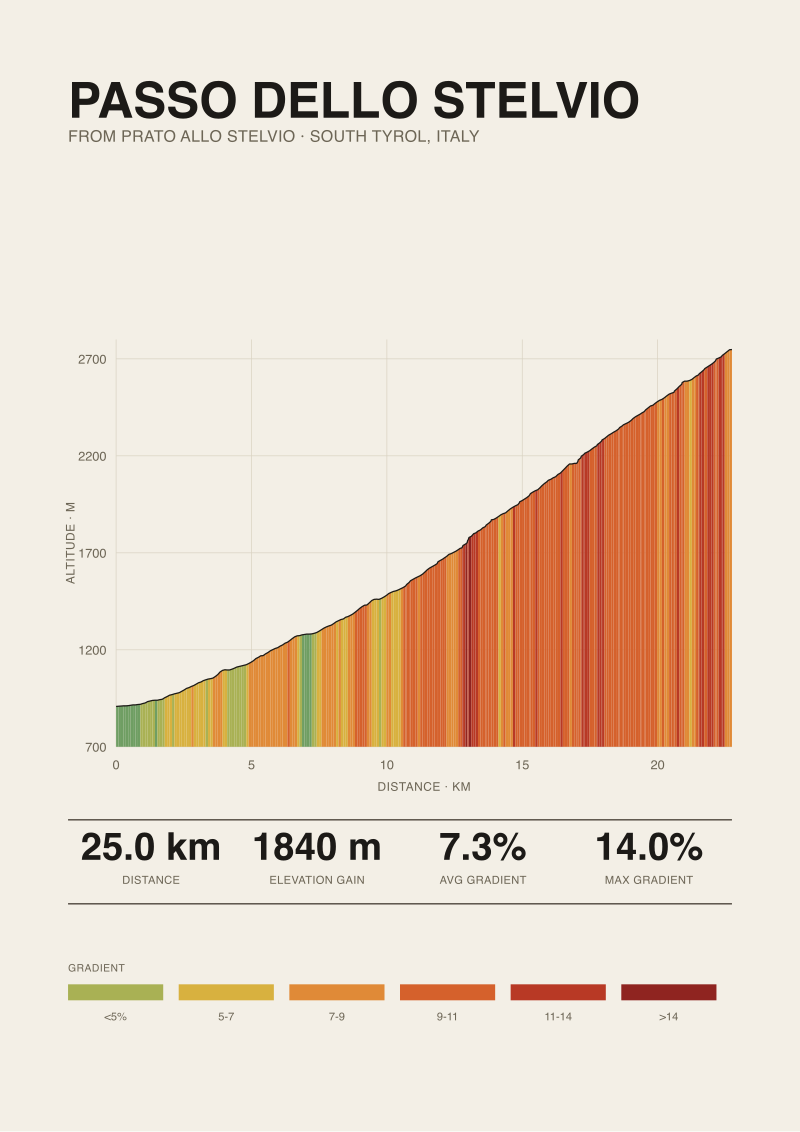
We have measured profiles of four of the great Alpine and Pyrenean passes on the Climb Prints desk. The Stelvio from Prato allo Stelvio, using OpenTopoData SRTM 30m elevation data, is 25.04 km long, gains 1,840 metres, averages 7.3 %, and summits at 2,748 metres, with a published maximum gradient of 14 % (climbfinder.com). That summit elevation alone is higher than the Galibier's. Stelvio has never appeared in the Tour de France, because it sits inside Italian territory and the race's route logic goes elsewhere. It is not a lesser climb — it is a different jurisdiction. If altitude were the honest arbiter of "roof of the race", the Tour would need an asterisk explaining that its ceiling is the ceiling of the roads it happens to choose.
Cime de la Bonette, when the Tour includes it, tops out higher than the Galibier. The Iseran, when included, is higher. Neither ever displaced the Galibier in the popular imagination. That fact by itself should tell us that altitude is not what does the work in the legend.
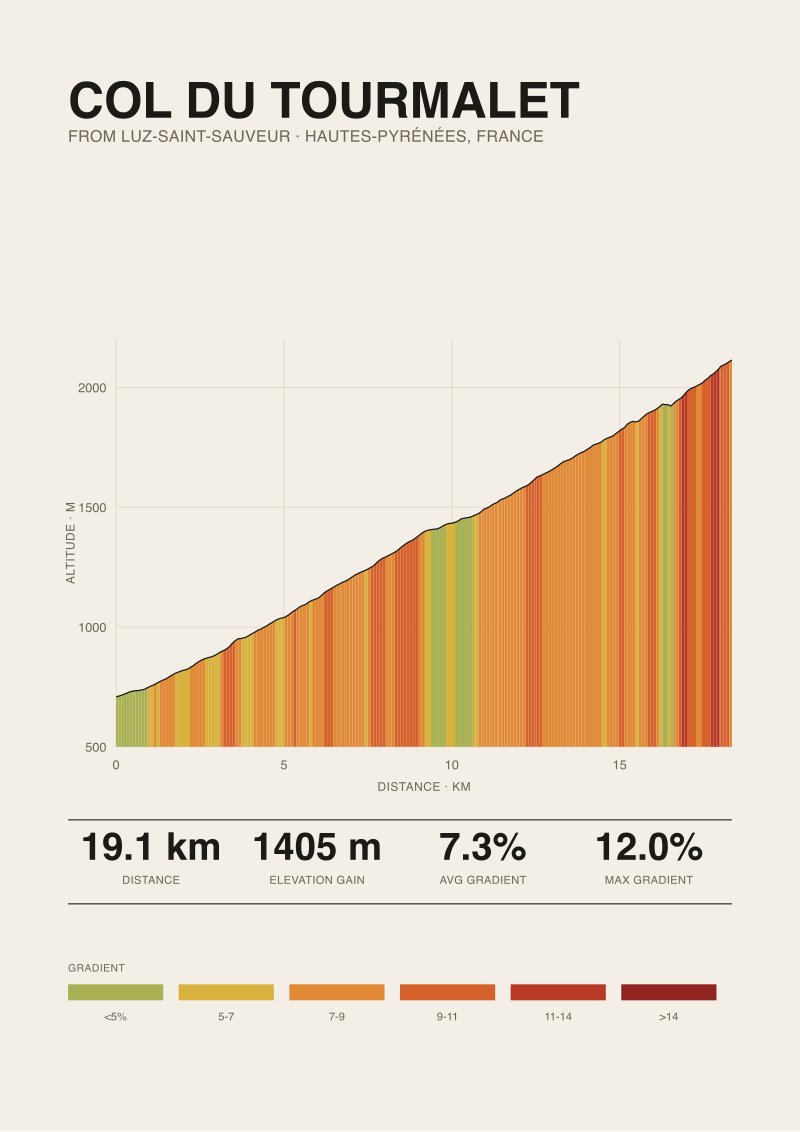
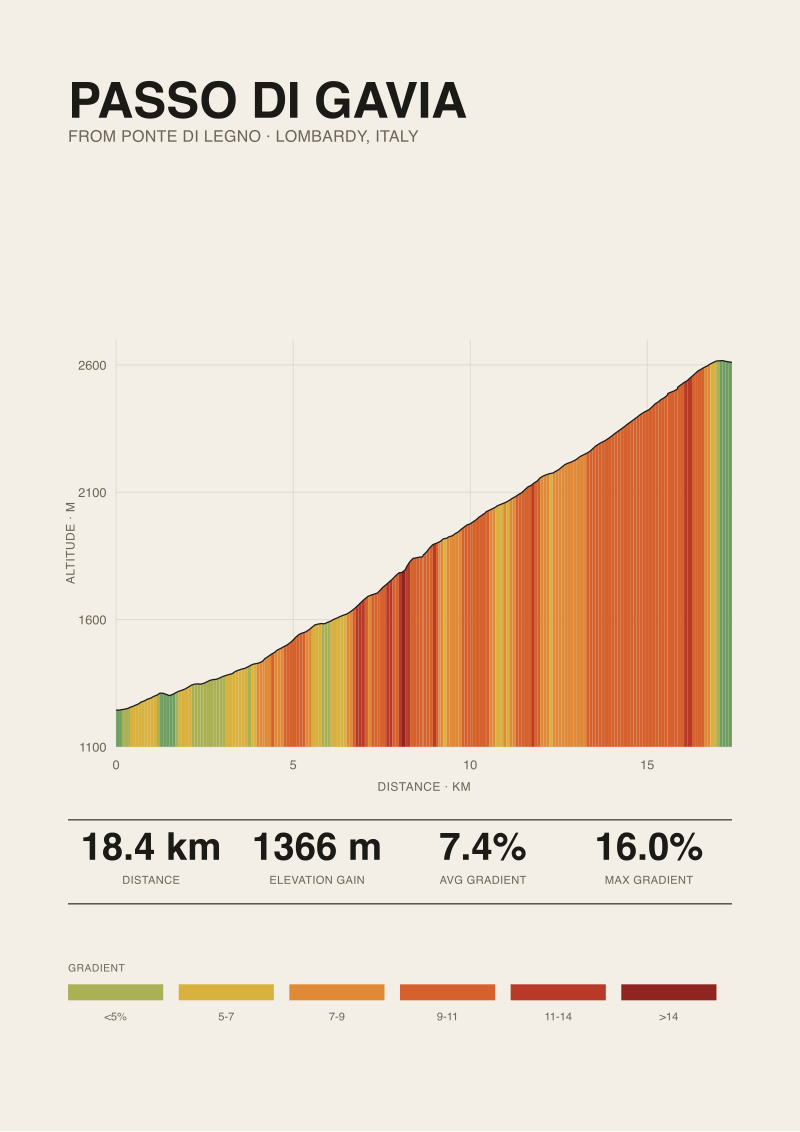
Consider gradient. The Ventoux from Bédoin, on the same measured basis, is 21.51 km, gains 1,575 metres, averages 7.3 %, and summits at 1,892 metres, with a published maximum of 12 %. The Tourmalet from Luz-Saint-Sauveur is 19.12 km, 1,405 metres of gain, 7.3 % average, summit at 2,114 metres, max around 12 %. The Gavia from Ponte di Legno — a Giro climb the Tour does not use — is 18.42 km, 1,366 metres, 7.4 % average, summit 2,610 metres, with a published maximum of 16 %. Each of those is a hard climb by any honest measure. The Tourmalet has been used in the Tour de France more than eighty times. The Galibier considerably less. If frequency of decisive appearance were the measure, the Tourmalet would be the totem, not the Galibier.
None of this diminishes the Galibier. It just relocates its significance. The legend rests on three things that are not strictly stats: Desgrange's founding-era canonisation, the geography of stages that route over the Télégraphe first and then use the Galibier as a fulcrum, and the visual grammar of a pass that opens onto a plateau above the treeline. Take away any one of those and the myth would be smaller. Replace the numbers with a rival climb's numbers — Stelvio's altitude, Gavia's steepness, Tourmalet's frequency — and the myth does not automatically transfer. It stays glued to a road it was written onto in 1911.
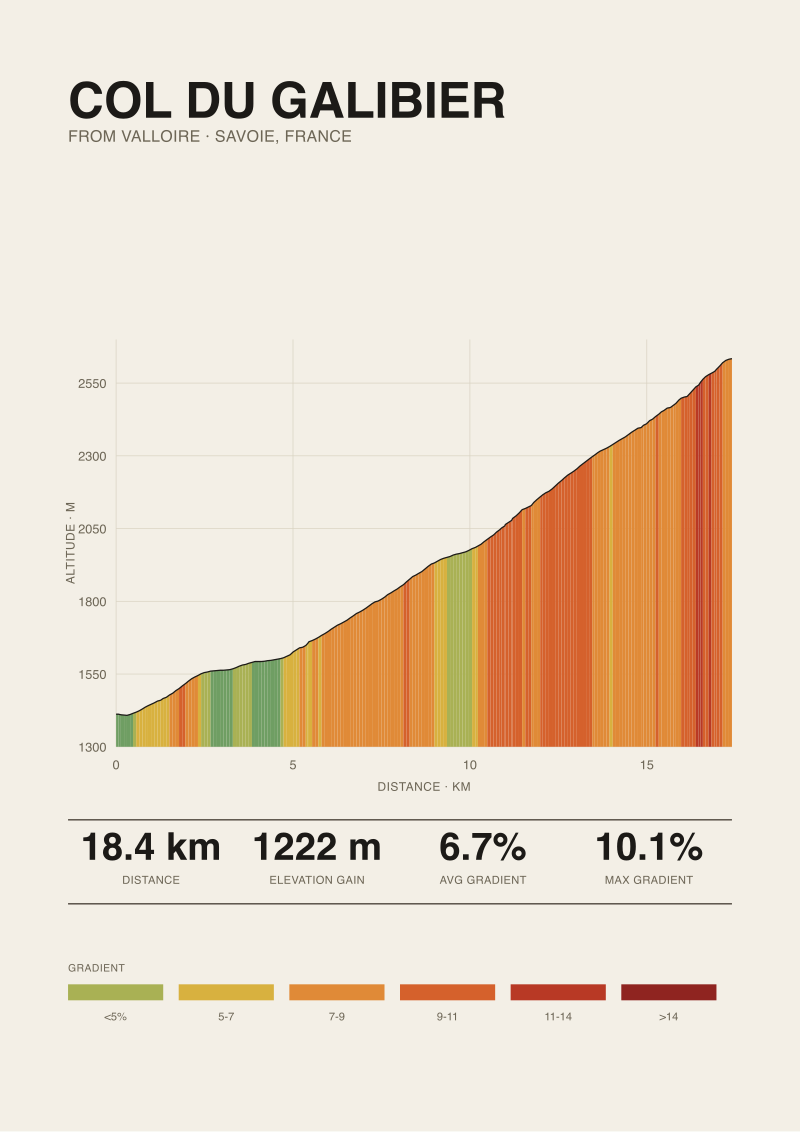 Col du Galibier
The print from this article · from €29.95
View the print →
Col du Galibier
The print from this article · from €29.95
View the print →
The Rule We Use Instead
When the Climb Prints desk ranks a Tour de France climb by what it has actually done rather than by what has been written about it, three measurements do more work than altitude.
First: frequency of decision. Not how many times a climb has appeared, but on how many of those appearances the general classification actually shifted. This is where availability bias distorts everything. Ask any cycling fan to list decisive Galibier stages and the same three or four days come back — 1952, 1998, 2011. Ask how many other Galibier crossings produced no GC change and the answers get vague. The road decides less often than its reputation implies. Most days over the Galibier are transitional. That is not a flaw. It is a statistic hidden by good storytelling.
Second: the gradient of the last five kilometres. Attacks stick on ramps, not on averages. A climb that averages 7 % but concentrates its steepest kilometres near the summit forces GC racing; a climb that front-loads its steep sections and eases off at the top gives defenders a place to close down. When we look at what our four measured profiles do in the final kilometres, the picture is not what the marketing implies. The Ventoux, with 7.3 % average and 12 % max, punishes the last five kilometres by exposing them to wind on a moon-surface plateau. The Tourmalet keeps the pressure sustained. The Gavia, at 7.4 % with a 16 % max, has ramps that end selections outright. The Galibier from Valloire, by contrast, does not concentrate its worst gradients at the summit — the road opens as it climbs. That is one reason attacks made on it often get reeled in.
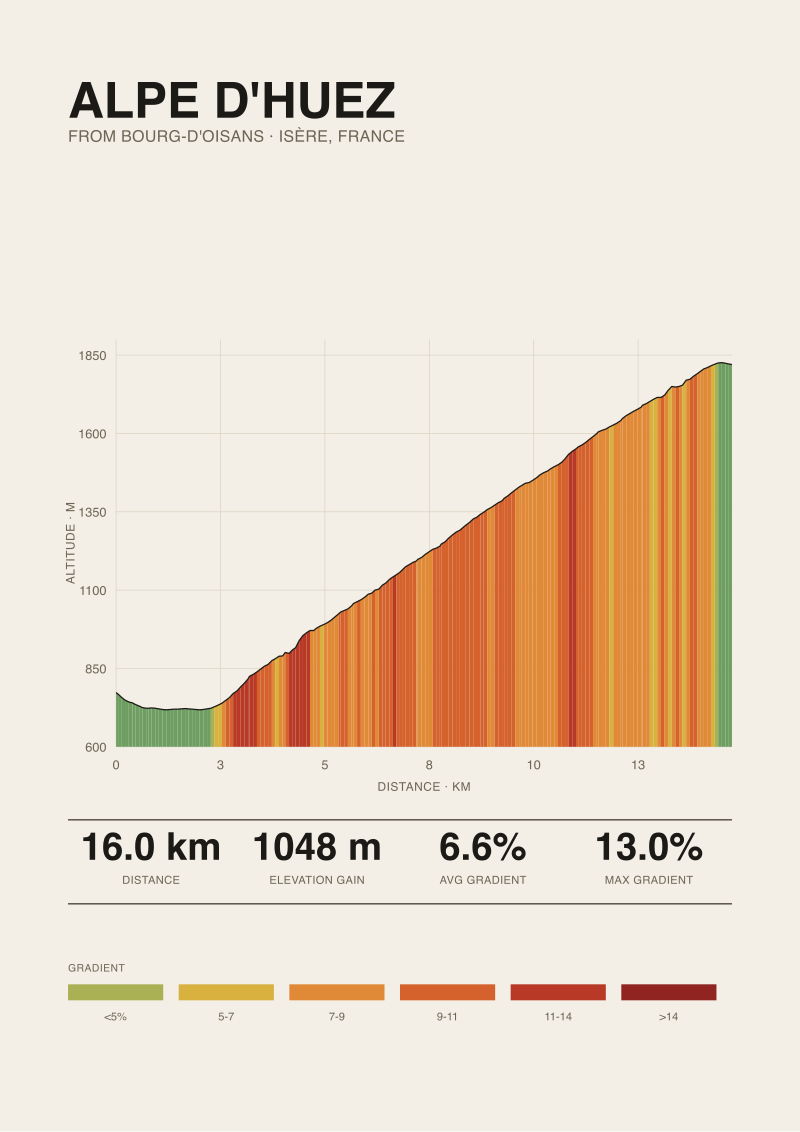
Third: stage geometry. A climb decides a race when the summit is close enough to the finish that the descent cannot undo the gap. Alpe d'Huez is a summit finish; the gap you build is the gap you keep. The Galibier is usually not a summit finish. It is usually followed by a descent to Serre Chevalier or the Lautaret and then onward. Attacks that dropped a rival on the climb often reassemble in the valley. The 2011 summit-finish stage is the exception that proves this rule, and the exception is a large part of why the day is remembered.
Those three measurements — decisions per appearance, terminal steepness, distance from summit to finish — give a very different ranking of Tour climbs than the traditional altitude-and-mythology ranking does. The Galibier still ranks. It just ranks differently. It is not the roof. It is a particular kind of anvil that works on particular kinds of stages.
When the Old Rule Still Wins
The rule above is not universal. There are days when altitude, weather, and narrative geography combine and the Galibier does exactly what the legend says it does. Third-week Tours with heat on the lower slopes and thin air at the top have unravelled riders who were fine everywhere else in the race. Stages that place the Galibier late, with a short descent to a finish that does not permit regrouping, have decided years. The 2011 centenary stage is one such day, and it is not an accident that a rider who understood the exception — Andy Schleck attacking from far out, betting that the summit finish would let a gap survive — used the exception well. The legend earned its keep on days like that.
The framework we use recognises those cases as edge cases rather than as the norm. That is the honest position. The Galibier is a great climb whose greatness has been slightly miscategorised for a century, and whose miscategorisation has produced some of the best writing in the sport. When we render its profile as a print — you can see the current edition in the studio's shop — we are drawing the road, not the story about the road. The two overlap more than the sceptic would like, and less than the romantic would insist. That gap is where the desk lives.
This piece did not measure the Galibier's own profile against SRTM data — it is not one of the four climbs we currently have on the desk — and every specific figure quoted here is either from that grounded set of four or from broadly established Tour de France history. It did not attempt to rank Alpine climbs by aesthetic reward, which is a separate argument the numbers cannot settle. And it did not address the descent, which is its own document.
 Col du Tourmalet
The print from this article · from €29.95
View the print →
Col du Tourmalet
The print from this article · from €29.95
View the print →
FAQ
When did the Col du Galibier first appear in the Tour de France?
- Émile Georget was first over the summit, one of only three riders to reach the top with the leaders on that stage. It was the Tour's first crossing above 2,000 metres and the moment the race stopped being a road race with occasional mountains and became a mountain race with roads in between. Henri Desgrange's report from that first ascent set the tone that every generation of Tour writing since has either extended or argued with.
Is the Galibier the highest climb in the Tour de France?
Not consistently. In editions that route over Cime de la Bonette or the Col de l'Iseran, both of those passes sit higher. The Galibier is often the highest point of a given Tour because race designers cycle through their marquee climbs — but "the highest of this year's Tour" and "the highest ever used by the Tour" are different claims. The legend blurs the two.
How does the Galibier compare to the Stelvio?
The two do not directly compete, because the Tour has never used the Stelvio — it sits inside Italian territory and belongs to the Giro d'Italia. Our measured profile of the Stelvio from Prato allo Stelvio, using OpenTopoData SRTM 30m data, is 25.04 km climbing 1,840 metres at 7.3 % average, topping out at 2,748 metres, with a published maximum of 14 %. That is a longer and higher climb than the Galibier from either standard side. Comparing them is a geography question rather than a difficulty question.
Is the Galibier harder than the Tourmalet?
On measured gradient the two are broadly comparable. Our Tourmalet profile from Luz-Saint-Sauveur reads 19.12 km at 7.3 % average, gaining 1,405 metres, summit 2,114 metres. The Galibier's additional difficulty comes from its altitude and from where it typically sits in a stage — usually after the Télégraphe — rather than from a steeper road. A rider who can pace the Tourmalet from Luz can pace the Galibier from Valloire; a rider suffering from thin air above 2,500 metres may find the final kilometres impossible regardless of pace.
Who has the most memorable ride up the Galibier?
Ask ten cyclists, get ten answers. Fausto Coppi's Alpine work in his 1952 Tour victory is one common answer. Marco Pantani's late-nineties raids are another. Andy Schleck's long solo in 2011, finishing at the Galibier summit on the climb's centenary, is a third. The frame of the question decides the answer, which is itself part of the point: the legend is a lens as much as a record.
Why does Henri Desgrange come up in every Galibier story?
Because he wrote the first draft of the myth, and every writer since has been in conversation with him. His 1911 reports canonised the climb in the register of religious pilgrimage. That framing has never been fully dislodged. Every generation of cycling journalism inherits it, either by repeating it or by trying to correct it. This piece is in the second camp, but the acknowledgement still belongs to him.
How often has the Galibier actually decided the general classification?
Less often than the legend implies. The pass has appeared in the Tour dozens of times, and on most of those days the overall standings did not meaningfully move. The days it did — 1952, 1998, 2011 among them — are the ones the sport remembers. Availability bias does the rest. A more honest framing would say that stage design around the Galibier decides races when it decides them; the road itself is the anvil, not the hammer.
Would you recommend riding the Galibier if it's a first Alpine climb?
Rider fitness matters more than climb selection. The Galibier from Valloire is a shorter introduction than the full route over the Télégraphe first, and pacing is more forgiving than on climbs that concentrate their steepest ramps late. If altitude is the concern — thin air genuinely affects unacclimatised riders above 2,000 metres — pick a stable-weather morning and give the day the time it deserves. The reward is the road, not the Strava file.
From the collection
New climbs and 10% off your first print.
One email now with your code. No noise after.