We have read a lot of articles trying to answer this question. They almost all quote the same rough band — somewhere between one hour and two — and they almost all arrive there the same way: someone rode it once, someone else rode it twice, and a table gets built out of the round numbers that survive. Alpe d'Huez from Bourg-d'Oisans is 15.97 km, 1,048 metres of gain, 6.6 percent on average. Those three numbers are the entire physics of the question, and the coverage keeps managing to answer around them rather than through them.
The pattern is remarkably consistent across languages, across publication types, across whether the byline belongs to a former racer, a tour operator or a content agency. Someone opens with the 21 hairpins, someone quotes the pro record without saying which pro record, and somewhere between the third and fourth paragraph an amateur time band appears with no working shown. If a reader wants to know how long the climb will actually take them, they walk away with a range that spans a factor of two and no way of placing themselves inside it. That is the gap this piece is trying to close, and the way to close it starts by naming what the coverage keeps doing wrong.
What They All Get Wrong
The first error is treating "amateur" as a category. Amateur covers a rider who finishes a local gran fondo mid-pack and a rider whose longest previous climb was a motorway flyover on the way to the hire-car depot. Those two people are not on the same mountain. When an article writes "amateurs take between 1h15 and 2h", it is technically true in the same way that "adults weigh between 45 and 130 kilos" is true. It answers nothing. The word amateur is doing all the work and none of the arithmetic, and the arithmetic is where the answer lives.
The second error is quoting an average gradient of 7.9 percent, or 8.1 percent, or "around 8". This is the number that has calcified into the internet's memory of Alpe d'Huez, and it is not what the mountain actually measures. From the traditional start in Bourg-d'Oisans to the finish arch at 1,820 metres, the climb covers 15.97 km and gains 1,048 metres. That is 6.6 percent on average, not eight. The eight-percent figure comes from cropping the profile: start the clock at the bridge over the Romanche where the ramp genuinely kicks up, ignore the first, flatter kilometre and change, and the remaining road averages closer to the number everyone quotes. It is a defensible measurement, but it is a measurement of a different climb. Every time-estimate built on 8 percent is estimating a climb that is about a kilometre shorter than the one the rider will actually pedal up.
The third error is the physics itself. Most time tables are built by picking a speed and multiplying. The speed is usually chosen by vibe. A modest amateur climbs at 10 km/h, a strong amateur at 14, a very strong amateur at 17, and so on. Speed on a road climb is a downstream consequence of power-to-weight, gradient, and the rider's ability to hold a steady effort for long enough that the mountain, not the rider, sets the pace. A 75 kg rider producing 200 watts steadily is a completely different Alpe d'Huez rider than an 85 kg rider producing the same 200 watts, and neither of them cares what average speed the article predicted. They will each climb at whatever velocity their own numbers permit, and the mountain will decide the rest.
The fourth error, quieter than the others, is comparing amateur times to the pro record without noting what the pro record measures. Historical Tour de France times up the Alpe are almost all timed from the bridge, not from the town, and the fastest of them was set in the tail of a mountain stage in which the climb was ridden after five or six hours of preceding racing. It is not a like-for-like benchmark for a fresh amateur starting at the Bourg-d'Oisans roundabout on the second day of a hire-car week.
What Is Almost Always Missing
The number that is almost always missing is the one that would actually let a reader estimate their own time: their sustained power-to-weight ratio, expressed in watts per kilogram, held over roughly an hour. It is a slightly awkward number to write around, because it requires the reader to have ridden with a power meter, or at least to have done a long, steady climb before and know honestly what pace they could sustain. Most articles skip past it because it feels technical. It is not technical. It is the only variable that turns 15.97 km and 1,048 metres of vertical into a time.
Given the climb's dimensions, the arithmetic is uncomplicated. Lifting 1,048 metres of vertical over roughly 16 km of road, on a 6.6 percent average, means a rider's climbing speed is dominated by the rate at which they can raise their own bodyweight against gravity, with rolling resistance and air drag as smaller corrections that get smaller still as the gradient climbs. Two watts per kilogram, held cleanly for the duration, puts a rider on a schedule around two hours. Three watts per kilogram brings that closer to an hour and a half. Four watts per kilogram, which is a well-trained club rider on a good day, puts the finish arch a little over an hour away. Below two watts per kilogram — which is where a lot of first-time visitors sit, honestly, on the second morning of a cycling holiday after a flight — the times stretch past two hours and the mountain starts to be as much a heat-management problem as an effort one.
Also missing: any acknowledgement that the climb does not have a constant gradient. The published maximum is 13 percent, per climbfinder.com, and it is not distributed evenly. The first two switchbacks after the bridge are the steepest sustained section of the whole ascent, and a rider who empties the tank there because the road looks manageable on the map will not finish in the time their power-to-weight would otherwise predict. Pacing failure adds ten to twenty minutes to an amateur ascent more often than fitness does. Nobody writes about that, because pacing failure is invisible in a table.
And missing almost universally: heat. Bourg-d'Oisans in July sits in a valley that traps afternoon sun against south-facing rock. The lower hairpins have almost no shade. A ten-degree difference between a 9 a.m. start and a 2 p.m. start is a real physiological penalty, and it shows up as a slower time long before the rider notices they are cooking. This is the sort of variable that a rider who has actually measured the mountain will mention. It rarely appears in the coverage.
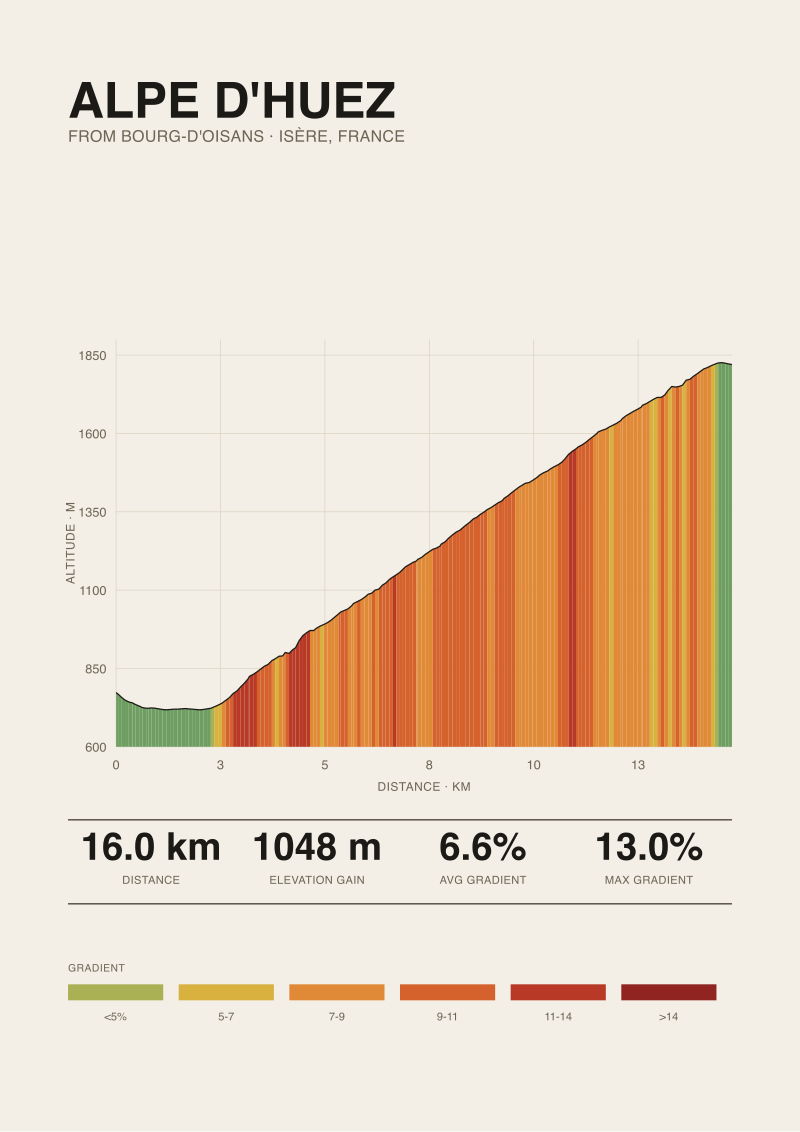 Alpe d'Huez
The print from this article · from €29.95
View the print →
Alpe d'Huez
The print from this article · from €29.95
View the print →
What I Would Say Instead
Instead of a time band, the honest answer is a small calculation the reader can do in their head before they leave the hotel. The vertical gain is roughly 1,050 metres. A well-conditioned club rider climbs at a vertical rate of about 1,000 metres per hour on a gradient like this — sometimes a touch more, sometimes less. So the first anchor is: a well-conditioned club rider takes about an hour, plus a few minutes for the flatter opening kilometre from the town to the bridge. That is the fastest realistic amateur time on Alpe d'Huez from Bourg-d'Oisans, and it corresponds to a sustained effort somewhere between 3.5 and 4 watts per kilogram.
Halve that vertical rate — 500 metres per hour, which is a common pace for a fit rider who does not train climbing specifically — and the arithmetic gives just over two hours. That is the slower end of the realistic band, and it is where most riders on a first cycling trip to the Alps will actually finish, whether they expected to or not. Between those two anchors, the sensible thing to do is not to pick a middle number and hope. It is to look at your own recent climbing rate on a familiar climb of similar length and gradient, then scale it. If your local half-hour climb comes in at 600 vertical metres per hour, Alpe d'Huez will take you close to 1h45. If it comes in at 800, expect around 1h20. The scaling is not perfectly linear because fatigue does not care about linearity, but it is more useful than the vibes-based tables in circulation.
Two adjustments then matter. The first is the opening kilometre. A rider who reaches the bridge with a heart rate already at threshold has made a strategic error the rest of the climb cannot rescue. The lower ramps punish this specifically, and the rider will hemorrhage minutes over the middle third of the ascent trying to recover an effort that should not have been spent. The correct first-time-up strategy is to arrive at the bridge feeling like the climb has not started yet. It has not.
The second adjustment is temperature. On a genuinely hot day, subtract five to ten percent from your realistic climbing wattage before doing any arithmetic. That is not a soft caveat; it is a physiological one. Cardiac drift and thermoregulatory cost eat into sustainable power on any climb over an hour, and Alpe d'Huez in high summer is the classic setting for it. A rider who would climb in 1h30 in April will climb in 1h45 in a July heatwave, and the difference is not fitness. It is the weather doing arithmetic on the rider's behalf.
None of this tells the reader what their exact time will be. That was never the promise. What it does is replace a false-precision band with a real one that a reader can locate themselves inside, using numbers about their own riding rather than someone else's holiday. The mountain is 15.97 km, 1,048 metres, 6.6 percent, and it has been sitting there patiently while the internet argues about how long it takes. For a print of the profile itself — the 21 hairpins drawn to scale from the same elevation data this piece is grounded in — our shop is where that lives.
FAQ
How long does Alpe d'Huez take an average recreational cyclist?
On the 15.97 km, 1,048 m ascent from Bourg-d'Oisans, a recreational rider in reasonable condition, sustaining roughly 2.5 to 3 watts per kilogram, will finish somewhere between 1h30 and 1h50. A first-time visitor who has not climbed for an hour continuously before will more often land between 1h50 and 2h20, especially in summer heat. The single strongest predictor is sustained power-to-weight, not perceived fitness on flat roads.
What time should a strong amateur target on Alpe d'Huez?
A strong amateur — the sort of rider holding around 4 watts per kilogram for an hour — should target roughly 1h05 to 1h15 from the roundabout in Bourg-d'Oisans to the finish arch at 1,820 metres. Riders who train climbing specifically and pace the opening ramps conservatively will land in the lower half of that window. Riders who go out too hard on the first two switchbacks routinely lose five to ten minutes in the middle third.
Why do published times for Alpe d'Huez vary so much?
Two reasons. First, articles measure different climbs: some quote the 15.97 km ascent from town, others start the clock at the bridge over the Romanche, which crops off the flatter opening kilometre and change and shifts the average gradient from 6.6 percent to close to 8. Second, "amateur" is not a single category. A time band built by averaging strangers' Strava PRs will always be wide, because the riders inside it are not comparable.
What is the average gradient of Alpe d'Huez, really?
Measured across the full traditional ascent from Bourg-d'Oisans — 15.97 km, gaining 1,048 metres — the average is 6.6 percent. Elevation data source: OpenTopoData SRTM 30m. The frequently quoted "around 8 percent" figure describes a shorter crop of the climb that begins after the flatter opening section. Both numbers can be defended; they are just measuring different climbs. Any time estimate should be built on the average of the segment the rider actually intends to ride.
How steep is the steepest part of Alpe d'Huez?
The published maximum gradient is 13 percent (source: climbfinder.com). It is concentrated in the lower switchbacks immediately above the Romanche bridge, not spread evenly across the climb. This is why pacing the opening kilometres matters more than pacing the rest: the steepest sustained ramps come early, when the rider is most tempted to overspend, and the road only eases meaningfully after the first handful of hairpins.
Does heat significantly slow amateur times on Alpe d'Huez?
Yes, and by more than most riders expect. The lower hairpins face south with very little shade, and Bourg-d'Oisans sits in a valley that traps afternoon sun against the rock. A rider who would climb comfortably at 3 watts per kilogram in mild conditions can lose five to ten percent of sustainable power in a July heatwave, which translates to roughly ten to fifteen extra minutes on the ascent. An early morning start is the single cheapest performance gain available.
Is it worth using the pro record as a reference for pacing?
No. The fastest recorded Tour de France ascents are timed from the bridge, not from town, and were set in the closing kilometres of full mountain stages after several hours of prior racing — conditions that do not translate to a fresh amateur starting at the roundabout. Using pro times as a pacing anchor produces either demoralisation or a first-kilometre effort the rider cannot sustain. Anchor pacing to your own recent climbing rate on comparable terrain instead.
From the collection
New climbs and 10% off your first print.
One email now with your code. No noise after.