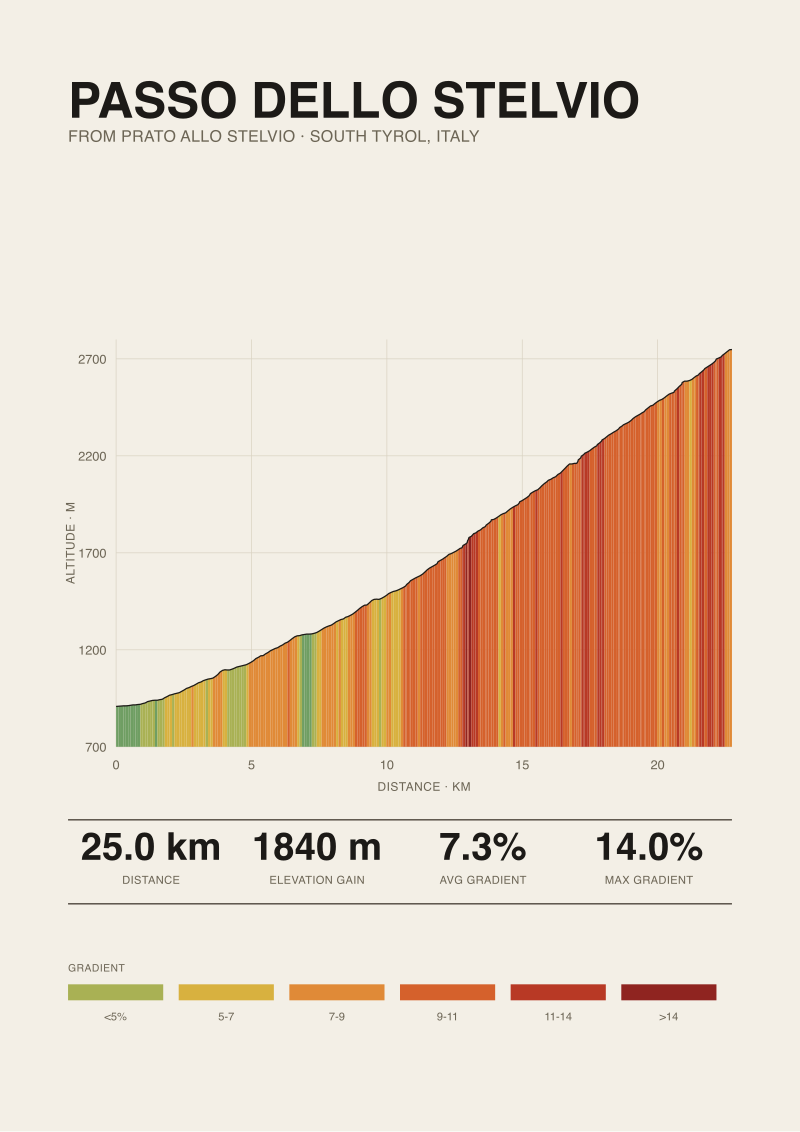
The honest answer is that it depends on why the climb matters to you. A print of the Passo dello Stelvio from Prato allo Stelvio is 25.04 km, 1,840 m of gain, 7.3 percent average on our SRTM-derived profile — but those numbers mean four different things to four different buyers, and only one of them is looking at the same wall you are. Rather than list generic criteria, we will walk through three hypothetical buyers who wrote to the desk this year, or could have. Same catalogue, three completely different decisions.
The point of this exercise is not to sell you a print. The point is to expose the fact that the criteria you should check — ascent side, measurement basis, published-vs-measured max gradient, the altitude the summit actually sits at — change depending on whether the print is a memory, an argument, or a room the buyer wants to walk into every morning. We will take each buyer, work through the numbers they should be pulling from the profile, and show which of our four Alpine and Pyrenean climbs would land differently for them.
Scenario 1: The Rider Who Suffered on the Stelvio Last Summer
Imagine a rider — call them Buyer A — who spent an August afternoon on the Prato allo Stelvio side and finished with the last four kilometres etched into memory. They want the print because they were there. That verb, "were", is doing all the work in the decision. Buyer A is not shopping for a mountain in the abstract. They are shopping for the specific 25.04 km they climbed, starting at 908 m and finishing at 2,748 m, and any print that quietly substitutes the Bormio side would fail them completely.
So the first thing Buyer A should check is not aesthetic. It is the ascent label. Our Stelvio profile is measured explicitly from Prato allo Stelvio; the Bormio ascent is a different climb with a different shape, different length, different gradient distribution and — crucially for the rider's memory — a different set of hairpins. A print that says "Passo dello Stelvio, 25.04 km, 1,840 m" from Prato is not interchangeable with one that says "Passo dello Stelvio" from Bormio. If a shop cannot tell you which side the profile depicts, walk away. The mountain has two answers to the same question.
The second check for Buyer A is the max gradient figure. Our profile is derived from OpenTopoData SRTM 30-metre elevation data. The 14 percent max gradient we cite as the published figure comes from climbfinder.com, which is compiled from road-book measurement rather than satellite interpolation. Those two sources are not the same tool measuring the same thing. Satellite data averages across a 30 m grid cell; a road book records the actual grade of the tarmac at that hairpin exit where the wheel slipped. When Buyer A tells a story about "the 14 percent bit before Trafoi", the print should reflect that number the way the road-book community records it — not smooth it into a friendlier 11 percent that satellite averaging tends to produce.
The third and last check is scale legibility. On a 25.04 km climb with 1,840 m of gain, the profile is long and comparatively shallow at a glance. A print that compresses the horizontal axis to fit a square frame will misrepresent what the rider actually felt. Buyer A should look for a print whose horizontal aspect matches the climb's real ratio — long and lean — not one that squares it up for framing convenience. If the drawing looks like the rider's memory, the memory is being served. If it looks like a stock silhouette of a triangle, it is not.
Scenario 2: The Armchair Reader Who Has Never Ridden Ventoux
Now picture Buyer B. Buyer B has never been on the road from Bédoin. They have read a shelf of books about the Ventoux, watched the Tour every July since they were a teenager, and think of the mountain as a piece of European sporting geography rather than a personal experience. They want the Ventoux print because of what the mountain means, not what it did to their legs. The criteria shift completely.
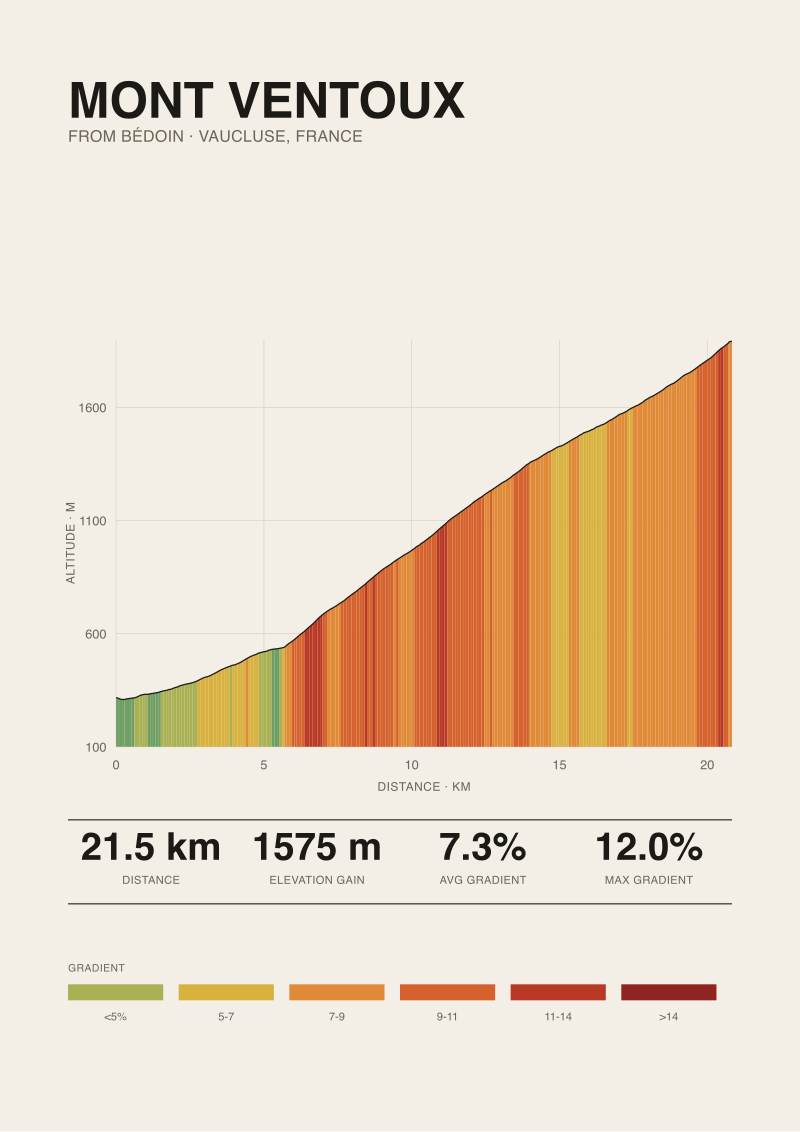
For Buyer B, the ascent side matters for a different reason. Our Ventoux profile from Bédoin is 21.51 km, 1,575 m of gain, 7.3 percent average, starting at 317 m and finishing at 1,892 m. Bédoin is the historically canonical side — the one the Tour de France uses when it uses the mountain as a stage finish — and that is the side Buyer B has absorbed through decades of race footage. The Malaucène and Sault ascents exist, are perfectly ridable, and produce different profiles; but they are not the mountain Buyer B is buying. The check here is: does the print label the ascent, and is it the ascent that carries the history the buyer cares about? If Buyer B ends up with a print of the Sault approach, they own a beautiful drawing of the wrong mountain.
The second thing Buyer B should look at is summit altitude. Ventoux from Bédoin finishes at 1,892 m — a metric that is meaningful because the summit sits above the treeline for the last six kilometres, which is the visual and thermal signature the mountain is famous for. A print that omits or obscures the summit altitude is denying Buyer B the single number they know from Chalet Reynard upwards. It is the number that separates Ventoux from every other 1,500 m climb of gain in Provence.
The third check is comparative. Buyer B is not buying one print — Buyer B is building a wall. They will want the Ventoux to sit next to the Tourmalet, the Stelvio, the Gavia. And this is where our four profiles create a quiet argument. Stelvio, Ventoux and Tourmalet share the same average gradient — 7.3 percent — despite Stelvio being 25.04 km and Tourmalet being 19.12 km. Gavia is fractionally steeper at 7.4 percent and shorter at 18.42 km. On a wall, that pattern reads. Buyer B should check that the prints use the same measurement basis across climbs, because inconsistency between prints — one drawn from SRTM, another from proprietary lidar, a third from an old book — turns the wall into a comparison you cannot make.
 Passo dello Stelvio
The print from this article · from €29.95
View the print →
Passo dello Stelvio
The print from this article · from €29.95
View the print →
Scenario 3: The Group That Rode the Tourmalet Together
The third case: a group of six riders, call them Buyer C, who rode the Col du Tourmalet from Luz-Saint-Sauveur last September and want a print each. Same climb, same day, same weather, six identical prints going to six different apartments. The criteria here are subtler than either of the first two cases, because the print is not a personal memory or a piece of geography — it is a shared receipt.
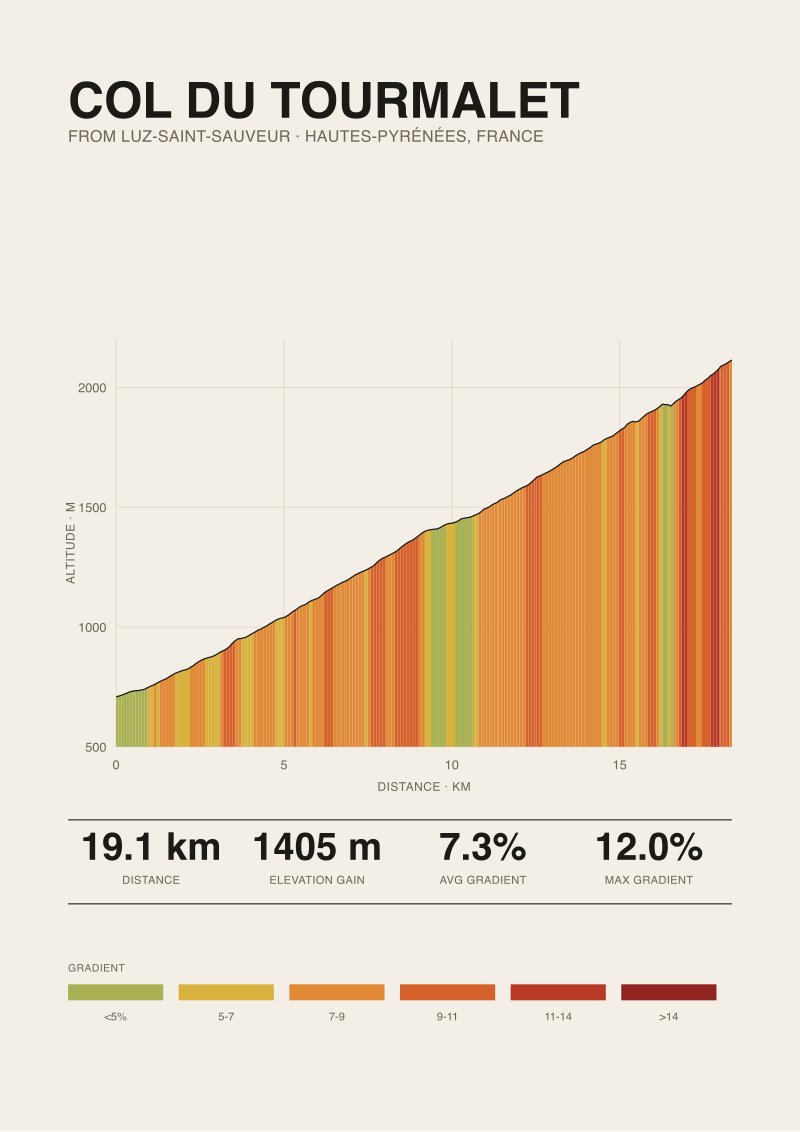
The first thing Buyer C should check is edition consistency. If six prints of the same climb are being ordered, they must all be drawn from the same profile pass — same start point, same measurement basis, same summit cutoff. Our Tourmalet from Luz-Saint-Sauveur is 19.12 km, 1,405 m of gain, 7.3 percent average, from 709 m to 2,114 m. Every one of the six prints must carry those exact figures. It sounds trivial, but studios that redraw popular climbs periodically produce editions that differ by fractions of a percent as the elevation data gets reprocessed. For a group that wants to hang six versions of the same shared afternoon, an edition mismatch is a real problem.
The second check is the max gradient story. The Tourmalet's published max gradient is 12 percent, sourced to climbfinder.com. Someone in the group of six will remember the steep ramp above Barèges more painfully than someone else who was fresher that day. A print that respects the 12 percent published figure is inviting the group's shared memory into the room. A print that smooths it out — or, worse, inflates it — is telling a different story than the one the group lived.
The third check, which sounds strange until you think about it, is the summit altitude relative to the other climbs the group has ridden. Tourmalet's 2,114 m is materially lower than Stelvio's 2,748 m and Gavia's 2,610 m, and slightly higher than Ventoux's 1,892 m. If any member of the six is likely to buy another climb print later, the summit altitude figure on the Tourmalet print becomes the reference point for whatever comes next. That is not aesthetics. That is future-proofing the wall.
What All Three Share
Across all three buyers, the same four checks quietly recur, even though the reasons behind them differ. The first is ascent-side labelling — every one of our four climbs has more than one legitimate ascent, and a print that does not name the side is functionally mislabelled. The second is the source of the numbers on the print: our profiles come from OpenTopoData SRTM 30 m elevation data, and the max gradient figures we cite as "published" come from road-book aggregators like climbfinder.com. Those are two different measurement traditions, and any honest print should tell you which is which.
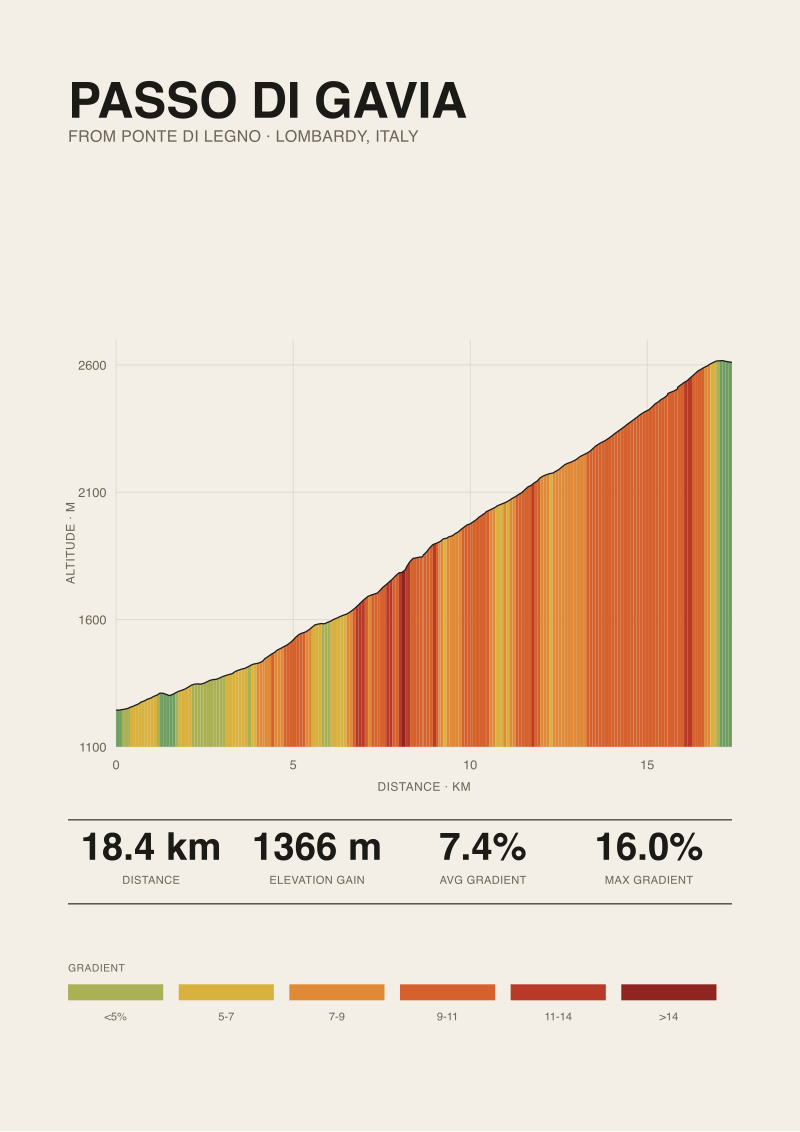
The third is scale honesty. A 25.04 km climb and an 18.42 km climb should not occupy the same horizontal footprint on a wall unless the print explicitly notes that the axes have been normalised. Compressing the Stelvio to match the Gavia turns the visual comparison into a lie. The fourth is the pairing of average and maximum gradient. Every one of our four climbs sits between 7.3 and 7.4 percent average, but Gavia's 16 percent published max gradient tells a completely different story of what those kilometres feel like than Ventoux's 12 percent. A print that shows only the average is showing you half the mountain.
None of this is difficult to check. It is only difficult to remember to check, because most buyers are shopping for a feeling and end up hoping the feeling and the facts happen to align. In prints of measured objects, they usually do not, unless someone has been careful about it on the way in.
 Mont Ventoux
The print from this article · from €29.95
View the print →
Mont Ventoux
The print from this article · from €29.95
View the print →
Which Scenario Is You
If the climb is in your legs — you rode it, you remember specific hairpins, you know which side you came up — you are Buyer A. Check the ascent label first and the max gradient figure second. Everything else is decoration.
If the climb is in your head — you have never ridden it but you have thought about it for years — you are Buyer B. Check the historically canonical ascent and the summit altitude first, and make sure any other prints you buy use the same measurement basis so the wall stays coherent as it grows.
If the print is a shared object — six riders, one climb, one memory — you are Buyer C. Ask the studio for edition consistency in writing. Six prints of the same climb should be genuinely identical, not merely similar.
If none of those quite fit, you are probably closer to Buyer B than you think. Most walls end up being arguments about geography rather than personal souvenirs, once they have more than one climb on them.
The prints of all four climbs discussed here live in the studio's shop, each labelled with its ascent side and both measurement sources.
What none of this tells you is whether the climb you are choosing is actually the climb you should hang. That decision — Ventoux over Tourmalet, Gavia over Stelvio, one wall over another — is a question about what you want to look at every morning for years, and it is not one an article about measurement can answer for you.
FAQ
Why does the ascent side matter so much on a climb print?
Every climb in the studio's catalogue has at least two legitimate ascents that produce materially different profiles. The Stelvio from Prato allo Stelvio is 25.04 km and starts at 908 m; the Bormio side is a different length, a different starting altitude, and a different shape entirely. A print labelled only "Passo dello Stelvio" without an ascent is drawing one of them and asking you to guess which. Insist on the ascent name.
What is the difference between measured profile data and published road-book figures?
Our profiles are derived from OpenTopoData SRTM 30-metre satellite elevation data, which averages across grid cells and produces a smoothed representation of the climb. Published max gradient figures — like the Gavia's 16 percent from climbfinder.com — come from road-book measurement of specific short sections of tarmac. The two disagree on the same climb because they are measuring different things at different resolutions. Good prints show both and label which is which.
If four climbs all average around 7.3 percent, why do they feel different?
Average gradient is the single most misleading statistic on a climb profile. The Passo di Gavia averages 7.4 percent over 18.42 km but touches a published 16 percent maximum. The Col du Tourmalet averages 7.3 percent over 19.12 km with a published 12 percent maximum. The distribution of steepness matters more than the average — a climb with sustained 9 percent ramps feels harder than one with a smooth 7 percent grind, even if the average maths out identical.
How much horizontal scale distortion is acceptable on a print?
Some is unavoidable — most walls cannot accommodate a strictly true-to-scale 25 km profile at readable resolution. The question is whether the studio has kept the ratio between climbs consistent across the range. If the Stelvio print and the Gavia print use the same horizontal-to-vertical scale, the comparison between them stays honest. If each print has been fit to its own frame independently, you are looking at four different mountains drawn to four different conventions.
Should a group ordering identical prints worry about edition drift?
Yes, and it is one of the most overlooked issues in shared-memory prints. Elevation datasets are reprocessed over time; a climb drawn from a 2023 SRTM pass may not be numerically identical to the same climb drawn from a 2026 pass. For a group of riders wanting six matching prints of a shared ride, the six prints should come from the same production batch, from the same measurement source, with the same figures. Ask the studio to confirm this in writing before ordering.
Do summit altitudes matter or is that just numerical noise?
They matter, and they matter more once your wall has more than one climb on it. The Stelvio finishes at 2,748 m, the Gavia at 2,610 m, the Tourmalet at 2,114 m, the Ventoux at 1,892 m. Those figures define the mountain's character — treeline, thermal profile, historical significance — as much as the gradient does. A print that omits summit altitude is stripping out one of the four numbers a serious buyer will read first.
Is there a case for buying a print of a climb you have never ridden?
There is, and it is one of the most common cases. Climbs are cultural objects as much as personal memories, and a print of the Ventoux from Bédoin can hang honestly on the wall of someone who has read about it for thirty years and never turned a pedal on it. The check for that buyer is different — historical ascent, canonical side, coherent measurement basis across whatever other prints join it — but the purchase is no less legitimate than one made by someone with the climb in their legs.
From the collection
New climbs and 10% off your first print.
One email now with your code. No noise after.