We have read a lot of gift guides for cyclists, and the ones about climb posters share a specific failure. They rank prints by decor palette and frame size, then move on. Not once does a guide ask whether the profile on the wall matches the road the rider actually knows. A poster of the Stelvio from Prato allo Stelvio is a different mountain — 25.04 km, 1,840 m of gain, 48 hairpins on the north face — than the Stelvio from Bormio. A rider who climbed one will notice immediately if you hung the other. The guides never mention this. That is the whole problem.
Everything downstream of that omission is decoration. Frame colour, mat width, portrait or landscape, matte or satin — none of it matters if the shape on the paper is the wrong shape. A climb poster is not a landscape print of a mountain. It is a diagram of a specific road, from a specific direction, gaining a specific number of metres over a specific number of kilometres. Treat it as decor and you will buy the wrong one. Treat it as a document of a ride and the shortlist collapses to three or four items.
What They All Get Wrong
The shared error is that conventional coverage treats the climb as a brand — Stelvio, Ventoux, Tourmalet, Gavia — and treats the poster as a souvenir of that brand. That is backwards. A climb is not a brand. A climb is an ascent, and an ascent has a direction, a starting altitude, a length in kilometres, and a total elevation gain in metres. Change any one of those and you have a different climb that happens to share a name with another climb.
Take the Stelvio. Our own measurement of the ascent from Prato allo Stelvio, using SRTM 30 m elevation data, returns 25.04 km, 1,840 m of gain, an average gradient of 7.3%, starting at 908 m and topping out at 2,748 m. The published maximum gradient in the road books is 14%. The ascent from Bormio, on the other side of the pass, has a different length, a different starting altitude, and a different rhythm entirely. Both are the Stelvio. They are not interchangeable. A gift guide that says "the Stelvio poster is a classic" and links to a print without specifying the side has already failed the rider it is supposedly buying for.
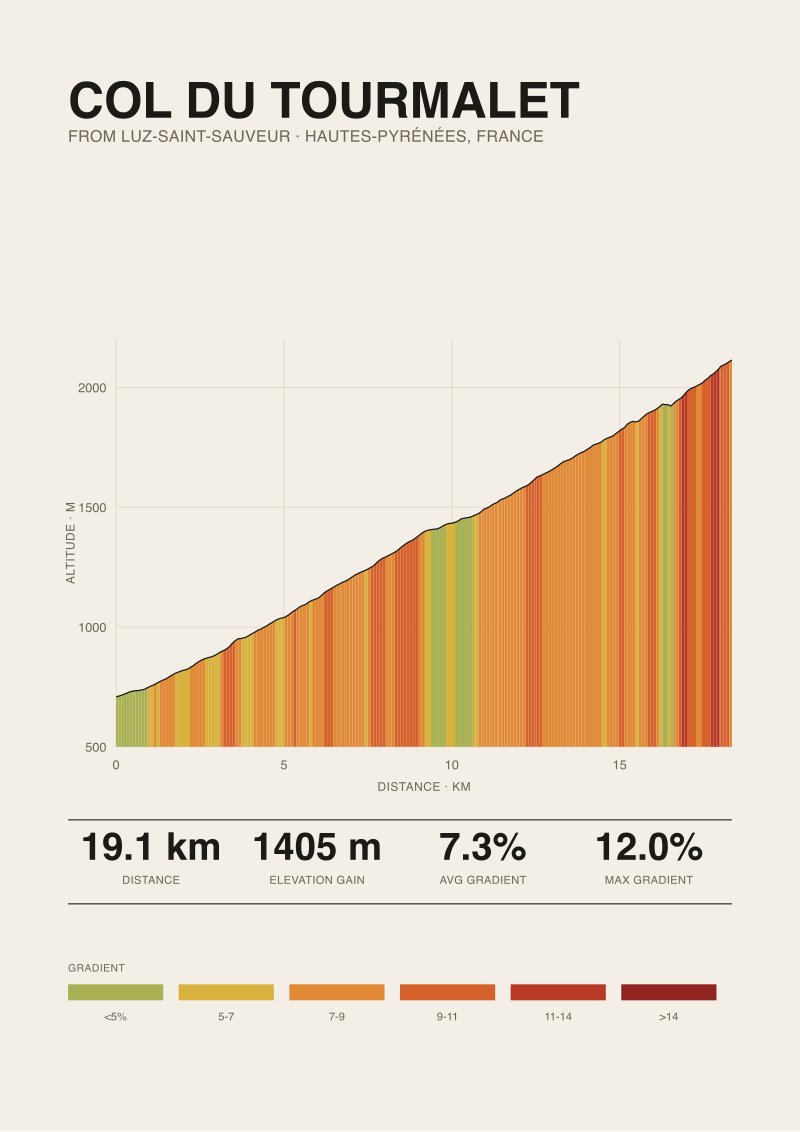
The same trap sits under every other legendary climb. Mont Ventoux from Bédoin is 21.51 km at 7.3% average, gaining 1,575 m from a start elevation of 317 m up to the 1,892 m summit, with a published maximum of 12%. The ascent from Malaucène is a different profile with a different upper section. The ascent from Sault is longer and shallower. Three roads, one summit, three completely different rides. The Col du Tourmalet from Luz-Saint-Sauveur measures 19.12 km at 7.3% average, 1,405 m of gain, topping out at 2,114 m, maximum 12%. From Sainte-Marie-de-Campan the numbers change again. The rider who climbed one side and gets the other on their wall will read that as: you didn't ask.
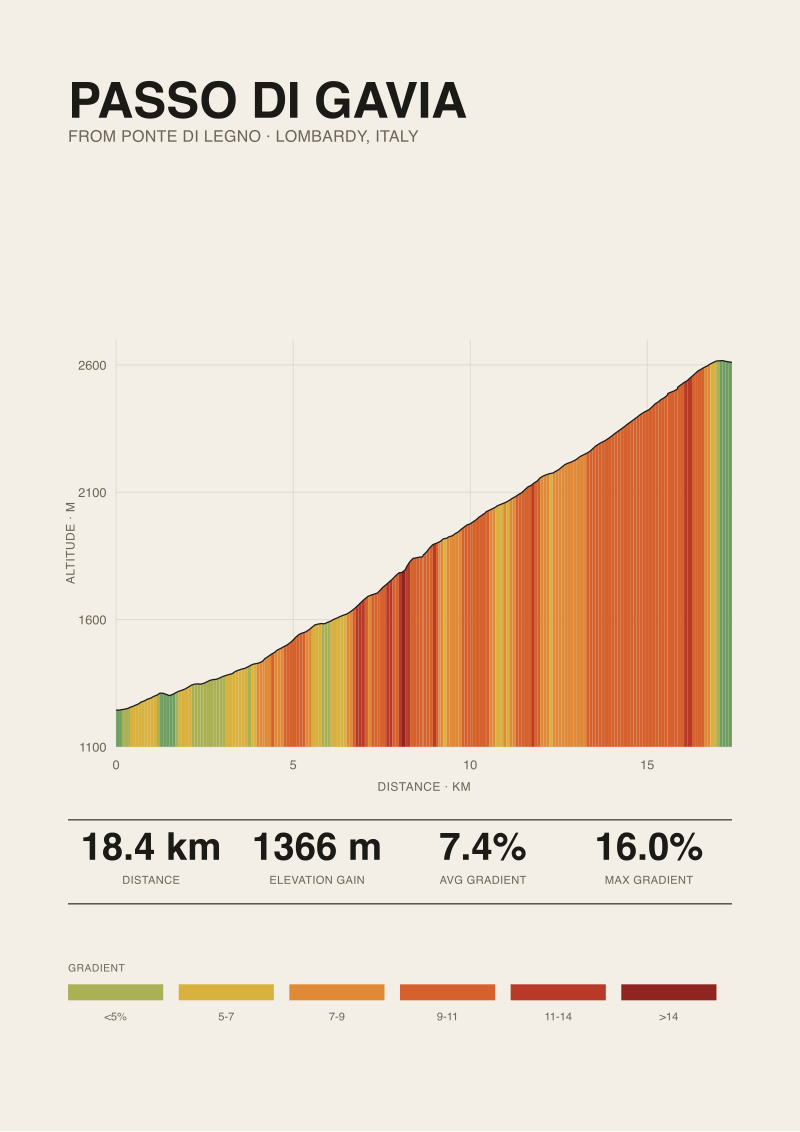
The second thing the guides get wrong is that they treat all posters as visually equivalent. They aren't. A profile print is a data drawing. Some are made from actual elevation data. Some are traced from a stylised road-book sketch and stretched to fit the page. The difference is legible to anyone who has climbed the road. On the real Gavia from Ponte di Legno, 18.42 km gaining 1,366 m from 1,244 m up to 2,610 m at a 7.4% average with a published maximum of 16%, the profile has a distinctive steep central section that anyone who has ridden it remembers. A stylised print smooths that out. A measured print preserves it. Same climb, same title, different objects.
What Is Almost Always Missing
What almost every gift guide fails to name is the single question that determines whether the print will land: which ascent of which climb does the rider on your list actually associate with the climb's name in their head? That question is not answered by asking them, because asking spoils the gift. It is answered by knowing enough about their riding to work it out.
There are three routes to the answer, and none of them appear in the guides we have read. The first is Strava. If the rider is on Strava and you have any access to their history — a shared ride, a screenshot they sent you once, a segment they mentioned — the ascent side is usually visible in the segment name. Stelvio segments on Strava are labelled by side. Ventoux segments distinguish Bédoin from Malaucène from Sault. The road they actually climbed is on the record. Ten minutes of scrolling gives you the answer.
The second route is the trip. Riders who have travelled to a climb remember where they started that morning. If they stayed in Bormio, they climbed the Stelvio from Bormio. If they stayed in Prato allo Stelvio or in the Val Venosta, they climbed from Prato. If they rode Ventoux from a base in Bédoin, that is the side they know; from a base in Sault or Malaucène, another side. Trip logistics are a reliable proxy for climb direction, and cycling trips are usually memorable events the rider has talked about.
The third route is the story. Riders talk about specific features of specific climbs. The 48 hairpins of the Stelvio's north face from Prato are not the same as the long straight ramps from Bormio. The forested lower half and lunar upper half of Ventoux from Bédoin do not describe the ride from Sault. The steep central kilometres of the Gavia from Ponte di Legno are the part of that climb that gets remembered and retold. If your rider has told a story that fits one profile, the print is decided.
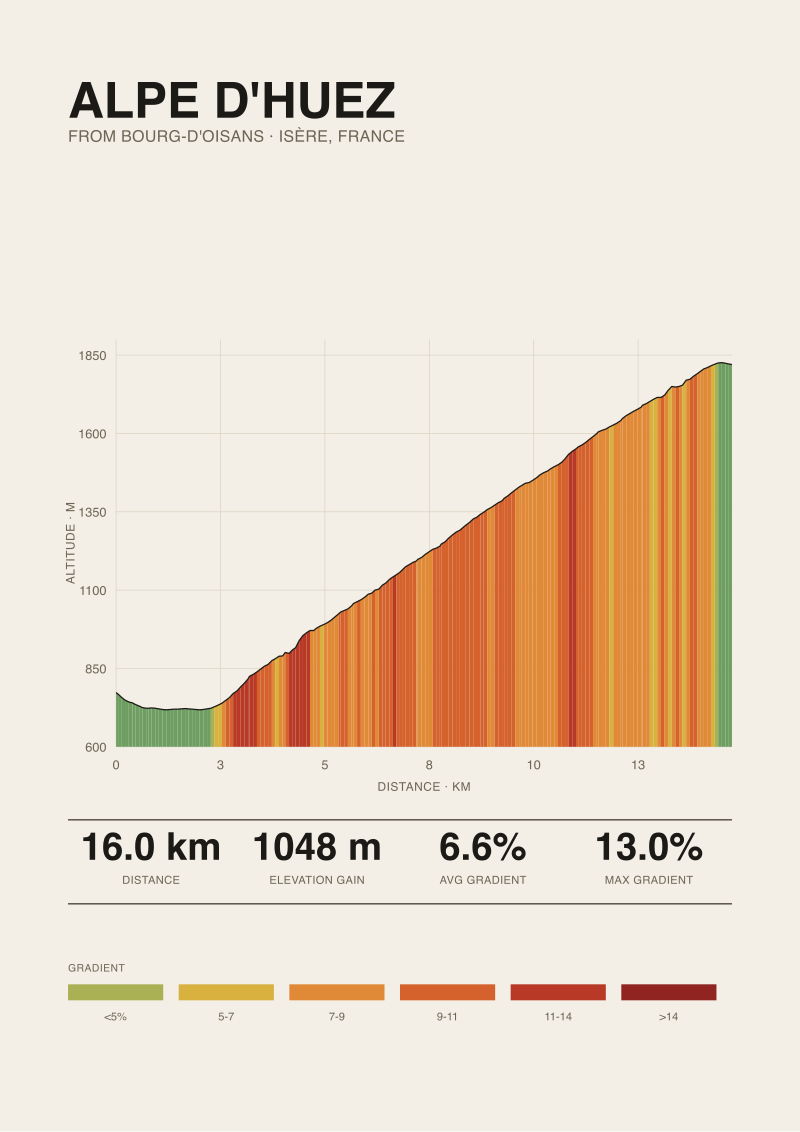
What is also missing from the guides is any honest handling of the numbers themselves. A print will often show a maximum gradient. Where does that number come from? On our own prints, the published maximum — for example 16% on the Gavia from Ponte di Legno, source climbfinder.com — is labelled as a published figure with its source, distinct from the average calculated from 30 m SRTM elevation data. Satellite elevation and road-book figures sometimes disagree. That disagreement is real and worth naming. Guides pretend the number is a single fact. It isn't.
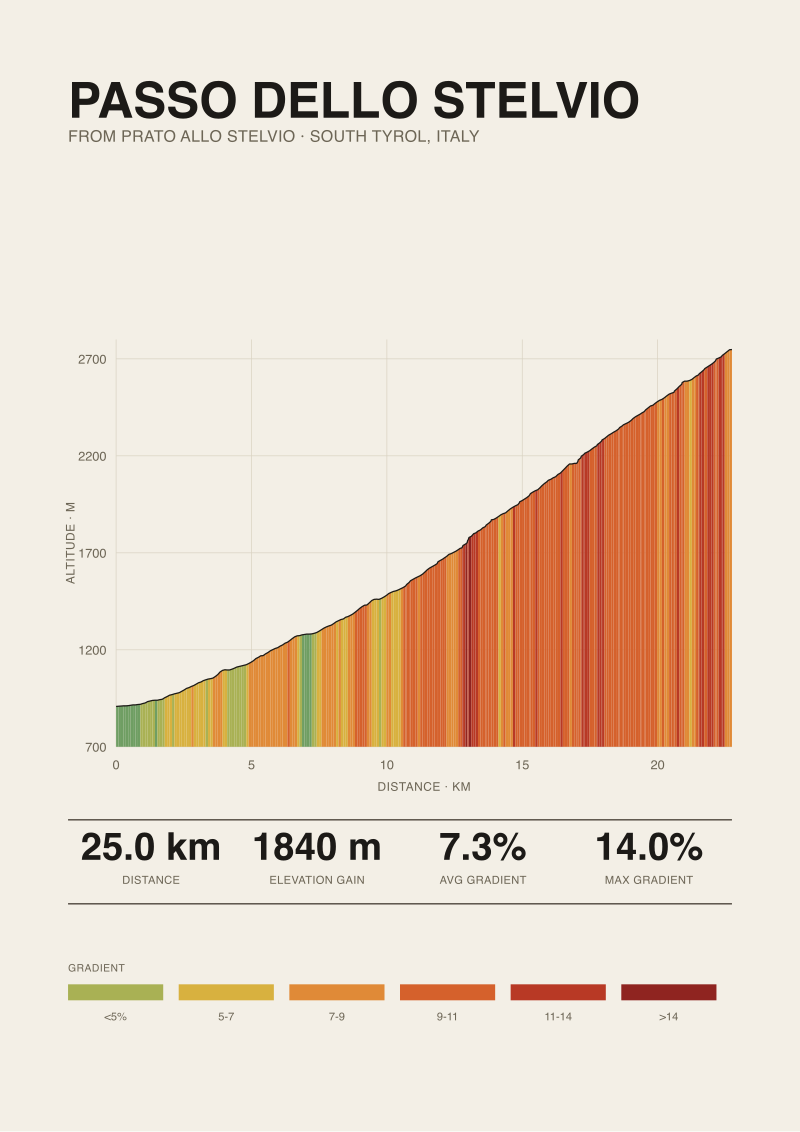 Passo dello Stelvio
The print from this article · from €29.95
View the print →
Passo dello Stelvio
The print from this article · from €29.95
View the print →
What I Would Say Instead
The framing that actually works is this: buy a print of the road they climbed, at the size their wall can hold, from a studio that will tell you where every number on the paper came from. In that order.
Start with the road. Not the climb, the road. Confirm the ascent side using Strava history, trip logistics, or the story they tell. If you cannot triangulate to one specific ascent, do not buy the print yet — buy something else and come back to it when you know. A wrong-side Stelvio on the wall is worse than no Stelvio at all, because it announces that the buyer did not know the difference. A correct-side print reads the opposite way: it says you paid attention to which mountain they actually rode.
Then check the numbers on the print against a reference you trust. If a poster of the Tourmalet from Luz-Saint-Sauveur shows a length that is not somewhere around 19 km, or an elevation gain that is not somewhere around 1,400 m, or a summit altitude that is not 2,114 m, something is off. The numbers should match what the rider knows. A Ventoux from Bédoin print that claims 25 km is describing a different mountain. A Stelvio print that shows a summit of 2,600 m has lost 148 m of altitude somewhere and should not be trusted for the rest of the profile either. These are quick checks, and they filter out most of the market in five minutes.
Then look at how the profile is drawn. Ask, or read, whether the elevation data behind the drawing is real elevation data — satellite-derived, GPS-derived, or otherwise sourced from measured points along the road — or whether it is a smoothed illustration. A measured profile of the Stelvio from Prato will show the density of the switchbacks near the top. A measured profile of the Gavia from Ponte di Legno will show the steep central section as a steep central section, not a gentle bulge. A measured profile of Ventoux from Bédoin will show the shift at Chalet Reynard where the forest ends and the shape of the ramp changes. If the print smooths those features out, it is a decoration of the climb rather than a document of it. Both are valid objects. Only one will make a rider stop in front of the wall.
Finally, treat the frame as the last decision, not the first. Frame colour, mat, glass — those are the parts most guides lead with, and they are the parts that matter least. A correctly identified, correctly measured print of the correct ascent will land in any frame. An incorrectly identified print will not be rescued by a good frame. If you want a single reference for the print itself — the Stelvio from Prato, Ventoux from Bédoin, Tourmalet from Luz-Saint-Sauveur, Gavia from Ponte di Legno, all measured before they were drawn — our own shop is where those live. The gift-guide question is not which one is the best print. The question is which one is their climb, and then buying that one.
FAQ
How do I find out which side of a climb someone rode without asking them?
Three quiet routes usually work. Strava segment names distinguish sides by default — Stelvio segments name Prato or Bormio, Ventoux segments name Bédoin, Sault, or Malaucène. Trip logistics are the second: where they slept dictates which road they climbed. The third is the stories they have told about specific features — 48 hairpins, a lunar upper section, a steep central ramp — each of which points to one ascent, not to the climb's name in the abstract.
Does the ascent side of a climb really change the profile that much?
Yes, and not subtly. The Stelvio from Prato allo Stelvio is 25.04 km with 1,840 m of gain from a start altitude of 908 m. The Bormio side is a different road with a different rhythm. Ventoux from Bédoin gains 1,575 m over 21.51 km from 317 m; Sault and Malaucène are different profiles again. A poster of the wrong ascent shows a mountain the rider did not ride, even though it shares the name.
What numbers should I sanity-check before buying a climb print?
Length in kilometres, elevation gain in metres, summit altitude, and average gradient. For the Tourmalet from Luz-Saint-Sauveur those numbers are 19.12 km, 1,405 m, 2,114 m, 7.3%. For the Gavia from Ponte di Legno they are 18.42 km, 1,366 m, 2,610 m, 7.4%. If the print shows figures that deviate meaningfully from a source you trust, the drawing behind them is probably wrong too.
Why do some prints show different maximum gradients for the same climb?
Because maximum gradient depends on measurement method and window length. Published road-book maxima — 14% for the Stelvio from Prato, 12% for Ventoux from Bédoin, 12% for the Tourmalet from Luz, 16% for the Gavia from Ponte di Legno, all sourced from climbfinder.com — are point figures. Averages calculated from 30 m SRTM satellite elevation data smooth over short pitches. Neither is wrong. A trustworthy print labels which number came from which source, rather than presenting a single figure without provenance.
Is a stylised profile print worse than a measured one?
Not worse as an object, but different in kind. A stylised profile is decoration inspired by a climb. A measured profile is a document of the road, with the switchback density, the transition points, and the steep sections preserved. Riders who have climbed the road tend to notice the difference immediately. If the gift is meant to acknowledge a specific ride, the measured print is the one that lands. If it is meant purely as decor, either can work.
What if I do not know which climb they associate with most?
Then do not guess a specific climb. Guess a region instead — the Alps, the Pyrenees, the Dolomites — and ask about a trip they took there in a normal conversation before buying. The information usually surfaces without effort once the topic is on the table. It is better to delay the gift by a week and buy the correct print than to hang a Stelvio from the wrong side or a Ventoux from a road they never climbed.
Are climbs like the Stelvio and the Gavia comparable as gift subjects?
They are close in stature but different in feel on the wall. The Stelvio from Prato is longer and taller — 25.04 km, 2,748 m at the summit — and the profile is dominated by its hairpin density. The Gavia from Ponte di Legno is shorter at 18.42 km but starts higher, at 1,244 m, and its published 16% maximum gives the central section a distinctive shape. Both are strong subjects. The right choice is the one the rider actually rode.
Where should the print actually come from?
From a studio that will tell you what the numbers on the paper mean and where they came from. Ours does — every print names the ascent side, the length, the elevation gain, the summit altitude, and separates satellite-measured averages from published road-book maxima with their source. The shop has the four climbs discussed here, each drawn from measured elevation data before anything decorative was added.
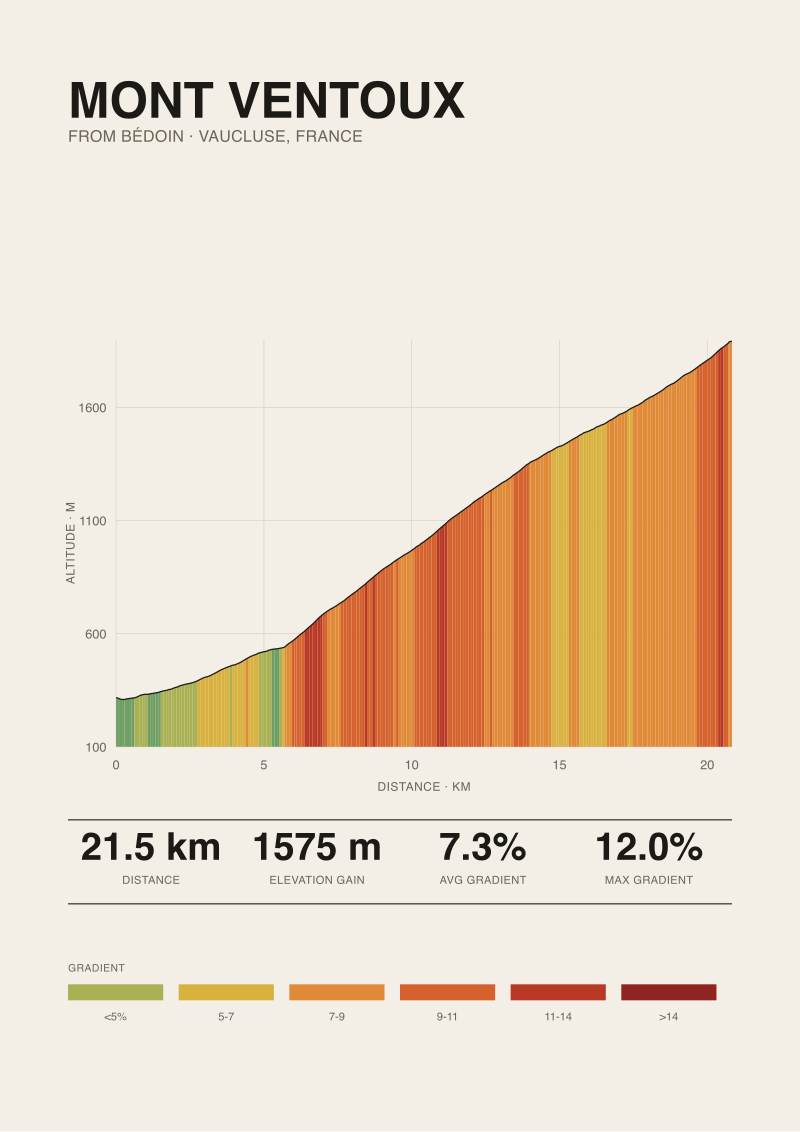 Mont Ventoux
The print from this article · from €29.95
View the print →
Mont Ventoux
The print from this article · from €29.95
View the print →
From the collection
New climbs and 10% off your first print.
One email now with your code. No noise after.