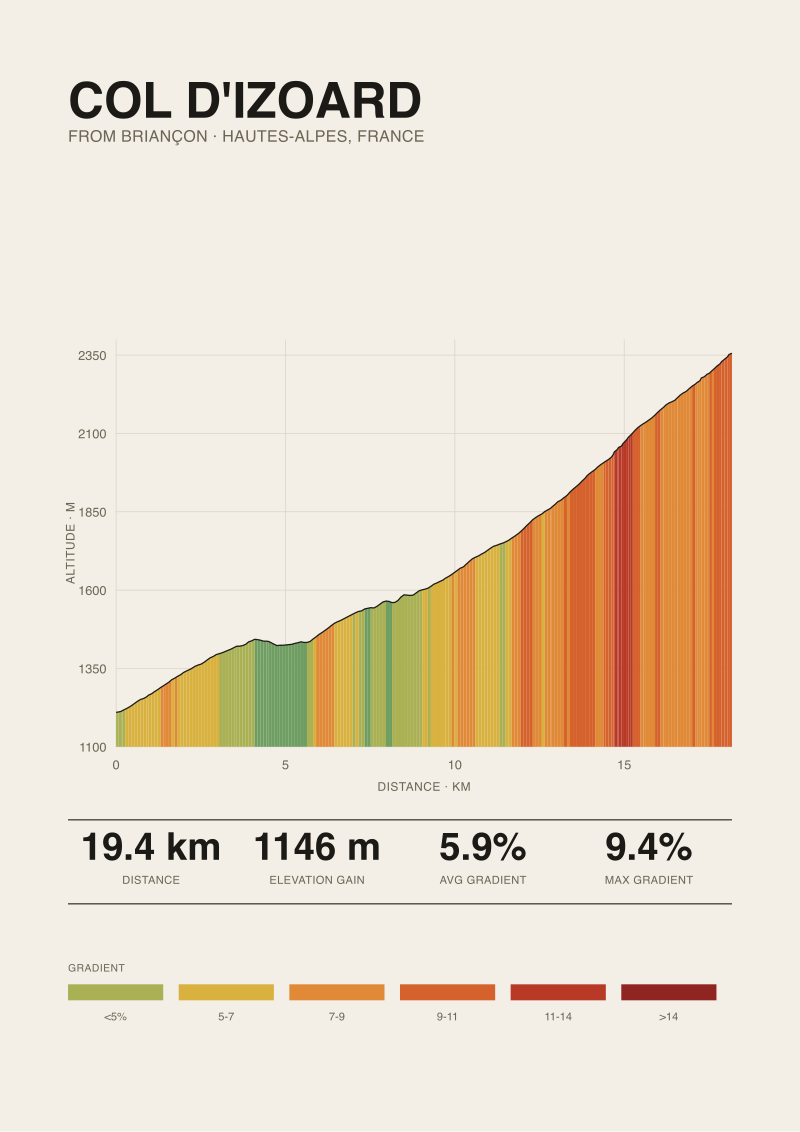
For the rider who has been up the 19.44 km from Briançon to 2,356 metres and wants the print on the wall to mean the ride and not the decor, unframed is the better default. The likely objection is obvious: a framed print looks finished, protected, gallery-ready, and most homeware advice online insists you never hang an unframed print in a living room. We are going to defend the unframed Izoard anyway, because the climb profile we drew, 1,146 metres of gain across a 5.9% average with pitches published at 9.4%, is doing work that a mat and a moulding actively interrupt.
The Case for Framing Is Real, and We Will Concede It First
There is a legitimate argument for framing an Izoard print, and pretending otherwise would be dishonest. A frame protects the paper from ambient humidity, from the fingertips of curious guests, from the slow yellowing at the edges that unmounted paper suffers over five or ten years in a room that catches afternoon sun. A mat gives the eye a resting distance before it lands on the linework. A moulding tells anyone walking past that this object is treated as a picture, not as a poster peeled off a bedroom wall in 2004. These are not aesthetic quibbles. They are the reasons the framing industry exists, and they apply to a climb print the same way they apply to a botanical illustration or a lithograph of a coastal village.
The homeware press pushes framing for a second reason that is worth naming plainly. Interior magazines, and the influencers who transcribe them, are almost always writing for a reader who does not have a specific relationship to the image on the wall. If you are picking a print because the palette matches the sofa, framing is essential. It lifts a decorative object to the level of considered furniture. Under those conditions, we would tell you to frame everything. If the Izoard print is going in a hallway because your partner asked for something calming in a warm neutral, frame it. Do not read the rest of this article. Buy the moulding.
We are not writing for that reader. We are writing for the person who counted the switchbacks above Cervières, who watched their power drop through the wooded section before the Casse Déserte opens up, who noticed that the last four kilometres are where the road stops pretending. For that reader, the framing conversation looks different.
1,146 Metres of Gain Do Not Want a Border Around Them
Here is the thing a mat and a moulding do to an elevation profile: they contain it. That is their design purpose. A frame draws a rectangle around the image and says, look inside this rectangle, the world outside it is unrelated. For a still life or a portrait, that is exactly the correct treatment. The subject is bounded. The frame reinforces the boundary.
An Izoard profile is not a bounded subject. It is a line that starts at 1,210 metres in Briançon and does not stop climbing until 2,356 metres. Those 1,146 metres of vertical are the entire point. The line goes up. It refuses to level off in any meaningful way across 19.44 kilometres. When you look at the raw profile without a frame, your eye reads the ascent as a continuous physical fact, the way your legs read it on the road. When you look at the same profile inside a mat and a moulding, your eye reads it as a graphic inside a picture, and the vertical stops feeling vertical. The frame flattens the climb, not because the frame is badly designed, but because that is what frames do to any line that wants to escape its container.
There is a related issue with the specific gradient signature of the Izoard from Briançon. The 5.9% average is misleading in the same way most averages are, and the 9.4% pitches published for the Briançon ascent by climbfinder.com are what any rider actually remembers. The profile line is jagged. It has a personality. A mat introduces a calm perimeter of white space around a jagged line, and the calm perimeter argues with the jag. You end up with a print that is visually resolved, but resolved in a direction that undoes what the drawing is telling you. Unframed, the jagged line ends at the edge of the paper and the eye finishes the movement in mid-air. That is closer to what the climb felt like at 2,000 metres of altitude with the summit still not visible around the last corner of the Casse Déserte.
 Col d'Izoard
The print from this article · from €29.95
View the print →
Col d'Izoard
The print from this article · from €29.95
View the print →
What the Interior Design Blogs Get Wrong About Cycling Prints
The interior design press has a template for prints, and the template is wrong for this category. The template says: never hang unframed paper in a formal room, always mat with a two-inch minimum border, always choose a moulding that echoes an existing wood tone in the space, and never let the print's subject dominate the wall it hangs on. Apartment Therapy prints a version of this advice roughly twice a year. The Architectural Digest sub-brands run a longer version with a stylist quoted for authority. The advice is not wrong for most prints. It is wrong for climb prints, and specifically wrong for a climb print of the Izoard.
The reason is that a climb print is not decor. It is a receipt. The rider bought it because they went up the road, and the object on the wall is a record of the road they went up. The homeware template is optimised for prints where the buyer has no prior relationship with the subject, so the framing has to do the work of making the subject feel present. When the buyer already climbed the mountain, the framing is doing the opposite work. It is inserting a layer of formality between the buyer and their own memory of 1,146 metres of gain. The mat becomes a small polite distance. The moulding becomes a picture-museum apology for putting a raw thing on a wall.
There is one more thing the interior blogs miss, and it is specific to the Izoard's palette. The upper reaches of this climb are pale stone. The Casse Déserte is scree and cream-coloured rock against high-altitude sky. A print that renders the profile in a restrained palette, which is what any measured climb print should do, is already living in a narrow tonal band. Wrapping that narrow tonal band inside a cream mat and then inside a wooden moulding creates three concentric bands of similar warmth, and the print stops being a print. It becomes a nested set of rectangles that happens to contain a line. Unframed, the print is one object with one edge and one story. The story is the line.
The Casa del Deporte Wall Test: A Comparison Table
There is a rough test we run when a customer asks us this question. Imagine two walls. On one wall, a framed Izoard print in a standard 40 mm oak moulding with a two-inch off-white mat. On the other wall, the same print, unframed, hung with two brass clips or a single wooden magnetic hanger. Now ask which wall belongs in the room of someone who ripped their bar tape on this specific climb.
| Dimension | Framed with mat and moulding | Unframed with clips or hanger |
|---|---|---|
| Perceived object category | Picture, decorative | Working document, personal |
| Distance between viewer and profile line | ~5 cm of mat plus ~4 cm of moulding | Zero, paper edge is the line's edge |
| Reads as "I climbed this" vs "I bought this" | Bought this | Climbed this |
| Effect on jagged 5.9% average with 9.4% pitches | Contained, softened | Preserved, jagged |
| Palette interaction with Casse Déserte tones | Three nested warm rectangles | Single tonal object |
| Physical protection over 10 years | High under UV-glass framing | Lower, edges will age |
| Ease of moving between homes | Fragile, glass risk | Rolls into a tube |
| Cost delta over the print alone | Typically 60% to 120% more | Zero or the cost of two clips |
The table is not a scorecard, and we are not going to declare a winner in the last row. Both columns describe a coherent object with a coherent purpose. What the table makes clear is that the two columns are answering different questions. The framed column answers, how do I turn this print into a piece of considered decor. The unframed column answers, how do I keep the print as close as possible to what happened on the road. Riders who want the second answer should stop reading design blogs that are answering the first.
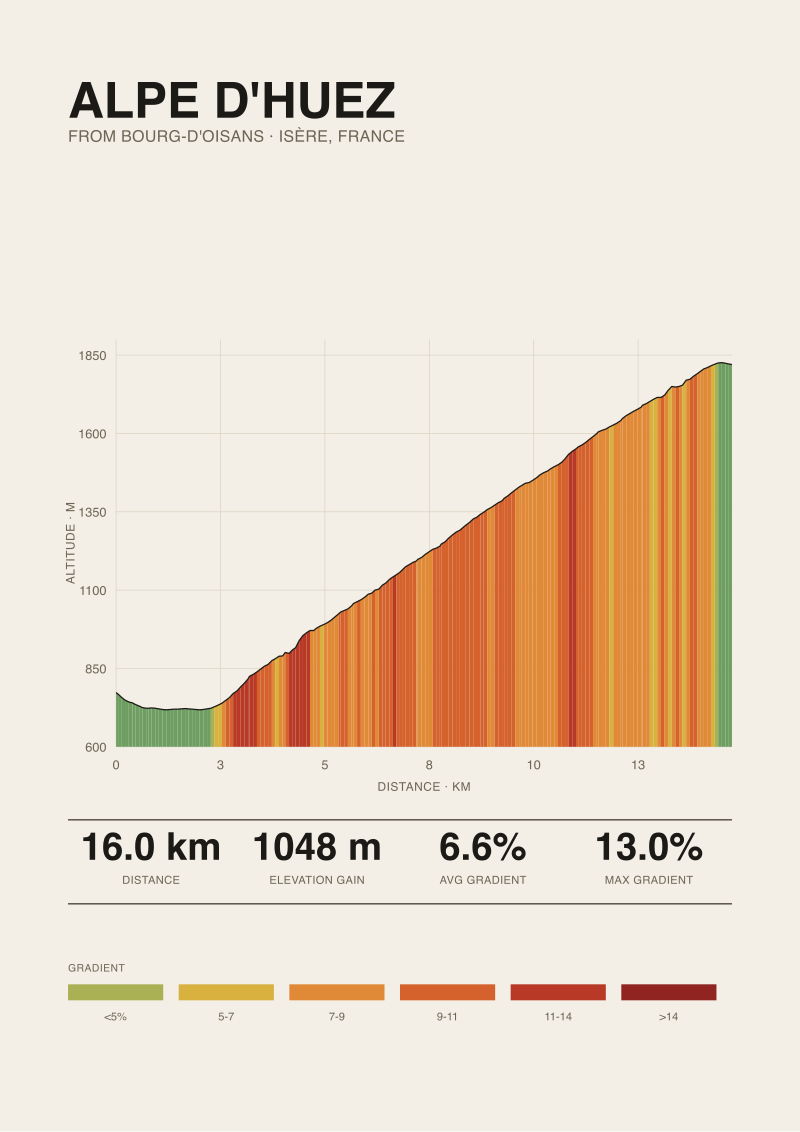
The one honest concession is the row on physical protection. Framed under UV glass, an Izoard print will look identical in 2036 to the day it arrived. Unframed, the top edge will yellow slightly, the corners will soften if the room is humid, and by 2036 the object will show that it has lived in the room for ten years. Whether that is a problem depends entirely on what you think the print is for. A rider we spoke to in Barcelona owns an unframed Alpe d'Huez print that has been on his kitchen wall for six years and has one small coffee splash near the bottom right. He considers the splash part of the object now. His wall, his rule.
 Alpe d'Huez
The print from this article · from €29.95
View the print →
Alpe d'Huez
The print from this article · from €29.95
View the print →
What You Should Actually Do
If you rode the Izoard from Briançon and you want a print of what you rode, order it unframed. Ask for a heavier paper stock than the default if the studio offers the option, because heavier paper hangs flatter without a frame and yellows more slowly. Hang it with two brass bulldog clips on a length of waxed cotton cord, or with a magnetic wooden hanger across the top edge. Put it on a wall in the room where you keep the bike or where you have coffee before rides, not in a formal living space. The unframed edge is doing the work of connecting the paper to the room, and that work fails in a space that treats prints as furniture.
If you have a partner or a housemate who is going to overrule this and insist on framing, negotiate for a shadow-gap float frame with no mat. It is the framing option that does the least damage to the argument we made above. The float frame lets the paper edge remain visible and does not insert a border between the viewer and the profile line. It costs more than a standard mat-and-moulding job, but it preserves the object's identity as a receipt for the climb rather than converting it into a picture of one. Skip the UV glass unless the wall gets direct afternoon sun; a plain acrylic glazing is lighter, safer if the frame ever falls, and does not add the museum sheen that a full glass sandwich creates.
The Izoard print itself lives at our shop alongside the rest of our measured climbs. The point of this article is not the shop link. The point is that if you spent an afternoon dragging yourself up 1,146 metres to a summit at 2,356 metres, the wall version of that afternoon should look like the afternoon, not like the wall.
FAQ
Does an unframed climb print really last long enough to justify skipping the frame?
On a decent cotton-rag or heavyweight archival stock, an unframed print in a normal interior will hold its colour and structure for well beyond a decade. What ages first is the top edge if the room is humid, and the corners where fingers touch it during hanging. A rider who moves house every three or four years will replace the object before those signs matter. The framing industry sells permanence; the question is whether you want the Izoard permanent or present.
Can I frame it later if I change my mind?
Yes, and this is the strongest single argument for buying unframed first. An unframed print rolled into a shipping tube can be professionally float-framed six months or five years later for the same cost as framing at purchase. A framed print, if you want to strip the mat and moulding to hang it raw, requires dismantling the frame job you paid for. Buy unframed, live with it for a season, and only frame if the wall genuinely demands it.
What is a float frame and why do you keep mentioning it?
A float frame holds a print by its edges or backing rather than covering them with a mat. The paper appears to sit inside the moulding with a visible gap around all four sides, so the edge of the paper remains part of the composition. For a climb profile where the line runs close to the paper edge on the vertical axis, a float frame preserves the sense that the line has room to continue past the drawn area. Standard mat framing does the opposite.
The climb is 19.44 km and 1,146 metres of gain — does the print's aspect ratio matter?
It matters a lot. The Izoard profile from Briançon is a long horizontal shape because the road covers 19.44 km while gaining only 1,146 metres of altitude. A print that respects the true proportions will always be substantially wider than it is tall. Fitting that shape inside a standard vertical mat-and-moulding format usually means compressing the vertical or padding the horizontal, and both distortions read as unearned. Unframed lets the print stay in its native proportions.
Would you frame a print of a steeper climb, like the Angliru or Zoncolan?
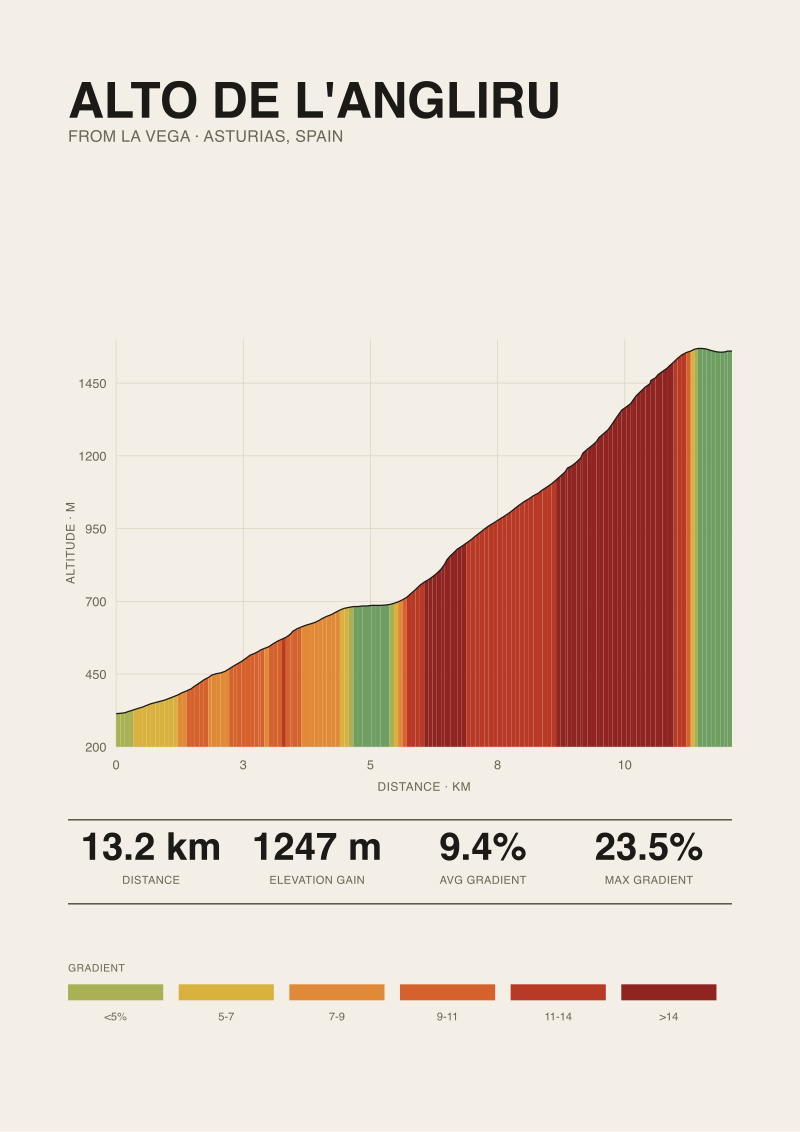
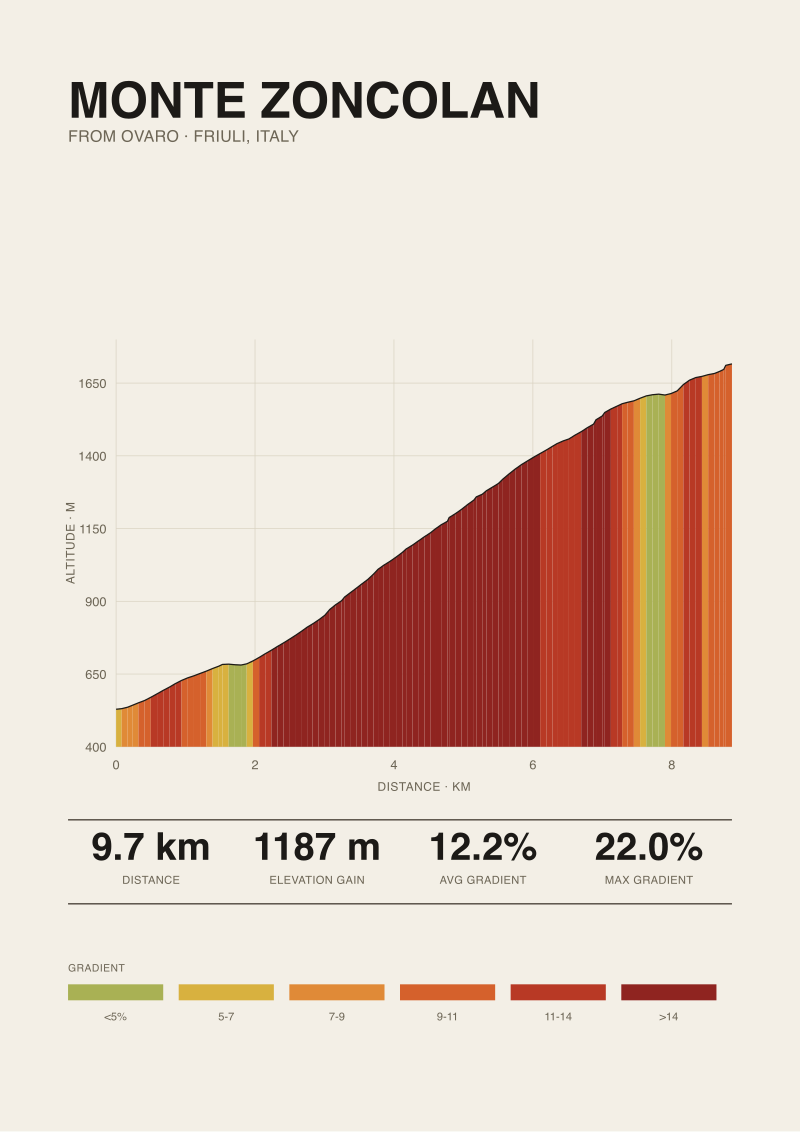
Interesting edge case. Very steep climbs have profile lines that rise sharply and often use a more compressed horizontal, so the drawing sits closer to a standard picture-frame aspect ratio. On those climbs, a float frame or even a slim mat becomes visually defensible in a way it is not on a long, gradual profile like the Izoard's 5.9% average. The rule is not universal. It follows the geometry of each climb.
Is the 9.4% figure the actual maximum gradient on the Izoard from Briançon?
The 9.4% figure is the maximum gradient published for the Briançon ascent by climbfinder.com, which is a road-book figure derived from their measurement methodology. Our own profile drawing uses OpenTopoData SRTM 30m elevation data, which can smooth over the steepest local pitches because 30-metre horizontal resolution averages short ramps into their surroundings. Published road-book peaks and satellite-derived profiles disagree on almost every climb; naming both sources is how we handle the disagreement honestly.
Where should the print go if not the living room?
Anywhere the rider's morning happens. The room where the bike hangs, the hallway between the bedroom and the coffee machine, the kitchen wall opposite the seat you sit in before a Sunday ride. An unframed climb print is a personal object and rewards being seen daily by the person who owns the memory. Formal living rooms optimised for visitors are the wrong context because the object requires prior knowledge of the road to do its work.
Does hanging it with clips look cheap?
It looks unfinished on a wall that expects finished objects, and it looks correct on a wall that expects working ones. Brass bulldog clips on waxed cotton cord read as considered rather than casual if the clips are good quality and the cord is not synthetic. Magnetic wooden hangers, sold by most independent print studios, achieve a slightly more formal register while keeping the paper edge visible. Both options cost under twenty euros and can be reused for any print you own.
From the collection
New climbs and 10% off your first print.
One email now with your code. No noise after.